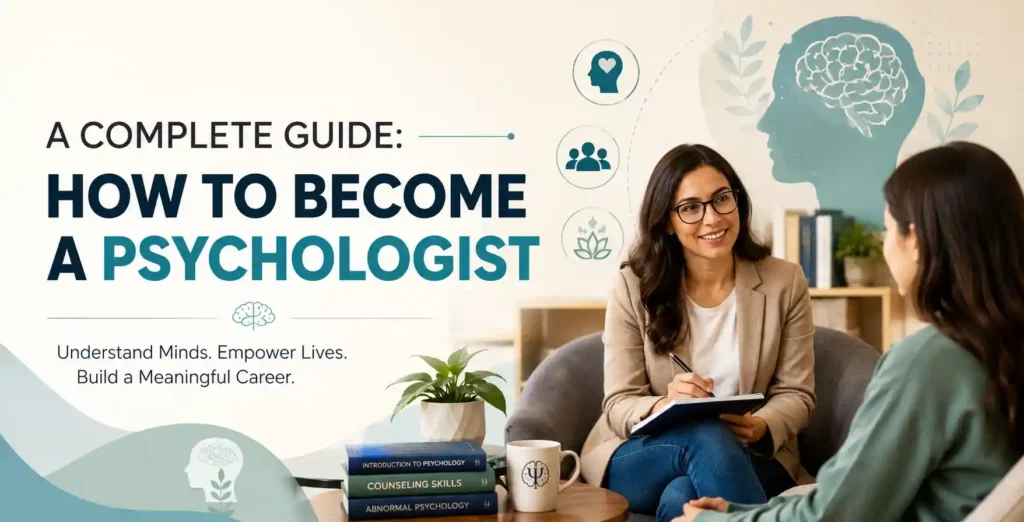
To become a Psychologist in India, 2026, read and understand this complete career guide, which provides in-depth knowledge and facts about the field.
In the past 10 years, there’s been a tremendous increase in awareness of mental health issues in India. The once obscure academic discipline has become one of the fastest growing careers. There has never been a greater need for trained psychologists, counsellors, and mental health professionals, particularly since the COVID-19 pandemic had necessitated an awareness of emotional health.
There is a significant gap between the demand for mental health care in India and the availability of services. There is a huge demand for psychological assistance, but few trained professionals available. Because of this, psychology is a lucrative career path for students who want to learn more about people’s behavior and assisting individuals to enhance their life.
If you want to know how to become a psychologist in India and what are the educational requirements, the career opportunities, salary expectations, and common questions, then this guide will answer all of the questions.
What is the role of a Psychologist?
A psychologist is a scientist who observes how people think, feel and act. They support people to work through their emotional, mental health, relationship, workplace, learning, and behavioural issues.
Psychologists can find employment in hospitals, schools, rehabilitation centers, corporate organisations, research institutions, private practice and government agencies depending on their specialty.
How to Become a Psychologist in India?
Finish class 12th.Pass out 12th standard exam.
In this case, the first step would be to get your higher secondary education (Class 12) from any recognized board.
**Eligibility Requirements:**
- Any stream is okay (Science, Commerce or Humanities)
- The minimum marks required by most colleges are 50–55%.
- The subject of psychology can be useful but not compulsory in schools
Once you have finished Step 1, you will be prepared to enter Step 2: Pursue a Bachelor’s Degree in Psychology.
Once completed, Class 12, register in an undergraduate program in psychology like:
- BA Psychology
- BSc Psychology
It usually takes 3-4 years.
As a bachelor student you will get the following knowledge:
- Introduction to Psychology
- Human Psychology
- Cognitive Psychology
- Social Psychology
- Research Methods
- Counseling Fundamentals
The third step involves obtaining a Master’s Degree in Psychology.The third step is to get a Masters Degree in Psychology.
Professional growth and specialization will be greatly facilitated by a Master’s Degree, which is highly recommended.
Some of the most sought-after postgraduate courses are:
- MA Psychology
- MSc Psychology
Common specializations are:
- Clinical Psychology
- Counselling Psychology
- Child Psychology
- Industrial and Organizational Psychology
- Forensic Psychology
A Masters program provides students with further assessment, counseling, research and intervention skills.
Gain Practical Experience Through Internships – Internships are an excellent way to gain experience in your field of interest.
You can’t just sit around and acquire knowledge in the field of psychology, and then find a job upon finishing your studies.
Students to be active in:
- Psychology internships
- Mental health workshops
- Diploma programs
- Counseling training courses
- Supervised fieldwork
Practical experiences enhance communication, assessment and counselling skills and prepare students for the real world.
Get Professional Registration (if applicable)
Depending on your specialty, there are different licensing requirements.
For Clinical Psychology:
It is compulsory to be registered with the Rehabilitation Council of India (RCI).
Some recognised professional training might be needed in addition.
For Counselling Psychology, Industrial Psychology and Child Psychology:
Generally, no registration is required at RCI.
However, work experience and qualifications add to employability.
What are the best career options in psychology?
There are a variety of psychology career paths in healthcare, education, corporate, sports, and legal settings.
Clinical Psychologist
A clinical psychologist evaluates, diagnoses and provides assistance to people who are suffering from mental health issues by using evidence-based interventions and therapy methods.
Work Settings
- Hospitals
- Mental Health Clinics
- Rehabilitation Centers
- Private Practice
Counselling Psychologist
Counselling Psychologists assist people to address emotional, personal, educational and career issues.
Work Settings
- Schools
- Colleges
- Universities
- NGOs
- Corporate Organizations
- Private Counseling Centers
Industrial and Organizational Psychologist
I/O psychologists use psychological principles in workplaces to enhance employee performance and enhance the effectiveness of the organization.
Responsibilities
- Employee well-being programs
- Leadership development
- Performance enhancement
- Workplace assessments
- Organizational training
Child Psychologist
Child Psychologists work with children and adolescents on emotional, cognitive, behavioral and developmental issues.
Work Settings
- Schools
- Child Guidance Centers
- Special Education Institutions
- Pediatric Clinics
Forensic Psychologist
Forensic psychologists are a combination of psychology and law.
Responsibilities
- Criminal behavior analysis
- Psychological evaluations
- Court-related assessments
- Juvenile case consultation
Neuropsychologist
Neuropsychologists examine how the brain works and how this relates to people’s behavior.
They frequently work with persons who are suffering from:
- Brain injuries
- Neurological disorders
- Cognitive impairments
- Memory-related conditions
Sports Psychologist
Sports Psychologists support athletes to enhance their performance, confidence, concentration and emotional coping.
Areas of Focus
- Performance enhancement
- Stress management
- Injury recovery support
- Mental conditioning
What skills are necessary for becoming a Psychologist?
The successful psychologist has the following qualities:
- Active listening skills:- The ability to understand and respond to the emotional needs of others.Empathy and emotional intelligence
- Communication skills
- Critical thinking abilities:- Research and analytical skills
- Problem-solving capabilities
- Ethical decision-making
These skills, along with academic qualifications, can greatly enhance one’s career prospects.
What is the salary of a Psychologist in India?
Psychologist salary varies by education, specialization, experience, location and workplace.
- Entry-Level Psychologist: – ₹2.5 LPA – ₹5 LPA
- Mid-Level Psychologist: –₹5 LPA – ₹8 LPA
- Experienced Psychologist: –₹8 LPA – ₹15+ LPA
In the metros like Delhi, Mumbai, Bengaluru, Pune, and Hyderabad, psychologists may command more pay as they see a greater demand for their services and have more customers.
Specialists and professionals who set up their own practices or focus on a specific area of specialization can make significantly higher incomes.
Psychology is a good career in India?
Yes, psychology is definitely among the most promising career options in India.
Psychology is an expanding field for a number of reasons.There is a good reason why Psychology is expanding.
- Enhanced mental wellness consciousness
- Increased interest in Counselors.Increased interest in Counselors.
- Increased school counseling services
Employee well-being:
Better understanding of the treatment benefits and methods.* More openness to therapy.
Increased demand for child and youth mental health workers.
The mental health industry is growing and qualified Psychologists should have excellent career prospects in the future.
Final Thoughts
Psychology professionals can make a positive impact in people’s lives and establish a stable, rewarding career. Psychology is a great field to pursue in India, as there is a great need for mental health professionals, but it takes dedication, practice, and learning to get to where you want to be.
Whether you are thinking of becoming a Clinical Psychologist, Counselling Psychologist, Child Psychologist, or Industrial Psychologist, the point is to have a mixture of academic qualifications, training and practical experience. You can become a successful career with this most effective profession in the modern world with proper guidance and skill development.
FAQ (Frequently Asked Questions)
Is there any other way to get into Psychology beyond class 12th?
Yes. Psychology is offered as an undergraduate degree for students with any stream of education.
Do you need to get a Masters Degree to become a Psychologist?
It is highly advised to pursue a Masters degree as many careers that involve psychology require advanced training and specialization.
What is the best Psychology Specialization for a Career?
Some of the more popular specializations are:
- Clinical Psychology
- Counselling Psychology
- Child Psychology
- Industrial Psychology
- Neuropsychology
What is the time required to become a Psychologist?
Usually takes 5-6 years (which includes):
Bachelor’s Degree: 3–4 years
Master’s Degree: 2 years
Depending on the specialization, the time could be longer due to additional training and certifications required.