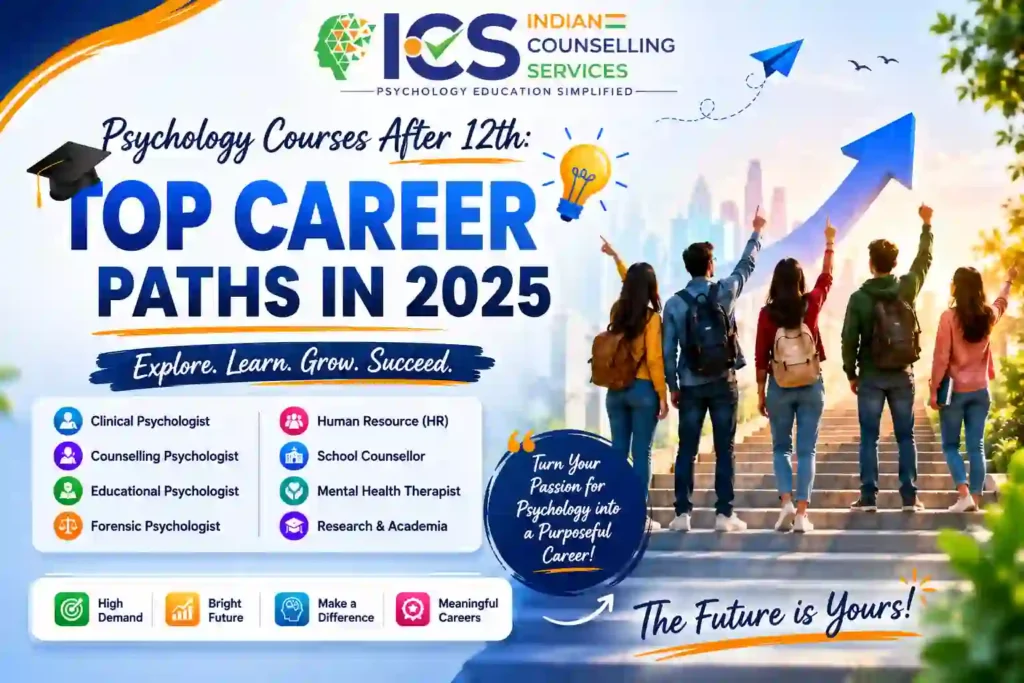
Students are showing a keen interest in psychology courses after 12th in today’s digital and rapidly changing world. Psychologists today are employed in a variety of settings, such as schools, hospitals, corporate institutions, rehabilitation centers, and in private practice.
Employment is projected to increase by approximately 7% from 2023 to 2033, putting the demand for Psychologists at a higher rate than most careers. Thousands of new opportunities emerge in mental health, counseling and behavioral sciences every year.
Psychology has become a highly relevant field of study due to various factors such as the COVID-19 pandemic, growing mental health awareness, stress in the workplace, and the expansion of tele-health services.
This blog will help students to understand which psychology course should be pursued after 12th, what are the career opportunities, what skills are needed to pursue psychology after 12th and what will be the future scope of psychology in 2026 and beyond.
Why Choose Psychology After 12th?
Personal Growth & Self-Understanding
Students who learn psychology can gain an understanding of human thoughts, emotions and behaviors. It also enhances self-awareness, emotional intelligence, and decision-making abilities.
Wide Career Opportunities
A psychology degree can lead to a variety of careers including:
- Clinical Psychology Counseling
- Psychology Organizational
- Psychology Educational
- Psychology Research & Academics
The flexibility makes psychology one of the most versatile career options after 12th.
Discuss the impact of digital life on mental health.Talk about the effects of Digital Life on Mental Health.
Today, in the digital age, questions such as:
- Social media addiction
- Cyberbullying
- Anxiety & stress
- Online comparison culture
are increasing. Psychology enables them to be aware of and address these practical issues.
Increasing sensitivity to mental health and wellbeing.Rising awareness of mental health and wellbeing
There is greater mental health awareness in the world which helps to minimize the stigma and demand for trained mental health professionals. Now, psychology students are vital members of this positive change.
Social impact & Human wellbeing
Psychology isn’t only a profession, it’s a means to enhance the emotional well being, relationships, and mental health of individuals and society.
The following are the best psychology courses offered after 12th (cluster section):
| Course Name | Eligibility | Key Focus |
|---|---|---|
| B.A. in Psychology | 10+2 with minimum 50% marks | Social psychology, developmental psychology, and personality theory |
| B.Sc. in Psychology | 10+2 with minimum 50% marks in science stream | Cognitive psychology, neuropsychology, and experimental psychology |
| B.A. (Hons.)/B.Sc. (Hons.) in Psychology | 10+2 Completion/ Science Stream for B.Sc. | Advanced studies and research-oriented careers |
| Specialized Psychology Courses | 10+2 with minimum 50% marks | Clinical psychology, counselling psychology, or organizational psychology |
| Diploma And Certificate Courses | 12th Grade Completion | Provide practical skills and knowledge |
| Short-term Courses | 12th Grade Completion | Specialized training programs for practical exposure |
- B.A. in Psychology: A Bachelor of Arts in Psychology offers a solid liberal arts foundation by exploring theoretical and social aspects of human behaviour. This course dives deep into fundamental topics like cognitive, developmental, and social psychology, as well as humanities-centric research methods and analysis. It is ideal for anyone wanting a holistic view of understanding people as social beings as it prepares students for careers such as counselling, social work, human resources, and further advanced studies.
- B.Sc. in Psychology: The Bachelor of Science in Psychology takes an empirical approach, emphasizing biological and experimental aspects of psychology. Students studying this program gain expertise in research methods, statistical analysis, and neuropsychology, which gives them a solid basis in scientific inquiry for careers in neuroscience or research. Laboratory work may also be involved, as this course often incorporates laboratory work and data analysis.
- B.A. (Hons.)/B.Sc. (Hons.) in Psychology: Honors designation represents more intensive and advanced studies within any discipline. Both B.A. (Hons.) and B.Sc (Hons.) programs feature deeper explorations of psychological theories and research with increased emphasis on independent investigation and critical analysis; B.Sc (Hons.) may offer stronger scientific foci, while the B.A. (Hons.) may emphasize theoretical or social research – thus equipping students for advanced academic studies and research careers.
- Specialized Psychology Courses: These courses specialize in specific branches of psychology such as applied, health, forensic, or sports psychology. While mastery typically requires postgraduate study, undergraduate programs sometimes provide concentrations or introduction courses on these fields of specialization. For instance, applied psychology often addresses applications found in organizational behavior or education environments, while health psychology investigates relationships between psychological factors and physical wellbeing.
- Diploma And Certificate Courses: Short-term psychology courses provide concentrated training in specific skills or areas of interest. Focused on practical application and skill development, such as stress management, communication abilities, or mental health first aid – such courses tend to be shorter in duration and more accessible than degree/diploma programs – making them suitable for individuals looking to boost either personal or professional capabilities in one specific area.
What Skills Are Needed for a Psychology Career?
- Empathy and Active Listening: Empathy and active listening are foundational skills of psychology professionals. Empathy involves understanding and sharing another’s emotions to foster a safe therapeutic space; active listening involves fully engaging with speakers by paying attention to non-verbal cues. These techniques allow psychologists to build rapport quickly with clients while fully understanding their experiences to provide practical assistance and lasting change.
Critical Thinking and Analytical Skills: Psychology requires rigorous critical thinking and analytical abilities. Psychologists must be able to sift through large volumes of complex information, identify patterns, and reach evidence-based conclusions. This involves case study analysis, research findings interpretation, treatment planning strategies development, and contributions towards expanding psychological knowledge advancement. Strong analytical abilities are an integral component of successful psychological practice, as they enable psychologists to diagnose psychological disorders accurately while understanding human behavior effectively and contributing toward furthering this field of knowledge.
Communication and Interpersonal Skills: Effective communication and strong interpersonal skills are fundamental in creating lasting relationships with clients, colleagues, and other professionals. Psychologists must be able to speak clearly and concisely both verbally and in writing. This includes explaining complex psychological concepts in an accessible manner, offering constructive criticism, providing constructive feedback efficiently, and working cohesively as part of a team. Strong interpersonal abilities help foster openness of dialogue while creating supportive environments for their clients.
Research and Data Analysis: Research and data analysis skills are fundamental for evidence-based psychology practice. Psychologists must possess the ability to design and conduct studies, collect and analyze data, interpret findings, and interpret methodologies and ethical considerations. Such capabilities help contribute to the development of psychological knowledge and evaluate the effectiveness of interventions.
Ethical Awareness and Professionalism: Ethics and professionalism in psychology are of the utmost importance in its practice. Psychologists must abide by stringent ethical regulations, maintain confidentiality, and uphold professional standards—including understanding and applying ethics in clinical practice, research studies, or any other professional endeavour Maintaining professionalism ensures psychologists provide competent services while upholding client’s profession.
Adaptability and Continuous Learning: Psychology is an ever-evolving field, necessitating professionals to be adaptable and dedicated to continued education. Psychologists must remain up-to-date with recent research findings, theories, and best practices by engaging in professional development activities, attending conferences, or seeking ongoing education opportunities. Furthermore, adaptability is necessary when working with diverse populations or meeting clients with shifting needs.
Conclusion
Selecting the right 12th pass psychology course after 12th is a crucial decision in shaping a successful and impactful career.
Along with the career paths, students will also gain a better understanding of themselves and society through psychology.
If you have some doubts about which psychology course you should take, it is always advisable to get help from professional counselors.
Indian Counselling Services provides services to students on choosing the right career path and psychology courses after 12th to them, based on their strengths and interests rendered by the expert counsellors and psychologists.
FAQs (Frequently Asked Questions)
Which psychology course is best after 12th?
The best psychology courses after 12th include B.A. Psychology, B.Sc. Psychology, B.A. (Hons.) Psychology, and diploma or certificate courses in counselling and mental health.
Can I study psychology after 12th from any stream?
Yes, students from Arts, Science, and Commerce streams can pursue psychology courses after 12th, depending on college eligibility criteria.
What is the scope of psychology in India?
Psychology has a growing scope in India due to increasing mental health awareness, demand for counselling services, corporate wellness programs, and online therapy platforms.
Is psychology a good career option after 12th?
Yes, psychology is one of the fastest-growing career fields with opportunities in counselling, clinical psychology, education, HR, rehabilitation, and mental health services.
What skills are needed for a psychology career?
Important skills include empathy, communication, active listening, emotional intelligence, critical thinking, and problem-solving ability.
What jobs can I get after studying psychology?
Students can pursue careers such as:
- Counsellor
- Clinical Psychologist
- School Counselor
- HR Professional
- Mental Health Practitioner
- Research Assistant
What is the difference between B.A. Psychology and B.Sc. Psychology?
B.A. Psychology focuses more on social and behavioral aspects, while B.Sc. Psychology emphasizes scientific, biological, and research-based approaches.
How many years does it take to become a psychologist?
Becoming a professional psychologist usually takes around 5–7 years, including bachelor’s, master’s, and specialized training.
Is NEET required for psychology courses?
No, NEET is generally not required for psychology courses in India. Most colleges offer admission based on merit or entrance exams.
What is the salary after psychology courses in India?
Salary depends on specialization and experience. Entry-level psychology professionals can work in schools, clinics, NGOs, hospitals, and corporate sectors with increasing growth opportunities.
Which psychology specialization has the highest demand?
Clinical psychology, counselling psychology, child psychology, and industrial-organizational psychology currently have high demand in India.
Can I become a counsellor after a psychology course?
Yes, students can pursue counselling careers after completing psychology courses and additional counselling certifications or training.
Are online psychology courses valid?
Yes, many recognized institutions offer valid online psychology and counselling courses that provide practical and theoretical learning opportunities.
Why is psychology becoming popular among students?
Psychology is becoming popular because of growing mental health awareness, career flexibility, and increasing demand for emotional and behavioral experts.
How can Indian Counselling Services help psychology students?
Indian Counselling Services provides professional guidance, psychology training, counselling certifications, and career support for students interested in mental health careers.