Introduction
You know you want to learn more about human behavior, emotional health and happiness, or about assisting people to make a positive change. Once you begin searching for a course, you’re suddenly presented with words such as CBT, psychotherapy, NLP, and other similar terms.
Initially, they appear to be variations of the same product.
They aren’t.
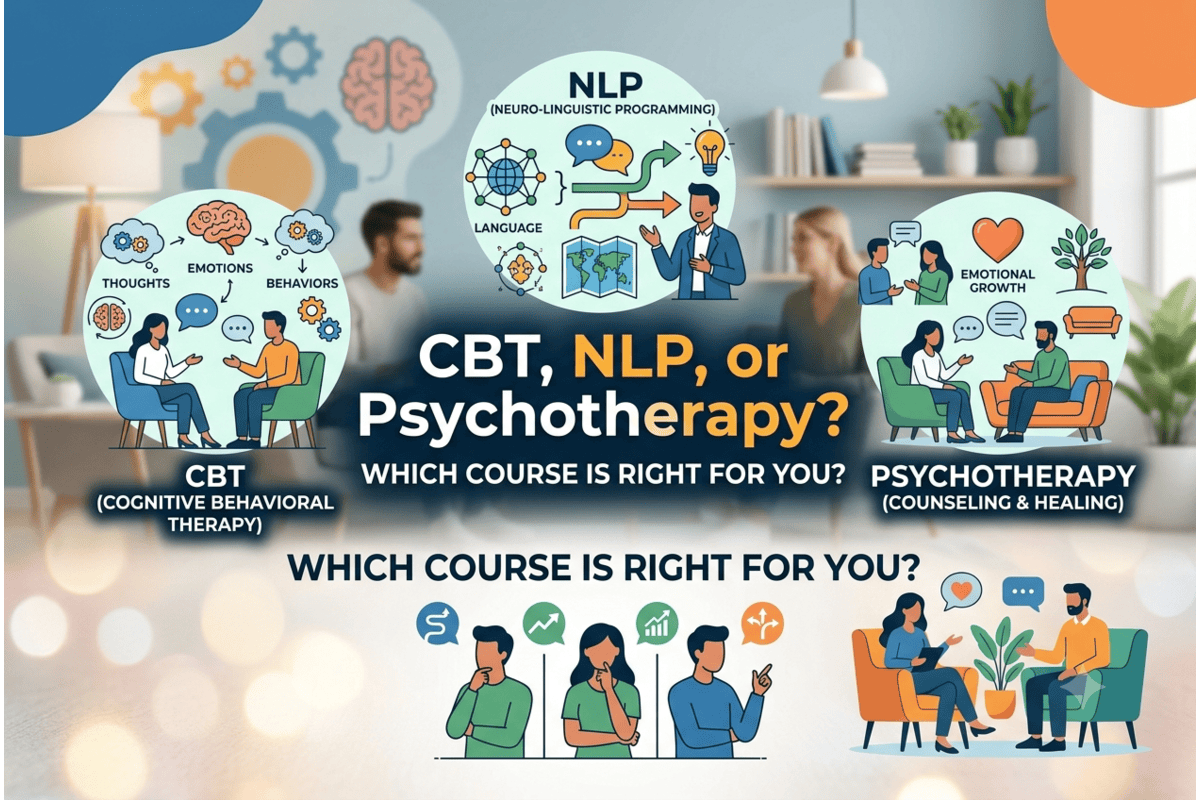
The CBT course is an introduction to a structured therapeutic approach, based on the link between thoughts, emotions and behaviours. During an NLP course, communication, language, behaviour patterns and personal development techniques will be studied. A psychotherapy course can be more general and include an introduction to Psychotherapy and relationships, psychological issues, and various therapeutic processes.
It’s crucial to understand these differences because it isn’t about which one sounds the best; it’s about which one you want to learn.
This guide will assist you in understanding CBT, NLP, and psychotherapy a bit more to help you decide.
First, What Is the Difference Between CBT, NLP, and Psychotherapy?
The terms used by learners, however, do not refer to three parallel categories, which is why they become confused.
Psychotherapy encompasses a variety of psychological methods that can be employed to address emotional, behavioral, and mental health challenges.
One type of psychotherapy is called Cognitive Behavioural Therapy (CBT).
Neuro-Linguistic Programming (NLP) is not the same. It is a framework that is related to communication, thoughts, and behavioural patterns and is also common in coaching, communication, and personal-development training. It has a much smaller evidence base than other well-established psychotherapies, like CBT, for mental-health conditions.
A better question is, then, which of the three is “best” for you?
Which one is similar to my learning goal?
Let’s go into them in more detail.
What Is CBT?
The concept of cognitive behavioural therapy is that thoughts, feelings, and behaviours can impact each other.
Suppose, for instance, that someone has to present at their workplace.
They might think:
I’m about to mess up, and they’re going to think I’m stupid.
Thinking about that can be a cause of worry. The anxiety could then make them reluctant to present when they can. Avoidance can perpetuate the initial fear due to the fact that they never get the chance to find out that it might be manageable.
CBT looks at patterns such as this and looks at ways in which people can recognise and engage with unhelpful thoughts and behaviours in a structured way.
This is a widely studied measure, and when provided by trained professionals, it has been applied to a variety of psychological problems.
What Might You Learn in a CBT Course?
The exact content of the course varies based on level and provider, but a CBT course might include the following:
- Foundations and principles of CBT.
- Relationships among thoughts, emotions, and behaviours.
- Automatic thoughts.
- Cognitive distortions.
- Behavioural patterns.
- Cognitive restructuring.
- ABC or ABCDE models.
- Case conceptualisation.
- Common CBT techniques.
- Applications and limitations of CBT.
Psychology students and others learning the techniques of CBT may benefit from introductory training to understand how CBT works. Professional application will need the appropriate foundational education, training and supervised experience for more advanced application.
Who Might Find CBT Training Useful?
CBT training might be of special interest to students of psychology, counsellors, aspiring mental health practitioners or current mental health practitioners who want to learn about a structured therapeutic approach.
It could also be of interest to learners who enjoy frameworks that relate psychological theory to well-defined techniques.
What Is NLP?
NLP is often referred to as Neuro-Linguistic Programming or NLP, and it was developed in the 1970s by studying the interrelationship of language, thought patterns, subjective experience, and behaviour.
In NLP training, techniques are usually provided that are designed to help individuals analyze their communication patterns, reframe experiences, set goals, and change some habits or responses.
This makes an NLP course especially appealing to those interested in communication, coaching, and leadership and/or personal development.
There is, however, a crucial difference to be highlighted.
NLP should not be thought of as a replacement for evidence-based psychotherapy. There is insufficient research to support many of its general claims. In particular, NLP training should not be confused with accepted evidence-based therapies in clinical mental-health treatment.
It doesn’t mean that an individual may not find a single NLP concept or exercise applicable to a communication or coaching situation. It means that the statements about them are substantiated with evidence.
What Might You Learn in an NLP Course?
The NLP training can involve the following aspects (depending on the program):
- Communication and language patterns,
- Rapport building,
- Goal setting,
- Reframing,
- Anchoring,
- Beliefs and behavioural patterns,
- Personal development,
- Communication strategies,
- Coaching-related applications.
There may be significant differences in the content and emphasis among providers, and it is especially important to review the syllabus carefully.
Who Might Consider an NLP Course?
An NLP programme might be attractive to:
- Coaches,
- Educators,
- Business professionals,
- Team leaders,
- Students,
- Counsellors interested in additional communication frameworks,
- People interested in personal development.
If your ultimate goal is improving communication skills, you might be looking for a coaching conversation or for an evidence-based clinical therapy to look at options for behavioural change, rather than NLP.
What Is Psychotherapy?
CBT and NLP are both types of Psychotherapy.
Therapies are not just one specific exercise; they are a variety of set psychological exercises that can be used to treat emotional, behavioural, relationship, and mental-health issues in individuals.
Psychological problems are defined differently in various traditions of psychotherapy.
In CBT, thoughts and behaviours are a focus. Past experiences and unconscious processes might be explored in psychodynamic approaches. Humanistic approaches tend to focus more on the subjective experience, personal growth, and therapeutic relationship of the person.
A Psychotherapy course can thus introduce learners to more than one theory, rather than focusing on just one technique.
What Might You Learn in a Psychotherapy Course?
Psychotherapy training can include the following:
- Foundations of psychotherapy.
- Counselling and communication skills.
- Therapeutic relationships.
- Different schools of psychotherapy.
- Ethics and professional boundaries.
- Case understanding.
- Client communication.
- Psychological concerns.
- Treatment planning concepts.
- Case studies and practical exercises.
More comprehensive programs can delve deeper into therapeutic modalities and supervised practical learning.
Who Might Consider Psychotherapy Training?
Psychotherapy training may be of special interest to psychology graduates, counsellors, mental-health professionals, and students who wish to be exposed to more than one model of psychotherapy.
Learners should be careful to read the eligibility requirements for a course carefully, and to consider how it matches with their current skills and knowledge, as this may include some of the more complex aspects of mental-health issues.
CBT vs NLP vs Psychotherapy: A Simple Comparison
Here is an easier way to understand the three.
| CBT | NLP | Psychotherapy | |
| Primary focus | Thoughts, emotions and behaviours | Communication, language and behavioural patterns | Broader psychological and therapeutic work |
| Scope | Specific psychotherapy approach | Communication/personal-development framework | Umbrella covering multiple therapeutic approaches |
| Learning style | Structured and technique-focused | Exercise and communication-focused | Theory, relationship and therapeutic practice |
| May suit learners interested in | Evidence-based psychological interventions | Coaching, communication and personal development | Broader therapeutic understanding |
| Clinical evidence base | Strong for a range of conditions | Limited for mental-health treatment | Depends on the specific psychotherapy approach |
| Typical learners | Psychology students, counsellors, mental-health professionals | Coaches, educators, professionals and students | Psychology graduates, counsellors and mental-health professionals |
The most important thing to remember is that CBT is in the psychotherapy category, but NLP is not in the same category.
When selecting a course, that distinction is important.
Which Course Should You Choose?
Instead of starting with the course title, start with what you hope to gain.
Choose CBT Training If…
You are interested in learning a structured psychological therapy, and you are very interested in how thoughts, emotions, and behaviours interact.
If you have a psychology or counselling background and you wish to expand your knowledge of CBT, a CBT program might also be a good fit.
Consider NLP Training If…
Your interests are more closely related to communication, coaching, personal development, behavioural patterns, or interpersonal effectiveness.
It can also be used as a second language to give professionals who deal with communication and purposeful conversations a new structure.
Simply remember, there is a difference between NLP and evidence-based psychotherapy.
Explore Psychotherapy Training If…
You are seeking more knowledge about therapeutic techniques and would like to know more than one psychological technique.
If you already have some psychology background and you are looking to learn more about the concepts of psychotherapy, casework, and models of psychotherapy, a longer psychotherapy program might be more appropriate.
Can Beginners Take These Courses?
It will depend on the program.
There are some CBT/NLP courses that are available for people who don’t have much professional experience. There may be more specific eligibility requirements for advanced psychotherapy education.
That’s why it’s not advisable to select a course based just on its name.
Check:
To whom is the course aimed?
What does it assume as background?
What is the content of what you will learn?
What is the amount of hands-on experience provided?
What is the certificate’s value?
Two seemingly identical concepts may have two very different purposes in a beginner’s certificate and in a professional clinical training.
What Should You Check Before Enrolling?
Regardless of whichever route you are interested in, there are a few items to look into.
Initial, take a close look at the overall curriculum. Course titles may be general; the syllabus provides you with a lot more information about what you are studying in the course.
Second, think about the trainer’s qualifications and experience. This is especially important for psychology and psychotherapy education.
Third, learn if there is interactive learning in the program. Discussions, demonstrations, role-plays, and opportunities to ask questions may be available to help make a concept understood when only reading about it.
Fourth, check the eligibility criteria. Just because you want to do a certain training doesn’t mean you qualify for the advanced version.
Last but not least, know the credential. Ask what sorts of questions they ask and what benefits they receive when they finish it.
Does Completing a Course Qualify You to Practise?
This is especially noteworthy.
You can gain education and skills from a short CBT course, NLP course or psychotherapy course. However, a course-completion certificate is not necessarily a prerequisite for diagnosis or treatment of mental health conditions, or for the use of a regulated professional title, or for working or practising outside the scope of a current professional competence.
Training is not necessarily the same as professional qualification.
If you are aspiring to a professional role in mental health care, think about the full sequence of education you will need to pursue your career and verify the current requirements of the regulatory and/or professional bodies you are interested in.
This is especially important when choosing advanced therapeutic training.
Exploring CBT, NLP and Psychotherapy With Indian Counselling Services
Indian Counselling Services provides various training programs for interested learners in these fields.
The Cognitive Behavioral Training Course is an online, interaction-based certificate program that lasts for one month. It covers topics such as CBT basics, counselling methods, automatic thoughts, the ABCDE model, and the uses of CBT.
The NLP (Neuro-Linguistic Programming) Course is a 2.5-month, interaction-based online course that is suitable for business people, students and educators, coaches, therapists and any interested learner.
Additionally, a shorter Psychotherapy Training Program and a longer one-year Diploma in Psychotherapy are offered by ICS. Diploma is designed for Psychologists, mental health and psychology graduates/postgraduates, and the areas covered are counselling practice, psychotherapy practice, and advanced CBT.
Eligibility and course length are a critical difference. However, do not think of these programs as being the same; there may be options that are available to the learner and that will provide the depth of training that they are seeking to pursue, depending on their current background.
There Is No One Course for Every Learner
CBT, NLP, and psychotherapy can take you on vastly different learning paths.
If you are interested in a therapeutic approach that is structured and evidence-based, learning about CBT might be most relevant.
NLP might be more relevant to you if your primary interest is in learning communication, coaching, and personal-development techniques.
Therapist training could be a better option if you are looking for a more comprehensive understanding of the different models of therapy and psychological practice.
Above all, don’t select the certificate with the highest-sounding name.
Select on the basis of educational qualifications, curriculum quality and depth, evidence of what is being taught, and the training’s relevance to your broader learning and/or career aspirations.
Want to learn more about these options?
Before you make your decision, review the CBT, NLP and Psychotherapy curriculum, eligibility, length of course and learning format offered by Indian Counselling Services to compare.
Frequently Asked Questions (FAQs)
- Is CBT the same as psychotherapy?
CBT is a kind of psychotherapy. The umbrella term for psychotherapy is psychotherapy, with a number of different therapeutic modalities under that umbrella.
- What is the difference between a CBT course and an NLP course?
A CBT course is based on a psychological therapy that is structured and looks at the relationship between thoughts, feelings, and behaviours. Typically, NLP courses are more about communication, behavioural patterns, coaching, and personal-development techniques.
- Is NLP a type of psychotherapy?
NLP is used widely in coaching, communication, and personal development settings, but shouldn’t be confused with evidence-based psychotherapies. There is limited evidence that NLP is effective in the treatment of mental-health conditions.
- Who should take a psychotherapy course?
This will depend on the level of the course. Most of the advanced psychotherapy courses are relevant to psychology graduates, counsellors and mental health practitioners. Be sure to review program eligibility.
- Can I learn CBT online?
Yes. Theoretical principles, case concepts and many CBT techniques can be taught online. Professional therapeutic application, however, also requires appropriate qualifications, practical training, and supervision relevant to the learner’s intended role.
- Which course should a beginner choose?
It depends on the beginner’s goal. Someone interested in psychology and structured therapeutic concepts might explore introductory CBT training, while someone focused primarily on communication or coaching may explore NLP. More advanced psychotherapy training may require prior psychology education.
- Can I become a therapist after completing one of these courses?
A standalone course-completion certificate does not automatically qualify someone for every professional mental-health or therapeutic role. Your ability to practise depends on your broader education, training, experience and applicable professional or regulatory requirements.