Introduction
Selecting a specialisation can be quite tricky if you are interested in psychology.
Understanding children’s thinking and development might sound like the obvious course, and you could well enjoy it. However, there is a possibility that you can also be interested in mental-health conditions, psychological assessment and therapeutic approaches, which can lead you to clinical psychology courses.
Both are disciplines involving human thoughts, emotions, and behaviour, but are not synonymous.
Child psychology is one of the psychology specialties, and it is defined by its main subject, children and adolescents. The focus of clinical psychology is more on the types of psychological problems and professional activities that psychologists work on, such as mental health evaluation and treatment.
Knowing this difference can help you pick the right course or psychology diploma that will really help you to achieve your learning objectives and career objectives.
What Is Child Psychology?
Child psychology focuses on the psychological development and experiences of children, generally considering how they think, feel, behave, communicate, and form relationships as they grow.
Childhood is not the miniature version of adulthood.
Five, 10 and 16 year old children can have very different experiences and ways of expressing feelings. They also have remarkable shifts in their cognition, sociability, family context, and needs.
The study of child development in psychology thus looks at development in the following domains:
- Cognitive development.
- Emotional development.
- Social development.
- Behaviour.
- Personality.
- Communication.
- Family relationships.
- School experiences.
- Peer relationships.
It can also discuss behavioral and emotional issues that can arise in childhood and adolescence.
What Do You Learn in a Child Psychology Course?
While the exact content of the course will differ from program to program, a child psychology course can cover subjects like developmental psychology, child behaviour, emotional development, parenting and family issues, communication with children and common childhood concerns.
Case discussions or activities may also be included in the practical programs to aid the learner in understanding the application of psychological concepts in realistic situations.
For instance, let’s say that a child starts to refuse school attendance.
It’s not enough to say the child is “difficult.
A child psychologist would certainly be drawn to investigate further. Is there something different going on in school? Does the child feel anxious? Are there peer problems? So what’s happened at home? Is it an unusual behaviour for their stage of development, or is it a communication of a need they’re unable to send without acting out?
Child psychology is an aspect of child development in which the learner is asked to look at behaviour within the broader developmental and environmental context.
Who Might Benefit From Studying Child Psychology?
Child psychology training may serve a number of groups.
It can be used by psychology students to investigate an interest in a potential specialisation. Teachers and special educators may wish to deepen their understanding of development and behaviour. School counsellors may want to reference it in their daily practice with students.
It might also be of interest to parents and professionals who work regularly with kids.
A child psychology course can thus have a variety of functions for the learner.
It could be professional development for one person. Otherwise, it could be an introduction to a future psychology specialisation.
It is important to select the level of training when selecting training.
What Is Clinical Psychology?
Clinical psychology focuses on the understanding, assessment, and intervention of psychological distress, behavioural problems, and mental-health conditions and is a specialised field of psychology.
It provides a basis for knowledge of psychological science and how people think, feel and behave, and how psychological difficulties can be measured, understood and addressed.
Clinical psychology can apply to individuals of varying ages other than adults.
What this means is that sometimes, there is a crossover between clinical psychology and child psychology. A clinical psychologist could focus on working with children and adolescents.
The distinction is primarily related to the nature and function of the disciplines.
While clinical psychology shares some overlap with child psychology in its assessment of children’s behaviour, clinical psychology is more concerned with psychopathology, mental-health problems and evidence-based intervention, as well as psychological assessment.
What Might You Learn in a Clinical Psychology Course?
A clinical psychology course could be different from each other, based on whether it’s an introductory course, academic program, internship or professional training pathway.
Topics may include:
- Foundations of clinical psychology.
- Abnormal psychology and psychopathology.
- Psychological disorders.
- Psychological assessment.
- Case history and mental status examination concepts.
- Therapeutic approaches.
- Ethics.
- Case conceptualisation.
- Psychological intervention.
- Research and evidence-based practice.
There are introductory courses available to provide an understanding of these concepts, but much more in-depth and supervised training is needed to attain proficiency in clinical practice.
That’s an important consideration when judging a course.
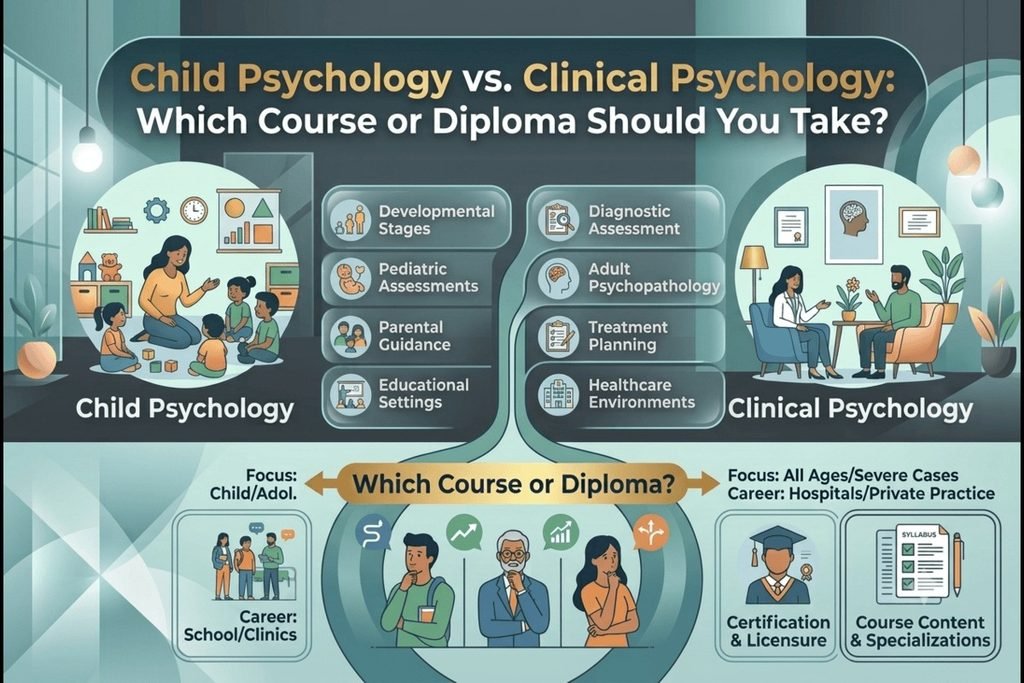
Child Psychology vs. Clinical Psychology: What’s the Main Difference?
An easy way to understand the difference is to think about focus and scope.
| Child Psychology | Clinical Psychology | |
| Primary focus | Development, emotions, and behaviour of children and adolescents | Psychological distress, assessment, mental-health conditions and intervention |
| Age Group | Primarily children and adolescents | Can include children, adolescents and adults |
| Common Topics | Development, behaviour, family, school, emotions and relationships | Psychopathology, assessment, diagnosis concepts and psychological interventions |
| May Interest | Teachers, psychology students, school counsellors, special educators and child-focused professionals | Psychology students and graduates interested in mental-health and clinical settings |
| Course Objective | Understanding children and their psychological development | Understanding clinical psychological concerns and approaches |
| Professional Practice | Depends on role and broader qualifications | Clinical practice requires specific recognised qualifications and applicable professional requirements |
There is some overlap between the two areas.
A student might take in-depth classes to learn more about childhood development and then continue with professional training to work with KIDS who have clinical mental health problems.
So it’s not a decision that needs to be final.
Which Course Should You Take?
If you want to say “which field is better,” think about what subject you’re interested in psychology for in the first place.
Consider a Child Psychology Course If…
A particular interest in the way children develop, communicate, and behave.
It could be a good way to go if you:
- Like to work with children in a positive way.
- Work in the field of education or special education.
- Are interested in school counselling.
- Desire to know how children develop.
- Interested in child psychology but don’t need to go into too much depth.
It may also be used alongside other work done with children where the scope of the course is in line with your work scope.
Consider Clinical Psychology Learning If…
You’re more interested in mental-health conditions, psychological assessment, psychopathology, and therapeutic interventions.
A clinical psychology program may be more relevant if you:
- Already study psychology.
- Desire exposure to clinical environments.
- Have an interest in psychopathology.
- Seek to know the meaning of psychological assessment.
- Thinking of a longer-term clinical psychology trajectory.
The content of your previous studies is of special significance here, as education and qualification for clinical practice are not identical.
What About a Psychology Diploma?
Learners tend to think that a psychology diploma is of more value than a short course simply because it takes longer.
Quality and professional recognition are not dependent on length of time.
A diploma might provide more general or more in-depth learning than a short certificate, but it’s still important to investigate:
- What are the topics of the curriculum?
- Who are the instructors of the program?
- Who is eligible?
- Does it contain application of learning?
- What is the name of the credential?
- What kind of things can you do with that credential?
This last question is particularly important.
Whilst a private diploma may offer useful education and skill development, the term diploma should not be assumed to be a licence or qualification of a professional nature.
Select according to the learning that has taken place and what it connects to, in your overall learning journey.
Course, Diploma or Internship: How Do You Decide?
There are various forms of formats, and they are used for different purposes.
It may be beneficial to use a short course when you are in an area for the first time or building new knowledge.
If you are looking for more in-depth and systematic learning and are willing to commit more time, a psychology diploma might be the right choice.
For students who already have an understanding of theory and wish to gain experience in case discussions or a professional setting or a practical application, an internship or practical training program may be valuable.
If you’re asking yourself whether a CV seems stronger in a particular format, you’re actually asking the wrong question. You should be asking what kind of gap you are looking to address.
Don’t you have the basic knowledge?
Looking for more in-depth knowledge?
Are you already knowledgeable about the theory but want some hands-on experience?
Your response has the potential to steer you in the right direction with regard to the type of program you are looking for.
Can You Study Both Child and Clinical Psychology?
Indeed, the two fields can complement each other.
An individual working with children’s mental health may require knowledge of normal child development and psychological issues.
Developmental expectations can aid in determining when behaviour might be an issue for concern. Similarly, awareness of psychological issues can add context to the emotional and behavioural development of children.
If you have an interest in child and adolescent mental health that is sustained over time, you may have to work in both fields during your schooling.
The question that will be asked is “Which one will I study for the rest of my life?”
It may simply be:
“Which one makes sense as my next step?”
Can a Child Psychology Course Make You a Child Psychologist?
Taking a course will build knowledge about child psychology, but a quick certificate or private diploma of study will not automatically lead to a registered professional qualification.
As is true for clinical psychology.
The profession of Clinical Psychologist is a regulated profession in India and recognized qualifications / registration requirements apply. The clinical psychology pathway is not to be confused with a short clinical psychology course or internship certificate or private diploma.
Proceed with caution if your aim is to become a professional practitioner: Always check with the relevant education and registration body for the most up-to-date requirements before embarking on a pathway.
Courses and diplomas may be part of learning but must be seen in relation to the overarching education and career plan.
What Should You Look for Before Enrolling?
Whichever area you choose, don’t make your decision based solely on the course title.
Pay careful attention to the curriculum.
A good child psychology course should not only provide you with some general ideas about children but should allow you to have an interesting taste of development and behaviour.
Likewise, a clinical psychology course should also indicate whether it is intended to give introductory education or training at the professional level.
Take the trainers into account also. Teachers who can relate concepts to real-life situations, rather than just memorizing definitions from a textbook, benefit the psychology education.
Include case discussions, exercises, interactive sessions, and other related practical activities as appropriate.
Lastly, take care in reading certification and accreditation claims. You need to be aware of the qualification that you will attain and its meaning.
Studying Child and Clinical Psychology With Indian Counselling Services
Students as well as professionals will find learning opportunities at Indian Counselling Services for both areas.
Child-focused training to work with or understand children can be delivered to learners with an interest in child psychology, including training on aspects of child development, behaviour and psychological issues.
Furthermore, ICS offers clinical psychology training and internships for psychology learners who are interested in having clinical experiences to complement academic learning.
The correct answer is dependent on your current location.
For a teacher who wants to know about pupils, the training needs are likely to be very different from those of a psychology graduate who is thinking of a career in psychology. Similarly, an individual new to child psychology might not wish to delve as deeply as a student intending to pursue advanced studies in psychology.
If you are considering enrolling, research the curriculum, admissions requirements, length of study, course delivery, and practical aspects of the programs of the ICS courses you’re interested in to ascertain which one is right for you now.
Your Next Course Should Fit Your Next Goal
It’s not a decision that requires you to make your whole career path today; you can choose what you want to do, either child psychology or clinical psychology.
Child psychology might be a logical choice for those who are interested in children, development, behaviour, families, and educational settings.
If you prefer psychopathology, psychological evaluation, mental-health conditions and treatments, then you might be interested in exploring clinical psychology further.
And if you’re looking for a full education, a psychology diploma that is relevant and has meaning to you is a longer learning journey, but it’s the content that really counts.
Use your interests as a beginning. Take into account previous credentials. Have an understanding of what is taught in the course.
Next, select the learning experience that will help you move closer to your next step.
Looking to advance your psychology career?
Visit Indian Counselling Services to get an overview of the Child Psychology, Clinical Psychology, and Diploma Programs, which include curriculum, eligibility, and learning format, and choose a program based on your educational journey.
Frequently Asked Questions
- Which is better, child psychology or clinical psychology?
They have different interests. Child psychology is more about the development of children, their emotions, and behavior, whereas clinical psychology is more general and has to do with the assessment of mental health, psychological issues, and interventions.
- Can I take a child psychology course without a psychology degree?
Some courses may accept students with a variety of backgrounds, and others may have certain requirements. Please check individual courses prior to enrollment.
- Is clinical psychology only about adults?
No. Clinical psychology can involve children, adolescents, and adults. A few clinical psychologists have a particular interest in child and adolescent mental health.
- Can I study child psychology and clinical psychology together?
Yes. These can complement each other, especially for learners with an interest in the mental health of children and young people.
- Is a psychology diploma enough to become a psychologist?
A short course or private diploma is not sufficient for all professional psychology occupations for educational or regulatory purposes. Requirements will vary based on the position and appropriate laws and regulations.
- What should I choose after a bachelor’s degree in psychology?
That depends on your intended career. Consider whether you are interested in child development, counselling, clinical work, research, or another specialisation, and then investigate the recognised educational pathway required for that field.
- Is an online child psychology course useful for teachers?
It can be useful for understanding child development, behaviour, emotions, and communication. However, such training supplements a teacher’s professional skills rather than qualifying them for regulated psychological practice.