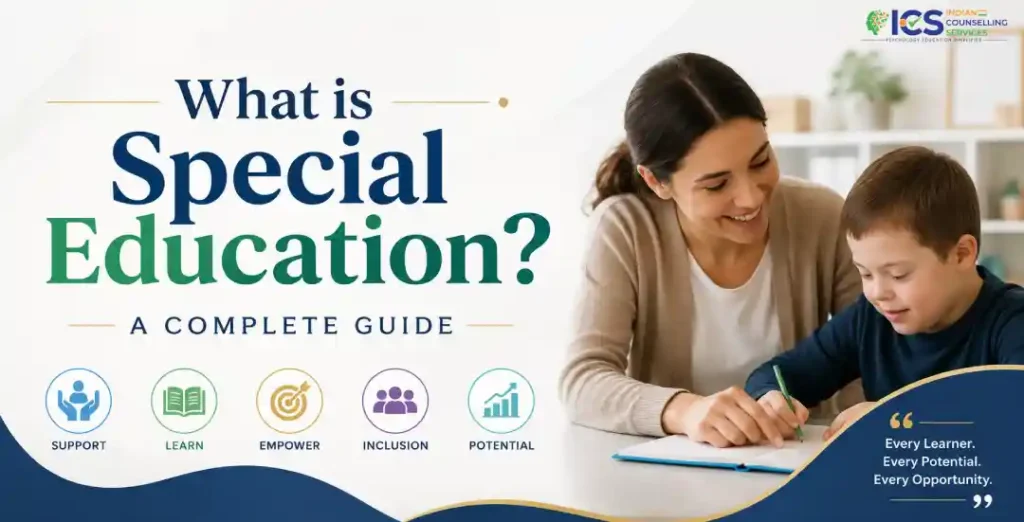
The debate about education has gone beyond good grades and test scores in recent years. Parents, educators, and policymakers now have an increased awareness of the fact that all children learn in unique ways and some require additional support to reach their full potential.
Special education has come into the light with the growing comprehension of the matter.
Though it is a significant area, many people have misconceptions about special education. Some think it’s just for children with very severe disabilities, and others feel it is a way of excluding children from mainstream school.
Actually, special education is much more expansive, encompassing, and enabling than many realize.
Knowledge of special education can be of growing value in today’s diverse learning environment, whether you are a parent seeking answers, a teacher seeking to add to your knowledge, or a thinking person considering a career in special education.
This complete guide explains what special education is, to whom they are for, the importance of special education, and how special educators using an SE course can provide meaningful learning opportunities for all children.
What is Special Education?
Special Education is specially designed instruction and support services for students with diverse learning needs to effectively access education.
The aim of special education is not to reduce expectations in academics. Rather, it is designed to eliminate factors that could hinder the student’s learning and engagement in educational activities.
These supports may involve:
- Using a variety of teaching approaches to accommodate different levels of learning.
- Making special learning materials and resources.
- Providing more academic or behavioral assistance.
- Accessibility tools use assistive technologies for accessibility.
- Development of individual education plans that reflect the strengths and challenges of the student.
Special education is based on the premise that, in some cases, access to equality of opportunity in education may require variation in the delivery of services to various learners.
Why is Special Education Important?
All children have the right to learn, develop, and succeed.
But conventional education usually follows a “one size fits all” approach. This can be effective for many pupils, but not for all pupils, and could be a challenge for pupils who think in a different way or need extra help.
Special education makes up for this.
Assists the students by:
- Access to relevant learning experiences.
- Fostering academic, social, and emotional growth.
- Development of confidence and self-esteem.
- Promoting self-reliance and skills.
- Facilitating an inclusive approach to school communities.
Pupils feel able to maximise their strengths and enjoy a fuller and more active school life when they are supported appropriately.
Who Can Benefit from Special Education?
The most common misunderstanding about special ed is that it’s for a limited number of students.
In practice, learners could need special educational support for numerous reasons.
Students with Special education can provide assistance with:
- Learning Disabilities: A student may experience difficulty in one or more of the following areas: reading, writing, spelling, and/or mathematics, and/or information processing, but have an average or above-average IQ.
- Autism Spectrum Disorder (ASD): Structured learning settings, communication aids, social skills programs, and individual education plans may be helpful to children with autism.
- Attention-Deficit/Hyperactivity Disorder (ADHD): If your child has ADHD, he or she might need support with attention, organization, controlling impulsiveness, and being in class.
- Intellectual Disabilities: May need individualized learning objectives, individualized instruction, and individualized assistance/revision of skills to accommodate the student’s developmental needs.
- Speech and Language Difficulties: Communication difficulties may impact learning, social skills, and academic performance, which may provide a benefit to seeking specialist support.
- Sensory and Physical Disabilities: Students with a sensory and/or physical disability may require assistive technology and/or accommodations to access learning.
Special education is individualised, and each learner is different.
The Principles of Effective Special Education
There are certain key principles in successful special education programs.
Individualized Learning
Every two students are unique in the way they learn.
Individual strengths, challenges, interests, and learning styles are understood through the eyes of the special education professional to provide customised learning experiences.
Inclusion and Participation:- Along with all these changes, more and more, there is a strong focus on inclusion in modern special education.
Many schools place emphasis on the ability of students to engage with the general education curriculum in meaningful ways with the appropriate level of support, rather than isolating the students whenever possible.Strength-Based Approaches:- Effective special education does not focus solely on challenges.
Experts also recognize and foster the strengths, talents, interests, and potential for learning development of each student.Collaboration:- Often, supporting students is a team effort.
The professionals also recognize and develop each student’s strengths, talents, interests, and growth potential.
The Role of a Special Educator
Special educators are an important component in overcoming learning barriers and achieving educational success.
They may be caring for their parents or other adults, and have responsibilities such as:
- Evaluating learning differences and/or difficulties.
- Designing individual learning plans.
- Assisting in the development of academic skills.
- Fostering social and emotional development.
- Being able to work with families and educational teams.
- Tracking student progress and making decisions on adaptations.
A special educator is an advocate, a mentor, and a facilitator to support learners in accessing opportunities that may be challenging to learners.
How Special Education Has Evolved
Over the last few decades, there have been significant changes in special education.
Traditionally, a student with a disability was not part of the mainstream school. Inclusion, accessibility, and individual support are now given much more consideration.
There is increased use of emerging technologies in special education today, like:
- Classroom practices that are inclusive and encourage participation.
- Assistive technologies to support access to learning.
- Evidence-based teaching strategies.
- Social-emotional learning approaches.
- Multi-professional models of collaborative interventions.
This change has come with the realization that diversity in learning is a human norm and a natural phenomenon.
Common Challenges Faced by Students with Special Needs
Pupils with special educational needs may have difficulties in areas other than their studies.
Typical issues are:
- Has trouble keeping up with standard classroom work.
- Social isolation or a problem with peers.
- Low self-confidence due to continued academic difficulties.
- Situations and other communication challenges that impact participation.
- Stressful feelings due to learning differences.
The first step to effective support is to acknowledge these challenges.
Many of these obstacles can be greatly diminished if teachers and families are unified.
The Growing Importance of Inclusive Education
One of the most recent and significant changes in the practice of education is inclusive education.
Inclusion is rooted in a simple philosophy: students are better served when learning in a setting that is diverse and offers opportunities for students to participate.
Here are some ways inclusive classrooms can help:
- Encourage students to be aware of others’ feelings and understand.
- Facilitate social development and cooperation.
- Minimize stigma of learning differences.
- Establish a stronger sense of belonging for ALL learners.
Inclusion is more than just an environment in which students are simply accommodated. It’s about making sure that they have what they need to succeed.
Career Opportunities in Special Education
Awareness of all types of learning needs continues to increase and there is an increasing demand for trained professionals in the field of special education globally.
People trained in this area might have a career in:
- Schools and educational institutions.
- Inclusive education programs.
- Special education centers.
- Child development organizations.
- Non-governmental organizations (NGOs).
- Counseling and support services.
- Educational consulting and advocacy roles.
The field provides a chance to make an impact without compromising the value of inclusion in a society.
Why More Professionals Are Choosing to Study Special Education
The number of teachers, psychologists, counselors, parents, therapists, and educators in training who are pursuing formal education in special education is growing.
An organized special education course will assist learners to gain insight into:
- Learning disabilities and developmental differences.
- Individualized educational planning.
- Inclusive teaching strategies.
- Strategies to support behaviour and emotion.
- Development and psychology of children.
- Methods for adapting and intervening in class.
These are the skills that will be more and more valuable in the school and professional environments that work with children.
The Future of Special Education
Innovation, inclusion, and personalization are likely to be the future of special education.
Emerging trends include:
- Increased access to assistive technology and/or digital learning tools.
- A shift towards addressing strengths and neurodiversity.
- Increased efforts on more inclusive education policies and practices.
- Improved teacher, therapist, and family partnership.
- Increased focus on social and emotional development and mental health.
Knowledgeable and caring special education professionals will always be needed as the education industry continues to develop.
Final Thoughts
Special education is not a matter of what they cannot do; it’s a matter of what they can do.
It respects all learners and provides them with access to education that is appropriate to their needs, strengths, and potential.
By providing individualized support, inclusion, and affirming different learning styles, students have the opportunity to become confident learners, acquire new skills, and lead a successful life in and outside the classroom with special education.
Awareness of learning diversity continues to grow, and so does awareness of special education among educators, parents, and professionals. A special education course can supply the knowledge and skills that anyone interested in making a difference in the lives of children and learners in our society with a variety of needs can gain.
FAQs (Frequently Asked Questions)
What is special education?
Special education: Instruction that is tailored and tailored support and accommodate students with varied learning needs.
Who needs special education services?
Special education support may be available for students with learning disabilities, autism, ADHD, intellectual disabilities, communication impairments, sensory impairments, and other developmental and/or educational needs.
What does a special educator do?
A special educator evaluates learning needs, creates individualized plans, educators and social development and works with the family and educational teams.
Is special education only for children with severe disabilities?
No. Special education serves a diverse population with a variety of learning, developmental, and behavioral needs.
Can a special education course help educators and parents?
Yes. Studying a special education course can be a great opportunity to learn about learning differences, inclusive practice, child development, and effective practice.