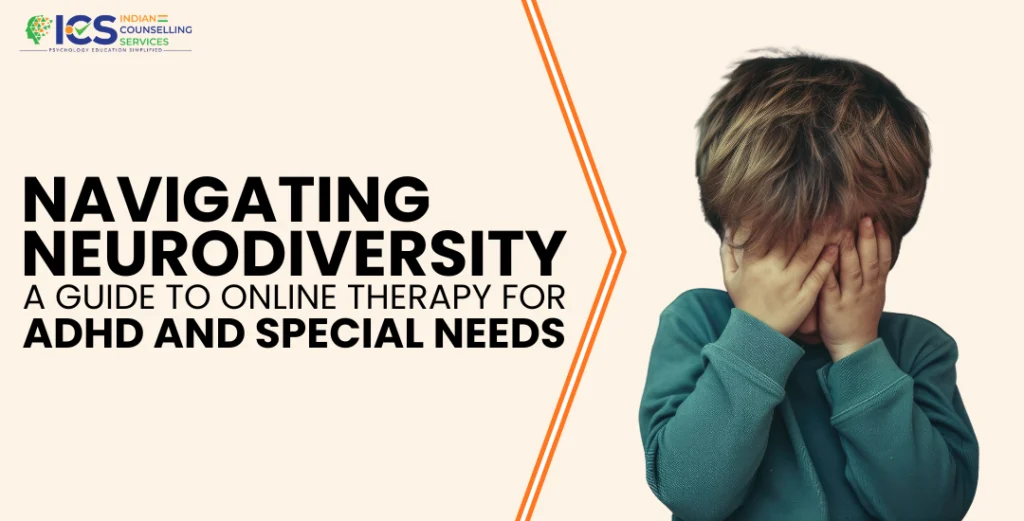
By 2026, the neurodiversity discussion will finally focus not on how to fix the differences but on how to learn and embrace different ways of thinking and learning. Such conditions as ADHD, autism spectrum differences, and other developmental variations are not considered only as a lack any longer, but as individual cognitive profiles that need personal assistance.
Simultaneously, with the emergence of online therapy, mental health care has become accessible to children and their families in a new way, particularly in India, where geographical, social, and logistical factors tend to restrict face-to-face assistance.
It is increasingly important for parents, educators, and future professionals to understand how to navigate this space, whether through formal study, such as a degree in child psychology.
What Is Neurodiversity?
Neurodiversity is the concept that variations in brain activity are normal variations on the human condition, not disorders that must be cured.
Children with ADHD or other special needs can:
- Learn differently and process information in different ways that do not necessarily conform to conventional education systems.
- Demonstrate ability to be creative, solve problems, or hyperfocus in particular areas of interest.
- Has problems with attention, emotional regulation, or social interaction.
To identify these differences is to begin the shift from limitation to support and adaptation.
Understanding ADHD and Special Needs in 2026
One of the most discussed neurodevelopmental disorders nowadays is ADHD.
Children with ADHD can have:
- Trouble with maintenance of attention, particularly concerning organized or monotonous activities.
- Impulsivity and the ability to make decisions and act.
- Vitality that can be misconstrued as disruptive instead of assertive.
Likewise, children with other special needs, including learning differences or developmental delays, also need a tailored solution that is in line with their cognitive and emotional profiles.
Why Online Therapy Is Gaining Popularity
Online therapy is turning out to be a very effective remedy for families who need an easy and convenient approach.
Online resources can overcome the geographical distance between professionals and families in India, where there might be an uneven distribution of mental health services.
- It enables children to be assisted in the comfort of their homes, which may help them become less anxious and more active.
- It provides access to specialized therapists who might not be based in your area.
- It offers flexibility in time scheduling, and thus, it is quite simple to be consistent as a family.
Accessibility is particularly helpful when children are in new settings and might be overwhelmed.
How Online Therapy Supports Neurodiverse Children
Online therapy is not a digital form of traditional therapy; it is frequently developed with neurodiverse needs in mind.
Personalized and Flexible Approaches
Therapists are able to step up sessions according to the attention span, interests, and learning style of the child.
To illustrate, more compact and interactive classes can be more effective with ADHD children, and visual aids can help children with communication difficulties.
Use of Digital Tools and Visual Aids
Therapists can employ interesting mechanisms online, including animations, games, and visual cues.
These devices will help to make sessions more interactive and allow children to remain engaged, particularly those with attention issues.
Comfort and Familiarity
Stress and sensory overload can be minimized by being in a familiar environment.
When safe and comfortable in their own space, children will be more willing to open up and participate.
Parent Involvement
Parents are usually invited to participate actively in online therapy.
This assists the caregivers to learn strategies and using them every day to make the environment more conducive to the child.
Common Challenges of Online Therapy
As much as online therapy has numerous advantages, it is not devoid of drawbacks.
- Other children can have issues around screen fatigue or the inability to remain entertained over long periods.
- Sessions may be broken down by technical problems, such as a bad internet connection.
- Some of these therapies involving physical contact might be less effective virtually.
Knowledge on these issues assists families in making wise choices about the most appropriate way their child should be managed.
Choosing the Right Online Therapist
It is important to recruit the appropriate professional.
Parents should look for:
- Experienced therapists in work with ADHD and neurodiverse children.
- Child psychology experts and evidence-based practices.
- A child-oriented and flexible communication style that is flexible and responsive to the needs of the individual.
Professional training, such as a diploma in child psychology, can provide the knowledge necessary to comprehend developmental stages and then intervene appropriately.
Practical Tips for Parents
Online therapy is a collaborative and consistent process that should support a neurodiverse child.
- Varying distractions can disrupt your child during the treatment sessions; therefore, make the therapy environment as quiet and distraction-free as possible.
- This is best achieved by keeping a regular time regime in which therapy becomes standard practice.
- You should also encourage your child to participate, but not pressurize them on this, and let them do it in their time.
- Keep in touch with the therapist to monitor progress and make revisions when necessary.
These are some minor steps that can make online therapy incredibly more effective.
The Role of Schools in Supporting Neurodiversity
Essentially, schools contribute to the reinforcement of what children have learned in therapy.
The focus on inclusive education as a teaching approach is growing in 2026 as the teaching process is modified to accommodate various learning styles.
Therapists, parents, and educators can work together to provide children with the necessary support at all times, irrespective of the setting.
Why Awareness Matters More Than Ever
Even though there is a growing awareness, there is still a stigma or a lack of understanding towards these children in India because of their differences.
Negative labels such as lazy or difficult have a negative impact on the self-esteem of a child and can interfere with his or her development.
Through neurodiversity, we are able to:
- Instead of judgment, use empathy.
- Pay attention to what is good, instead of what is lacking.
- Provide conditions to grow and learn.
The initial step towards an effective change is education and awareness.
Building a Supportive Future
The point of supporting neurodiverse children is not to make them fit into these strict systems but to adjust them to various mind frames.
As online therapy grows in popularity and more information on the subject is now available, such as a diploma in child psychology, families and professionals are now better equipped than ever to support each other.
Children will tend to:
- Develop self-esteem and self-confidence.
- Learn how to understand yourself and others emotionally and socially.
- Suicide and excel in life.
FAQs (Frequently Asked Questions)
Is online therapy effective for children with ADHD?
Yes. When sessions are tailored to the attention capacity and mode of learning, online therapy can prove to be very effective through interactive and engaging techniques.
At what age can a child start online therapy?
Children can begin therapy at a young age, depending on their needs. Early intervention often leads to better outcomes.
How can parents support online therapy at home?
Parents can create a structured environment, maintain consistency, and actively participate in reinforcing strategies outside sessions.
How does a diploma in child psychology help in this field?
A diploma in child psychology provides foundational knowledge about child development, behavior, and therapeutic techniques, helping professionals support neurodiverse children effectively.