
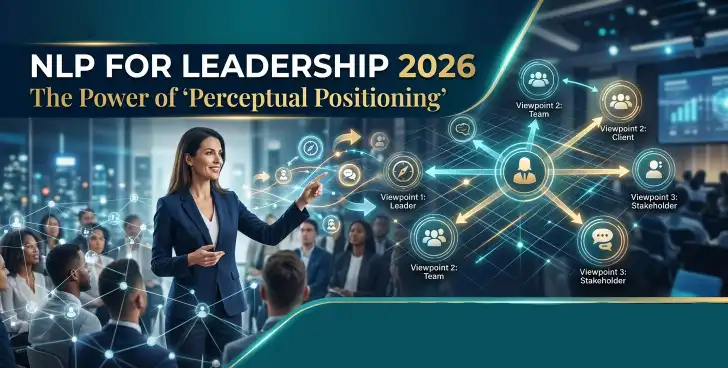
In 2026, leadership will not be about power or making decisions, but about outlook. Being able to listen to an alternative point of view and navigate through interpersonal dynamics and react with emotional intelligence has emerged as a characteristic of successful leaders.
Here, Neuro-Linguistic Programming (NLP) brings a very potent idea of what is referred to as Perceptual Positioning. It is a pragmatic approach that enables leaders to step out of their perspective and view situations through various perspectives.
To develop these skills, perceptual positioning is commonly one of the techniques taught in an NLP Practitioner Program as a way of enhancing communication, conflict resolution, and influence.
What Is Perceptual Positioning in NLP?
Perceptual positioning is the skill to intentionally change your mindset in any dialogue or circumstance.
You are not confined to your own opinion, but learn to look:
- Your personal opinion (first position).
- The opinion of the other person (second position).
- A disinterested view (third position).
This psychological pliability enables leaders to react as opposed to respond, particularly in a stressful circumstance.
The Three Core Perceptual Positions
These three positions are important in understanding how to implement this technique.
First Position: Your Own Perspective
It is here that you place yourself in the situation and think about it in your own thoughts, in your own feelings, and in your own beliefs.
- You know what you want, what you plan, and how you will respond at that time.
- You are aware of your emotions and the reason why you are reacting in a specific manner.
This stance is significant to self-awareness and genuineness.
Second Position: The Other Person’s Perspective
In this case, you get into the position of the other individual and attempt to put yourself in his or her situation.
- You take their feelings, purposes, and interests into consideration.
- You seek to place yourself in their position and view things without condemnation.
Such a stand creates sympathy and closer interpersonal relationships.
Third Position: The Observer Perspective
This is an unbiased, objective opinion- like observing what is happening outside.
- You observe both sides without emotional involvement.
- You identify patterns, dynamics, and communication gaps.
This position enhances clarity and strategic thinking.
Why Perceptual Positioning Matters for Leaders in 2026
The contemporary work environments are more diversified, hectic, and emotionally intricate than ever. Leaders will not only deal with tasks, but also with people, views, and disputes.
The positioning of perceptions assists leaders:
- Converse with challenging situations more sensitively.
- Minimize conflict in teams.
- Make well-informed and balanced choices.
- Develop a relationship of trust by being understanding and caring.
Basically, it changes leadership into reflective leadership.
Real-World Leadership Applications
The technique is not merely a theory, but can be put into practice in real-life leadership situations.
- Conflict Resolution: Leaders are fond of being caught in their perspective when there are conflicts. Their ability to change sides helps them to know both sides and arrive at balanced solutions.
- Team Communication: By taking into account the reception of the message, the leaders can achieve better communication and prevent misinterpretation.
- Decision-Making: When a situation is viewed in many ways, it will result in more informed and less biased decisions.
- Feedback and Coaching: Knowing the perception of the receiver of the feedback enhances delivery and effectiveness.
A Simple Way to Practice Perceptual Positioning
To begin to use this technique, you do not need a formal session. It is applicable in everyday life.
- To begin with, consider your personal thoughts and feelings regarding the situation.
- Then, imagine how the other person might be experiencing it.
- Finally, step back and observe the interaction as a neutral third party.
This is something to practice on a regular basis, and it will eventually build flexibility in the mind and emotional intelligence.
Common Mistakes to Avoid
Although perceptual positioning is an effective one, it should be utilized wisely.
- Never presume the viewpoint of the other individual.
- Do not overthink situations to the extent of not doing anything.
- Do not look after the needs of others and forget about your own needs.
The balance is the most important–both empathy and self-awareness are necessary in terms of effective leadership.
How NLP Training Supports Leadership Growth
Organized courses can offer a more in-depth understanding of how to use NLP techniques.
A typical NLP Practitioner Program assists you:
- Learn patterns of communication and cues.
- Gain emotional intelligence and self-awareness.
- Such practice methods as reframing and perceptual positioning.
- Put these skills into practice in practice.
This renders NLP an effective instrument for practitioners wishing to develop as contemporary, flexible leaders.
The Future of Leadership: Perspective Over Power
The conventional leadership model (control and authority) is slowly giving way to a more human-centric model.
Leaders of 2026 will:
- Know different perspectives in teams.
- Change communication styles according to contexts.
- Provide psychologically safe environments.
- Be conscious and not presumptive.
Perceptual positioning is the most suitable for this change, and thus, it is a skill that leaders of tomorrow need to possess.
Final Thoughts
The 2026 leadership is not about possessing all the answers, it is about having the big picture.
Perceptual positioning will enable you to be out of yourself and get to see the real dynamics going on around you. It enables you to guide in a clear, empathetic, and balanced way.
Since, at times, the strongest change in leadership does not emerge due to doing more: it is a result of seeing other-wise.
FAQs (Frequently Asked Questions)
What is perceptual positioning in simple terms?
It is the skill to see a situation in your own light, in the light of another person, and in the light of a neutral observer.
Is NLP useful for leadership?
Yes, NLP offers effective means of enhancing communication, emotional intelligence, and decision-making.
Can beginners learn perceptual positioning?
Yes, it is a simple idea that is enhanced through experience and mentoring.
Do I need an NLP Practitioner Program to learn this?
Maybe not, but organized programs will assist you in using the technique more efficiently.