
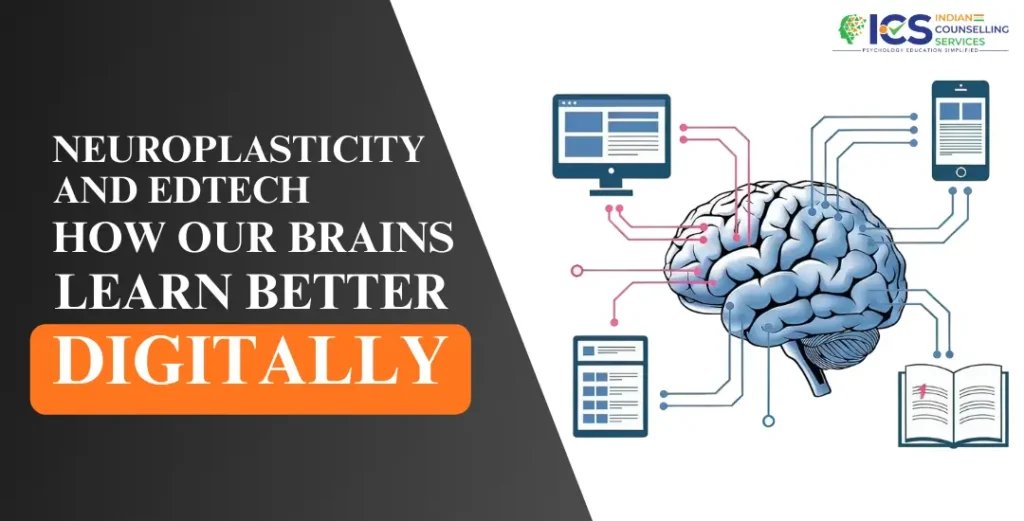
Digital education is not merely a convenient form of traditional learning anymore; but it is transforming the way the human brain receives, processes, and holds the information. The recent developments in neuroscience and educational technology (EdTech) have shown that neuroplasticity, which is the capacity of the brain to restructure, is an important factor in digital learning. This relationship is of particular interest to students and instructors studying contemporary models of education, such as human psychology, when the design of learning directly influences the level of cognition and retention.
Understanding Neuroplasticity in Learning
Neuroplasticity is the ability of the brain to establish new connections with neurons throughout life. However, unlike the previous assumptions that the brain is hardened after childhood, studies indicate that neural pathways can be continually reinvented by learning, experience, and repetition.
Neuroplasticity enables one to learn new information, skills, and environments in a learning context. This flexibility is used to advantage by digital learning platforms that provide repetitive exposure, different formats, and interactive experiences that reinforce neural connections in the long run.
The Rise of EdTech and Cognitive Engagement
Digital tools that are included in EdTech are learning management systems, interactive modules, video-based teaching, and personalization powered by AI. These instruments are crafted in such a way that they are consistent with the way the brain comprehends information.
Digital platforms tend to resolve big issues into small, digestible bits, minimizing the cognitive load. This is a format that allows one to focus on an entire topic and to gain a deeper understanding of the material, something that works especially well when the subject matter is conceptually dense, such as psychology and neuroscience.
How Digital Learning Supports Memory Retention
Repetition, emotional involvement, and input of various senses have a very powerful effect on memory formation. All three are backed by digital learning environments.
Quizzes, interactive exercises, and the use of spaced repetition are some of the examples that are used to reinforce long-term memory by repeatedly stimulating the neural circuitry that is associated with it. Encoding is further boosted by visual aids, animations, and real-life examples, and this makes the encoding easier to remember. This is among the reasons why digitally delivered content is often beneficial to those studying human psychology courses.
Personalized Learning and Brain Adaptation
Personalization is one of the most effective benefits of EdTech. Adaptive learning applications observe the behavior of the learners and alter the velocity, level of difficulty, and content format.
This individual process is very much similar to the neuroplastic principles. Learners are motivated and receptive when they are challenged at the most appropriate level, neither being too easy nor too difficult. This will lead to learning in the long term and cognitive flexibility.
Attention, Focus, and Digital Learning Design
Although the problem of digital distractions is very widespread, properly designed EdTech platforms can facilitate attention management. Learners would remain focused with the help of structured modules, clear learning objectives, and tracking of their progress.
Neuroscience indicates that neural connections get enhanced with attention. Digital platforms like those that promote learning in brief and concentrated learning environments are congruent with the mechanism that the brain uses to maintain attention, which results in more effective learning as opposed to long and passive learning.
Emotional Engagement and Motivation in Digital Education
Emotions are critical in learning. Positive affective states have a positive effect on motivation and memory consolidation, and stress may suppress learning.
To increase motivation, EdTech platforms tend to use gamification, feedback loops, as well as achievement tracking. These are characteristics that are stimulated by the brain reward pathways, which reinforce involvement and neuroplastic modifications that render learning more efficient and enjoyable.
Why Psychology Education Benefits from Digital Learning
Education in Psychology demands that learners combine theory, research, and practice. This integration is made possible by digital platforms via case studies, simulations, interactive discussions, and multimedia explanations.
To students who are pursuing human psychology classes, digital learning gives them the chance to be exposed to intricate ideas over and over again, reflect at their own pace, and apply them practically, all of which complements the enhanced mental processing and conceptual understanding.
The Role of Self-Paced Learning in Brain Development
Self-paced learning provides the learner with the leverage to control the manner and time in which they approach material. This freedom eliminates stress and promotes self-motivation.
This is based on the neuroplasticity view, whereby self-paced learning enables the brain to consolidate information at its own pace. Students have the opportunity to reconsider the problematic issues, developing neural networks, until the knowledge is obtained, which in the inflexible classroom environment is usually hard to do.
EdTech, Neuroplasticity, and Lifelong Learning
Due to the dynamism of careers, lifelong learning is inevitable. Neuroplasticity is what allows adults to keep acquiring new skills, and EdTech provides new opportunities to facilitate this process.
Digital education also enables people to reskill and upskill effectively and would be of particular use to such areas as mental health, behavioral sciences, and psychology, where lifelong learning is essential.
The Future of Learning: Where Neuroscience Meets Technology
Neuroplasticity and EdTech are the key to the future of education. Learning processes will keep on transforming as the digital platform becomes increasingly neuroscience-driven to suit the normal workings of the brain in learning processes.
To learners and professionals venturing into human psychology courses, the integration is not only convenient but also science-based and can achieve more meaningful and effective learning.
Final Thoughts
The connection between neuroplasticity and EdTech points towards the fact that learning is best facilitated by the process through which the brain can respond in its natural capacity to adjust and restructure. Well-thought-out digital learning environments promote attention, memory, emotional involvement, and individual-paced learning- these are the primary factors that consolidate the success of the learning process. With the current state of education in progress, neuroscience and technology are coming together to create more effective and valuable learning processes. For learners studying the course of human psychology, this convergence presents an opportunity to approach intricate concepts in a scientifically based manner, promoting lifelong learning and cognitive development in the ever-digitized world.
FAQs (Frequently Asked Questions)
What is neuroplasticity in simple terms?
Neuroplasticity is the capability of the brain to adjust and create new connections with the help of learning and experience.
How does digital learning support neuroplasticity?
Repeating, being interactive, and personalizing are the same techniques of strengthening neural pathways and enhancing retention that digital learning employs.
Is digital learning effective for complex subjects like psychology?
Yes. Self-paced interactive learning is best facilitated on digital media, and it is suited to the teaching of psychology.
Can adults benefit from neuroplasticity-based learning?
Yes. This aspect means that the brain is flexible throughout life and, as such, lifelong learning can occur at any age.
Why are human psychology courses well-suited for online learning?
They enjoy multimedia materials, case study learning, and repetition concept learning that is offered in digital platforms.