
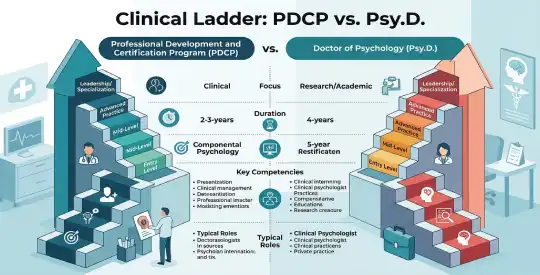
The route to becoming a mental health professional is no longer a one-size-fits-all in 2026. As mental health awareness in India and other parts of the world expands, so does the need to have a wide variety of training options, flexible and skill-focused training options. This change has seen the creation of what many today refer to as the new clinical ladder – a series of educational choices that address various career objectives, time implications, and commitment.
Two alternatives that tend to arise here include PDCP (Post Diploma in Clinical Psychology) and Psy.D. (Doctor of Psychology). Although both of them are related to the issue of clinical psychology, they can be used for entirely different purposes and career paths.
To students and professionals considering a course in Clinical Psychology, it is important to know the distinction between these two careers. Not only is it a matter of qualification, but it is also a matter of ensuring that the education you choose is the one that matches your career vision, investment of time, and your responsibilities as a professional.
We will deconstruct PDCP vs. Psy.D. in a straightforward, realistic manner in this guide, so you can see what route will suit your objectives in 2026 and beyond.
What Is PDCP?
A Post Diploma in Clinical Psychology (PDCP) is generally a short, skills-based course aimed at developing applied knowledge of mental health, counseling methods, and fundamental clinical practices.
Students who wish to join the mental health sector within a short period of time or improve on an already acquired qualification usually choose it.
- PDCP programmes typically emphasise practical knowledge as opposed to in-depth research training.
- They are usually taken following a bachelor’s program or a first degree in psychology.
- They offer exposure to counseling skills, case management, and simple evaluation.
PDCP is a stepping stone instead of a qualification in most instances.
What Is a Psy.D.?
The doctoral-level professional degree is known as post-doctorate or Psy.D., a professional degree in psychology that specializes in clinical practice, assessment, and therapeutic intervention.
The Psy.D. also focuses on practical clinical training and practice, in contrast to the research-intensive Ph.D. programs.
- Psy.D. programs entail a lot of supervised clinical hours and internships.
- They include in-depth training in diagnosis, therapy, and psychological assessment.
- They are created to meet the needs of the people who strive to become licensed clinical psychologists (depending on the country’s regulations).
This is the best course of action for people who are interested in establishing a long-term and specialized career in clinical work.
Key Differences Between PDCP and Psy.D.
Although both choices are classified as clinical psychology, they vary considerably in terms of scope and depth.
Duration and Time Commitment
- PDCP programs typically require a number of months or one year to be completed.
- Psy.D. programs are usually three or five years of rigorous study and training.
This fact contributes to the fact that PDCP is more applicable to faster entry, whereas Psy.D. is a long-term commitment.
Depth of Training
- PDCP provides both theory and practice of counseling and mental health.
- Psy.D. offers advanced clinical training, diagnosis, and management of complex cases.
The difference lies in the breadth versus the depth of expertise.
Career Scope
- Graduates of PDCP usually have to work in supportive or coaching jobs or in entry-level counseling environments.
- The graduates of Psy.D. may become clinical psychologists and/or therapists as well as mental health care specialists.
You should be informed by your career objectives.
Academic and Professional Recognition
- The certification of PDCPs can differ in recognition based on the school.
- Psy.D. is an internationally accepted doctoral-level qualification in most parts of the world.
You should check the accreditation and regulatory requirements, particularly in India.
Cost and Investment
- The PDCP programs are usually cheaper and more available.
- Psy.D. programs demand much more investment (financial and time).
This choice usually relies on your material means and long-term strategies.
Which Path Is Right for You?
PDCP or Psy.D. is a matter of choice based on where you are and where you want to be.
PDCP May Be Right If:
- You would like to dive into the field first and then make a long-term commitment.
- You seek shorter and more flexible learning.
- You want to develop the initial counseling skills as soon as possible.
Psy.D. May Be Right If:
- Your goal is to be a fully qualified clinical psychologist.
- You are prepared to have long-term academic and clinical training.
- Your professional desires are to work with complex psychological problems.
The Indian Context in 2026
In India, the pathway to becoming a licensed clinical psychologist is regulated and typically requires RCI-recognized qualifications.
Although PDCP programs can make you better at your skills, they might not be enough to be independent in clinical practice in regulated environments.
- Psy.D. or M.Phil. Clinical Psychologists are frequently required to be licensed.
- Role in counseling, coaching, and wellness services can also be useful with PDCP.
These are the key differences one should comprehend prior to selecting a course in Clinical Psychology.
Can You Combine Both Paths?
Yes, and lots of professionals do.
One strategy is to begin with a PDCP to get exposure and a hands-on feel of it. As time goes by, with increased interest, they seek higher qualifications such as Psy.D. or other similar programs.
- It is best to start small to see whether you are interested and to gain confidence.
- Moving on will assist you in specializing and broadening your career prospects.
This is a very flexible solution that fits into the contemporary, non-linear model of career.
Skills That Matter Regardless of the Path
Regardless of your path of choice, there are some key skills you need in clinical psychology.
- High level of empathy and emotional intelligence in dealing with clients.
- Good listening skills and effective communication.
- Professional responsibility and ethical awareness.
- Life-long learning and flexibility in a dynamic discipline.
These are skills that make you more effective than any one qualification.
Final Thoughts
The new clinical ladder is indicative of a larger reality of careers in 2026: there is no right way to be a career, just the way that suits you.
PDCP provides a fast, effective point of entry, whereas Psy.D. has specialized, comprehensive knowledge. They are both valuable, yet they are used for different purposes.
In case you are new, a course in Clinical Psychology at the diploma level may assist you in trying out the field. Advanced training will be needed in case you are determined to pursue a long-term clinical career.
Ultimately, you must not be trendy when making your decision, but rather be guided by clarity, dedication, and the type of influence you wish to have in the mental health sphere.
FAQs (Frequently Asked Questions)
Is PDCP enough to become a clinical psychologist in India?
No, PDCP alone is usually not sufficient for licensed clinical practice. Additional recognized qualifications are required.
How long does it take to complete a Psy.D.?
It typically takes around three to five years, depending on the program structure.
Can I start with PDCP and later pursue Psy.D.?
Yes, many students use PDCP as a starting point before committing to advanced degrees.
Which option is more affordable?
PDCP is generally more affordable, while Psy.D. requires a higher financial investment.