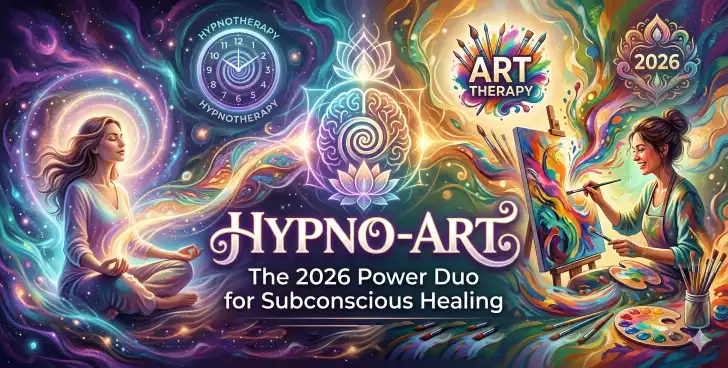
By the year 2026, the discussion on mental health is shifting to something other than talk therapy. Individuals are seeking out more integrative methods in which to merge science, creativity, and subconscious work. This is a very interesting development in the field, a potent combination of hypnotherapy and art therapy, which practitioners are terming Hypno-Art.
This is a process that exploits two highly transformational processes: the ability to reach the subconscious mind through hypnosis and to convey inner experiences through creative art. This combination forms a channel through which deeper emotional healing, self-discovery, and behavioral change can occur.
To people who want to learn about these modalities, taking an art therapy course may offer the basics of how creative expression can be used to promote psychology.
What Is “Hypno-Art”?
Hypno-Art is not a clinical term, but one that is on the rise as an integrative approach in which:
- Hypnotherapy assists people to reach their subconscious thoughts, feelings, and memories.
- Art therapy enables the expression of such internal experiences in a visual, symbolic manner.
This combination allows people to experience, imagine, and analyze emotions on a more profound level as opposed to using words alone.
Why the Subconscious Mind Matters in Healing
Numerous emotional models, including fears, habits, and relationship dynamics, are subconsciously based.
- Past experiences and emotional traces are repressed in the subconscious.
- It affects behavior in an unconscious manner.
- It tends to oppose change by reasoning only.
That is why there are certain problems even when you can comprehend them on the rational level. Real change can be achieved by simply getting in touch with the subconscious and operating on it.
How Hypnotherapy Contributes
Hypnotherapy involves guided relaxation and concentration to produce a situation in which the mind is open-minded.
People are able to study the latent emotional styles in a safe manner.
- People are able to study the latent emotional styles in a safe manner.
- Restricting beliefs may be spotted and rephrased.
- New, constructive ideas may be presented.
This process facilitates the avoidance of the critical conscious mind and gets into deeper levels of thought and feelings.
How Art Therapy Complements the Process
Art therapy offers a non-verbal means of processing what arises in hypnotherapy.
- There are hard-to-describe emotions that can be depicted in visual form.
- Symbolism and imagery are capable of unmasking latent thoughts and patterns.
- Artistic expression fosters emotional discharge and understanding.
You do not require the art; you just have to do it, not the result.
Why “Hypno-Art” Works So Effectively
The merging of art therapy with hypnotherapy produces a multi-layered healing effect.
- Hypnosis brings subconscious material to the surface.
- Art assists in the externalization and processing of that material.
- The assimilation strengthens emotional knowledge and transformation.
This two-fold methodology appeals to the analytical and creative modules of the brain, and thus heals more holistically.
What a Typical “Hypno-Art” Session Might Look Like
Although the formats may differ, these sessions usually have a systematic course:
- The session starts with a guided relaxation or hypnosis to reach the subconscious.
- The patient is advised to imagine feelings, recollections, or internal processes.
- Once the hypnotic stage has taken place, they make an artwork on the basis of what arose.
- The therapist assists in giving meaning to the imagery and relating it to the patterns in real life.
This is the process by which people are able to visualize and learn more about their inner world.
Who Can Benefit From Hypno-Art?
This integrative method may be useful for a broad range of issues.
- People who have anxiety, stress, or are emotionally overwhelmed.
- Individuals who are laboring through trauma or unresolved experiences.
- Individuals with self-esteem or restrictive beliefs.
- Everyone who wants to develop personally and get to know himself/herself.
It comes in handy, especially to those people who struggle to convey feelings by using words alone.
Hypno-Art in the Indian Context
The knowledge of holistic mental health practices is gradually increasing in India.
- There have been increasing numbers of individuals who are willing to use alternative treatments in conjunction with conventional approaches.
- Cities have been experiencing a rise in demand for innovative and integrative methods.
- The younger generations are experimenting with self-development outside of traditional models.
It should be noted, though, that such approaches should be undertaken with well-informed awareness and professional advice.
Important Considerations
Although Hypno-Art has potential, it is important to maintain a balanced approach.
- It must be applied by certified personnel who are familiar with the two modalities.
- It does not substitute clinical treatment of severe mental conditions.
- Additional experiences and results can be different.
Similar to any treatment method, it is an effective one that needs to be used appropriately and in context.
The Role of Training and Education
The need to have the appropriate training is important as integrative therapies are gaining popularity.
A course in art therapy will assist you in:
- Know the psychological concepts underlying the creative expression.
- Get to know how to make the sessions safe and effective.
- Get an understanding of emotional processing with art.
- Establish a base of integration of art with other forms of therapy.
Additional special training is also advisable for those who have an interest in hypnotherapy.
The Future of Integrative Healing
Mental health is shifting towards the personalized and multi-dimensional in the future.
Instead of adopting one approach, practitioners are integrating approaches to deal with:
- Emotional, cognitive, and behavioral aspects
- Subconscious and conscious processes.
- Non-verbal and verbal expression.
Hypno-Art is such a transition, a transition to more holistic, more flexible, and more human-centered healing.
Final Thoughts
The process of healing is not always a straight, logical process. At times, it involves going inside a person to find the innermost parts of the mind and articulating what cannot be articulated using words.
Hypno-Art is a very special way, one that combines science, imagination, and unconsciousness. It encourages you not only to reflect upon your experiences but also to imagine, embody, and change them.
With mental health constantly adapting in 2026, solutions such as this one are a constant reminder that the best solution is usually just below our feet- in the invisible and unrealized.
FAQs (Frequently Asked Questions)
Is Hypno-Art scientifically proven?
It is a new integrative method. Although there is supportive evidence of both hypnotherapy and art therapy, joint research is in its infancy.
Do I need to be artistic to try art therapy?
No. Art therapy is about expression, not artistic ability or talent.
Is hypnosis safe?
Hypnotherapy is usually safe when carried out by a trained professional to most people.
Can Hypno-Art replace traditional therapy?
It may be used in conjunction with conventional therapy, but not for the clinical treatment of severe conditions.