
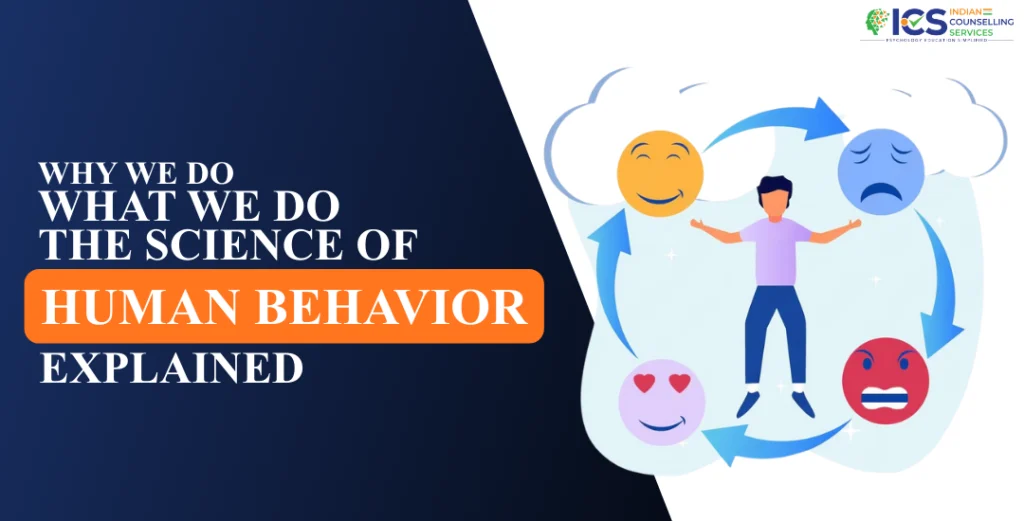
Human actions are usually unpredictable, emotional, or even irrational. But psychology demonstrates that we do not act in some way just by chance. There are biological, cognitive, emotional, and social processes underlying every decision, habit, reaction, and pattern of relationships. These processes are the basis of psychology, of knowing ourselves and other people.
It is a blog that dissects the science behind human behavior in a simple, accessible manner, and the reason why studying such principles as offered in top psychology courses in India is getting more and more relevant in the complex world we live in today.
What Is Human Behavior from a Psychological Perspective?
Human behavior is the visible actions, reactions, and patterns that come out of the internal mental processes as well as the external influences.
How Psychology Defines Behavior
- Biology, environment, and personal experience make an interaction that determines the behavior of a human being.
- Psychological science examines conscious as well as unconscious reactions.
- Learning, emotion, cognition, social situation, and culture affect behavior.
This is a holistic perspective that enables psychologists to go beyond judgment and concentrate on the patterns.
The Role of the Brain and Nervous System
Behavior begins in the brain.
How Biology Influences Behavior
- The brain controls emotions, impulses, making a decision, and reactions to stress.
- Dopamine and serotonin are examples of neurotransmitters that control motivation, mood, and reward-seeking behavior.
- The nervous system dictates the response that individuals exhibit towards threats, pleasure, and uncertainty.
This biological premise is the reason why behavior may vary dramatically across individuals.
Learning, Conditioning, and Habit Formation
Most of our actions are acquired through time.
How Learning Shapes Behavior
- Classical conditioning can be used to explain why emotional responses get attached to certain experiences.
- Operant conditioning reveals the mechanism of stimulating behavioral patterns with rewards and consequences.
- Repetition and reinforcement gradually turn actions into habits.
These principles are useful in explaining both productivity routines and anxiety reactions.
Cognition: How Thoughts Shape Actions
What we believe will impact what we act.
The Cognitive Drivers of Behavior
- Perception, interpretation, and emotional responses are determined by thoughts.
- The cognitive biases affect decision-making unconsciously.
- Self-related and other-related beliefs shape the behavior patterns in the long term.
Cognition is a key aspect of behavior change and psychological intervention.
Emotions and Motivation
Logic can hardly be the motivator for behavior.
Emotional Forces Behind Action
- Sensations give immediate responses to safety, reward, and social connection.
- Intrinsic values and external rewards are motivational factors.
- The control of emotions is what makes the difference between adaptive and impulsive reactions.
Psychology assists one in reacting to feelings instead of letting feelings dictate them.
Social and Cultural Influences on Behavior
Human beings are social creatures.
How Environment Shapes Behavior
- Social norms determine what is good or bad in terms of behavior.
- Communication style, expression of emotion, and decision-making are all influenced by cultural values.
- Conformity, leadership, and identity are influenced by group dynamics.
These forces are the reason why behavior differs among societies and circumstances.
Why We Repeat Patterns Even When They Harm Us
Well-being is not necessarily always consistent with behavior.
The Psychology of Repetitive Patterns
- The well-known behaviors are psychologically safer than the change, even when unhealthy.
- The relationship and coping patterns are unconsciously formed through early experiences.
- Fear of uncertainty reinforces existing behavior loops.
Awareness and restructuring are put to the fore in psychology and not blame.
Applied Psychology: Using Behavioral Science in Real Life
The study of behavior is useful in industries.
Where Behavioral Science Is Applied
- Behavioral science is applied by mental health professionals to treat emotional and psychological disorders.
- Teachers use psychology to enhance learning and motivation.
- Behavioral insights are applied by organizations to maximize performance and well-being.
That is why the demand for organized education with top psychology courses in India is still increasing.
Why Studying Human Behavior Matters in 2026
The new demands on mental resilience in the modern world are based on new requirements.
The Relevance of Behavioral Science Today
- Electronic space exacerbates the problem of attention and emotional overload.
- Emotional intelligence and flexibility are needed in greater amounts in social changes.
- Mental health awareness requires evidence-based knowledge and not assumptions.
Psychology offers the means of maneuvering the complexity in a way that is thoughtful and empathetic.
Learning Psychology: From Curiosity to Competence
Interest alone is not enough.
The Value of Formal Psychology Education
- Developed learning forms scientific knowledge of behavior.
- Effective and ethical intervention strategies are taught during applied training.
- The best psychology courses in India are integrated courses between theory, research, and practical use.
Quality education makes sure that psychological knowledge is applied responsibly and productively.
Final Thoughts
The behavior of humans is not a chance occurrence, but a patterned and knowable phenomenon as it is affected and explained by the psychological field. Psychology, through studying the brain, emotions, cognition, and the social environment, helps in understanding how people think, feel, and act as they do. Behavior is something that is no longer an option in a world where stress is on the rise, complexity is increasing, and there is a need to deal with emotional issues. Taking top psychology courses in India provides the student with scientific knowledge, ethics, as well as practical know-how to comprehend behavior and make a positive contribution to the world.
FAQs (Frequently Asked Questions)
Is human behavior predictable?
Human patterns of behavior are shaped, and results are dependent on individual variations and circumstances.
Why do people behave irrationally?
Logical reasoning is frequently overcome by feelings, mental biases, and unconscious learning.
Can behavior be changed?
Yes, it is possible to change behavior by creating awareness, learning, and structured intervention.
Is psychology only for therapists?
No, the field of psychology is used in education, business, healthcare and in daily life.
Why study psychology formally?
Proper understanding and moral use of behavioral science is achieved in formal education.