
You must have come across various cognitive triangles simplifying how CBT actually works. It shows how changing negative thinking into positive thinking will develop better emotions and make overall behaviour healthier. But how CBT actually works in treating mental health conditions. The question comes here. One of the widely used psychotherapies, CBT, helps in treating various conditions like depression, anxiety, sleep disorders, and more. So if you are an aspiring psychologist or a working professional, doing an online CBT course is a must for you.
In today’s blog, we’ll dive deeper into CBT and learn how it can be used in treating various mental health conditions. Let’s begin…
What is CBT?
Cognitive Behavioral Therapy is a modern form of talk therapy that is based on the idea that our thoughts, emotions, and behaviours are interconnected. Its principles are made from cognitive therapy (focuses on identifying and reframing distorted thoughts) and behavioral therapy (encourages healthy changes in behaviour through practice, exposure, and reinforcement).
Cognitive Behavioural Therapy starts when the therapist conducts an assessment and evaluation to find out the person’s specific problems and goals. The following sessions focus on finding the problematic thoughts, knowing how accurate they are, and finding ways to alter them. Activities are incorporated after every session, like thought journals or relaxation techniques. This helps the client in building new thoughts in their life.
Core Principles of CBT
Several principles of CBT make it a practical and structured form of therapy:
- Psychological distress often arises from unhelpful ways of thinking and learned behavior patterns.
- By learning to recognize and modify these patterns, individuals can relieve symptoms and improve their daily functioning.
- Therapy is collaborative, meaning the therapist and client work as a team to identify problems and set measurable goals.
- It is goal-oriented and problem-focused, centering on the present rather than extensively dwelling on past events.
- CBT is educational—it teaches clients to become their own therapists by developing skills to manage future challenges independently.
- It employs structured sessions with active participation and homework assignments that reinforce learning outside therapy sessions.
Use of CBT In Mental Health Conditions
As I mentioned above, CBT can be used for treating various mental health conditions. It starts by recognizing harmful thinking patterns, challenging them, and replacing them with more constructive ideas. Below is the list of mental health problems that CBT can fix:
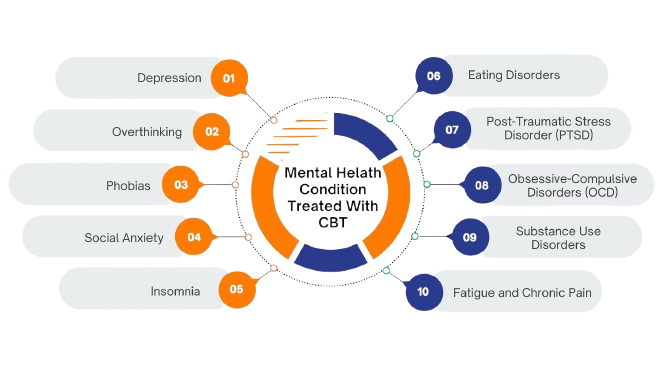
In depression, a person is highly influenced by negative thoughts like “I am useless” or “things will never be in my favour”. CBT helps in changing these distorted thoughts by encouraging positive thoughts, pleasant activities, and reducing the feelings of hopelessness. For example, a person who stopped exercising due to a low mood schedules small physical activities, tracks emotions, and improves mood over time.
In overthinking, a person gets trapped in their own thoughts, either worrying about their own mistakes or getting stressed about the future. CBT helps the person in identifying triggers, helps them distinguish productive thoughts from rumination, and refocuses attention on problem-solving.
Phobias are extreme fears that can be of various types. For this, exposure therapy in CBT can be used to slowly and safely confront a person with their feared objects. With this, the brain relearns safety cues, and this helps in breaking fear responses.
The core cause of a socially anxious person starts from a negative thought (people will judge me, or they won’t accept me). So CBT can help in breaking such negative beliefs through cognitive restructuring and exposure.
For example, if someone is highly anxious about speaking on stage. They can start by practising in front of a mirror, then near small groups, correct distorted thoughts, and gain confidence again.
Post-traumatic stress comes from any traumatic event that could be stressful for a prolonged time. Such trauma-centred thoughts can be reduced through techniques like protracted exposure or cognitive processing therapy to relieve traumatic memories and reframe them.
Eating disorders arise from distorted thoughts about one’s body image, food, and self-worth. CBT can help address these thoughts by breaking rigid beliefs, encouraging balanced thinking, and structured eating behaviours.
CBT for insomnia can help in reducing negative beliefs about sleep (I can never sleep) by using components like stimulus control and sleep restriction therapy.
OCD originates from obsessive or compulsive thoughts that persistently occur, causing distress in a person’s life. CBT can help in removing these thoughts, and anxiety declines automatically when one does not have compulsive thoughts.
CBT can reduce addiction by recognizing patterns due to which a person might be drinking. It can use strategies like restructuring thoughts and developing coping strategies. Healthier activities can replace relapses that occur due to addictive substances.
When a person experiences chronic pain due to physical conditions or fatigue, negative thoughts like “My pain makes me helpless” do come and build catastrophic beliefs. CBT can provide a client with various ways of controlling their responses rather than eliminating them.
Conclusion
In 2025, CBT is likely to expand its use to treat more mental health conditions. As most mental health conditions start with an idea that some internal problem exists. And so CBT focuses on solving that very idea and its existence. Overall, with this therapy, people can take control of their inner thoughts and reframe them with new thoughts.
Want to learn Cognitive Behavioural Therapy? Indian Counselling Services provides an online CBT therapy course, which is highly rated and one of the popular Cognitive Behavioral Therapy courses in India. And guess what! You don’t need a prior Psychology background to do this course.
Ready to empower your life by learning CBT? Click here and get started!