
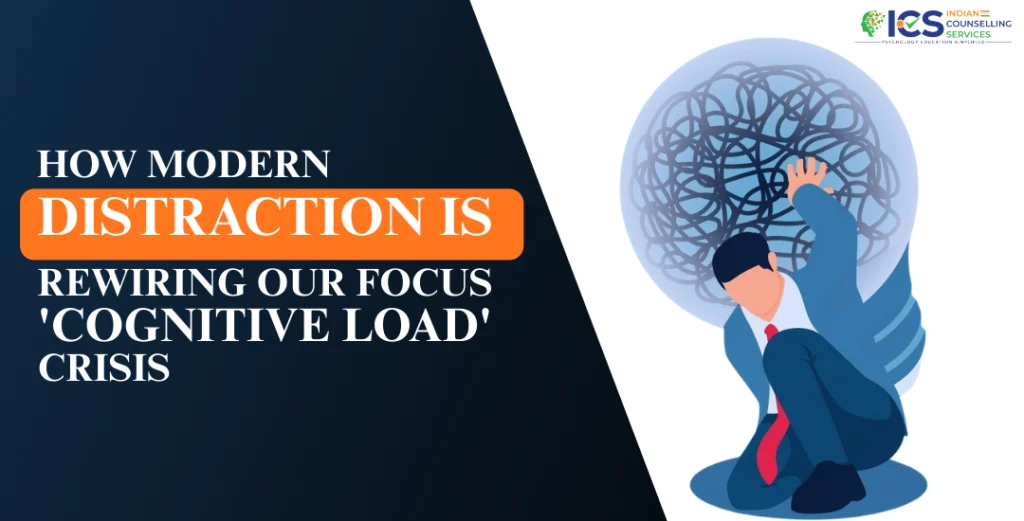
Humans have never been as well-informed, stimulated, and given so much choice at the same time. Alerts, multitasking, the continuous stream of content, and constant switching between activities are not a rare occurrence anymore, but rather it is the natural state of the environment. Consequently, several people complain of a lack of concentration, mental exhaustion, and they constantly feel overwhelmed. This is more frequently referred to as a cognitive load crisis. The concept of modern distraction rewiring attention is an increasing topic of research in behavioral science, professional education, and advanced psychology qualifications, which cover cognition, attention, and mental exhaustion.
What Is Cognitive Load?
The cognitive load is the mental effort that is needed to process information within a particular time.
The working memory capacity of the human brain is limited. Beyond this capacity, efficiency decreases, errors rise, and fatigue ensues, which is described through cognitive load theory and describes why learning, decision-making, and attention decline with excessive mental load.
The contemporary world is highly demanding in its attention, and it causes most people to extend their cognitive load to unbearable levels.
How Modern Distraction Increases Cognitive Load
Digital life has an enormous impact on the volume and speed of information processing.
- The continuous notifications are distracting and compel the brain to divert its attention every few minutes, thus taking up a lot of mental resources.
- Multitasking involves switching tasks very quickly, thus adding more cognitive load and not enhancing productivity.
- Unlimited content streams eliminate natural pauses, and mental relaxation is not attained.
- The problem of information overload causes prioritisation of information to become a challenge, leading to decision fatigue and cognitive load.
These tendencies ensure that the brain is in a state of constant semi-attention and thus has less depth of focus.
The Brain’s Adaptation to Distraction
Neuroplasticity helps the brain to respond to the repeated environment.
The neural routes prefer scanning to attentional resources, as opposed to prolonged attention when attention is fragmented. This is not to state that the brain is being damaged but that is to say that the habits of attention are being remodeled.
With time, people can experience profound attention becoming the more challenging one, even in low-distraction environments. Training programs and psychology certifications study how the systems of attention can be changed and retrained by means of conscious practices.
Cognitive Load vs. Mental Fatigue
Mental fatigue and cognitive load are two terms that are closely related but different.
Cognitive load is defined as the burden of mental resources, and mental fatigue is the consequence of the overload. Fatigue is experienced when cognitive load is sustained without any form of recovery.
Mental exhaustion decreases motivation, working memory, emotional regulation, and problem-solving capacity. This is the reason why distracting environments tend to cause burnout and not efficiency.
Signs of the Cognitive Load Crisis
The cognitive load crisis has both minor and evident forms.
- The inability to maintain attention in individual tasks can be a symptom of overloaded working memory.
- The problem of insufficient cognitive capacity to encode information well may lead to increased forgetfulness.
- Being irritable and emotive is an obvious display of a depleted mental resource.
- Learning retention is usually low when attention is divided in course of information reception.
These indications are often misconstrued as laziness or the lack of discipline, and not as neurological overload.
Why Focus Feels Harder Than Ever
Not only attention is involved, but also the inhibition of competing stimuli is a requirement of focus.
The contemporary world is always in a state of competition, and that requires the brain to filter out all the time. This process of filtering in itself uses mental resources.
The higher the cognitive load, the higher the brain focuses on efficiency rather than depth, resulting in easy shallow engagement instead of maintaining attention. This is one of the most important elements of cognitive psychology education and psychology certifications.
The Impact on Learning and Work Performance
There are high cognitive loads that have a great impact on learning and productivity.
When the working memory is overworked, new information will not transfer to long-term memory. This renders learning less effective and slower, despite the time used seeming adequate.
Cognitive overload is a factor in professional situations that leads to errors, a lack of creativity, and decision fatigue. The issue of cognitive load should thus be approached to promote the well-being of education and the workplace.
Emotional Consequences of Cognitive Overload
Cognitive load does not just influence thought alone; it influences emotional control, too.
Once the brain is exhausted by the overwhelming amount of mental resources, it is unable to cope with emotions. This may cause murder, stress, frustration, and emotional depletion.
Anxiety and burnout are also possible causes of chronic overload, as the nervous system will be constantly activated without having proper rest.
Can Cognitive Load Be Reduced?
Although contemporary distraction cannot be absolutely avoided, the cognitive load may be handled deliberately.
- Organizing the environment to minimize unnecessary stimuli is useful in terms of conserving mental resources.
- Single-tasking is more effective in terms of lowering task-switching costs.
- Intentional breaks create cognitive recovery and consolidation.
- Learning and work processes should be designed keeping cognitive limits in mind to enhance the results.
Such strategies are now gaining more prominence in the education of applied psychology and psychology certifications that are dedicated to cognitive health.
The Role of Psychology in Addressing the Crisis
Psychology offers theories on how to comprehend attention, learning, and mental exhaustion.
Cognitive and behavioral science-trained professionals assist people and organizations in creating systems that are compatible with the way the brain functions. This involves minimizing overload as opposed to driving to perpetual optimization.
With increased awareness, psychological credentials become important to provide practitioners with evidence-based instruments to help them overcome cognitive overload in the field.
Final Thoughts
The cognitive load crisis is not a failure of concentration on an individual level, but a natural response to distracting working environments that are beyond the cognitive capacity of the brain. The contemporary distracter is transforming attention by overloading it repeatedly, whereby it becomes more challenging to focus. Knowing about cognitive load and its influence, people are able to make more brain-centered approaches to learning, work, and well-being. With this problem gaining momentum, it is necessary that education and training should be accomplished by way of certifications in psychology so that the professionals can create healthier cognitive environments and inject significant attention back into an oversaturated world.
FAQs (Frequently Asked Questions)
What is cognitive load?
Cognitive load refers to the effort that one applies in the processing of information at a given time.
Does multitasking increase productivity?
No, multitasking does add more cognitive load and is likely to lower efficiency and accuracy.
Can attention be retrained after years of distraction?
Yes, attention can be retrained through intentional focus practices and reduced cognitive overload.
Is cognitive overload linked to burnout?
Yes, long-term cognitive overload is a cause of mental exhaustion, emotional exhaustion, and burnout.
Do psychology programs teach about cognitive load?
Indeed, cognitive load and attention control are common topics in psychology test training and applied psychology training.