

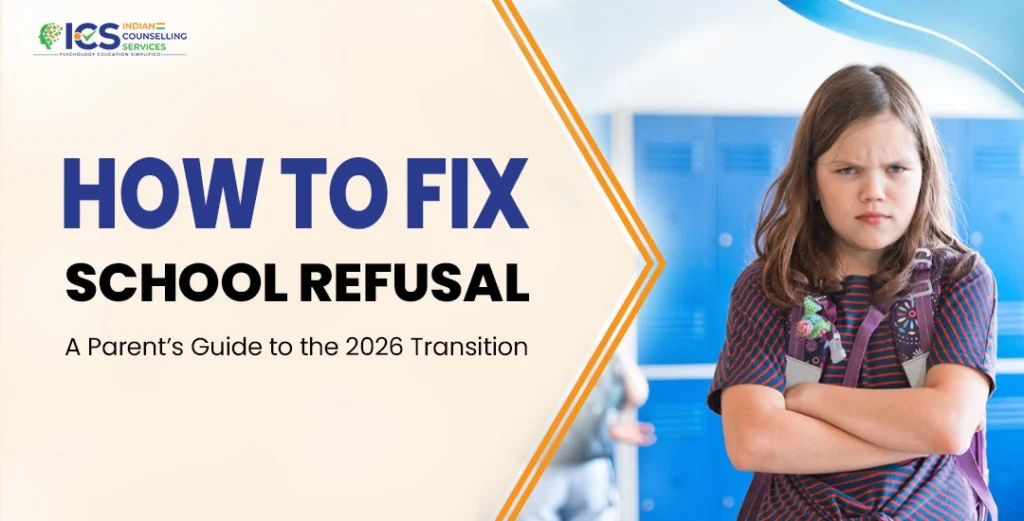
School refusal will be one of the most prevalent problems among parents in 2026. School refusal is not a slight case of occasional excuses or a slight reluctance, but a distressing emotional distress of going to school. It can be in the form of tears, panic attacks, stomachache, headache, or even a full shutdown before the day is over.
As pressure at work and school mounts, more children are encountering digital distractions, and social adaptation after the pandemic continues, many families are going through this challenge for the first time.
The positive aspect is that school refusal can be corrected. The majority of children, with patience, organization, and appropriate psychological tricks, will be able to go back to regular attendance.
This guide will assist you in realizing why it occurs and what you can do about it.
What Is School Refusal?
Truancy is different from school refusal. Truancy is typically the skipping of school without parental consent. School refusal is, however, anxiety-based, fear-based, or emotion-based.
Children who refuse school usually:
- Request to be excused because of some physical reasons, such as a stomachache or headaches.
- Have panics in the house before going outside.
- Cry intensely at drop-off.
- Display emotional withdrawal or restlessness in the morning on school days.
Notably, such children do not lack diligence or rebelliousness. They are overwhelmed.
It is necessary to comprehend this emotional ground. Most of the parents who acquire a diploma in child psychology later confirm that the acquisition of information on the development of anxiety transformed their way of handling the behavior of their child.
Why School Refusal Is Increasing in 2026
This increase is being attributed to a number of factors in the modern world.
To begin with, there is an increased academic pressure. Early success pressure, performance checks, and competitive examinations are the cause of chronic stress.
Second, digital lifestyles have altered the comfort zone of children. Most children feel secure in the confines of their homes rather than in socially unpredictable classrooms.
Third, social anxiety is increasing. The comparison of people using social media adds more fear of judgment, bullying, or embarrassment.
Fourth, there are more difficult transitions. The transition of online or hybrid education to complete in-person education has been problematic for a number of children.
The understanding of such environmental factors assists parents in reacting empathetically rather than frustratingly.
The Most Common Psychological Causes
The common causes of school refusal are one or more of the following:
- Separation anxiety is popular amongst the younger children who are afraid to leave their parents alone.
- Social anxiety may leave older children afraid of presentation, being judged by their peers, or even being in a group.
- Academic pressure and fear of failure may be the cause of performance anxiety.
- The school might be unsafe emotionally due to bullying or social conflict.
- Motivation and energy may decrease under the influence of underlying mood disorders, including depression.
It is essential to know the underlying cause, as the solution will be based on that. This is one of the major principles of professional training programs like the diploma in child psychology.
Step-by-Step: How to Fix School Refusal
Threats and anger as a reaction contribute to anxiety. Rather, respect your child and his or her emotions and have clear expectations.
You can tell, school is very difficult, just at the moment. We shall see this out jointly.
Validation minimizes the emotional intensity.
Children are more comfortable when they can follow a routine. Establish strict schedules of rising and sleeping, eating, studying, and sleeping.
Do not spend too much time on screens on days when they are on holiday at home, because this will be an honest encouragement to not go out.
Stability is expressed through consistency.
It is better to be exposed to something gradually than abruptly.
For example:
- Begin by going through the school building during the evening.
- Advance towards attending a single class.
- Slowly increase the duration over days or weeks.
Minor achievements generate confidence and less panic.
Speak to teachers or school counselors. The schools of 2026 are becoming more conscious of absenteeism due to anxiety and can provide flexibility in the process of reintegration.
Request support such as:
- Adjusted assignments.
- Someone the child can go to in order to be safe.
- Short-term changes in schedules.
When parents and school work together, results become better.
Children have access to the practical means of coping.
Exercises on breathing deeply relax the nervous system.
The tricks of grounding focus the mind away from catastrophic thinking.
Self-positive thoughts minimize fear predictions.
Formal courses, such as a diploma in child psychology, can be used to learn systematic anxiety-reduction methods, which can prove to be extremely effective in the event that they are practiced accordingly.
Consulting a child psychologist is advisable in case the school refusal continues beyond two weeks and causes a lot of disturbance to the family life.
Intervention at an early stage avoids academic and social effects in the long run.
Therapy may also be used to find the triggers that have been buried in the subconscious, coping skills can be taught, and slowly, confidence in school can be restored.
What Parents Should Avoid
It is also important to know what should be avoided.
Do not call your child a dramatic or lazy child. This increases shame.
There should be no excessive assurance, which will reinforce fear unwillingly.
One should not permit such a long-term absence without a reintegration plan because fear will increase with time.
Time is of the essence, combined with planned action.
The Long-Term Outlook
School refusal mostly responds to early intervention. Children who are supported emotionally and systematically exposed tend to be more resilient and cope better than before.
This is the challenge that can be turned into a growth opportunity if it is handled.
To gain more knowledge on child development, emotional control, and anxiety patterns, a diploma in child psychology offers a good understanding of why children act in certain ways and how to influence them.
FAQs (Frequently Asked Questions)
Is school refusal a phase?
Mild resistance passes through, but a prolonged distress in school needs to be proactively supported.
Should I force my child to go to school?
Anxiety can be amplified by force without emotional assistance. It is better to do it gradually, systematically.
How long does it take to fix school refusal?
Less severe cases can be cured in a few weeks. More complicated cases ought to take several months of regular intervention.
Is professional training like a diploma in child psychology useful for parents?
Yes. It assists the parents to learn more about anxiety, child behavior, and emotional development.