
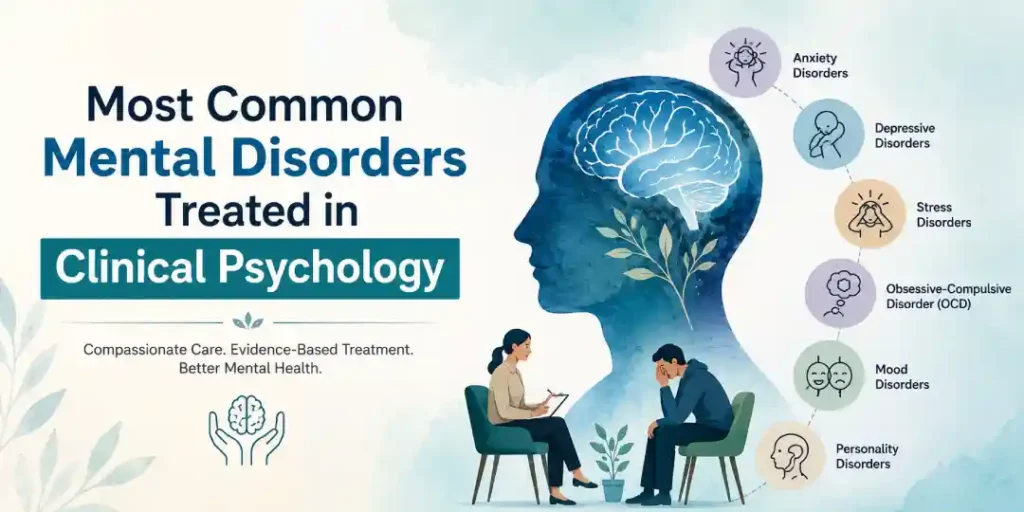
Therapy is no longer a subject people talk about behind closed doors. In India and around the world, there has been a lot of awareness of psychological well-being in recent years. There is an increasing awareness of the “mental health” aspect, and people are reaching out for professional help more frequently.
Despite all this awareness, many people are still not aware of what clinical psychologists treat. Others think that therapy is just for major mental illnesses, and some feel that, over time, emotional problems will just go away.
In practice, clinical psychologists assist individuals with dealing with different mental conditions, including normal stress and work fatigue, or serious conditions that can have a significant impact on their everyday lives.
Awareness of the most prevalent Mental Disorders Treated in Clinical Psychology can help break the stigma surrounding mental health and promote seeking help when needed. It can also be used to help students and professionals who are interested in a CBT Training Certification to get a glimpse of applying evidence-based therapies in actual clinical practice.
What Does a Clinical Psychologist Do?
Clinical psychologists are mental health experts who assess, diagnose, and assist in the treatment of emotional, behavioural, and psychological issues. Their work involves much more than simply listening to problems. They use scientifically tested testing and therapeutic procedures to inform people of their challenges and strategies to help them manage those challenges.
The treatment may be aimed at symptom management, emotional regulation, changing unhelpful thinking patterns, strengthening relationships, and/or learning about resilience in difficult life situations.
One of the more common therapies is called Cognitive Behavioral Therapy (CBT), which helps to recognize and modify thoughts that cause negative emotions.
1. Anxiety Disorders
Anxiety disorders are one of the most common disorders in clinical psychology practices today. Anxiety is a normal and acceptable experience at times, but it becomes an anxiety disorder when fear, worry, and anxiety begin to negatively impact the person’s work, relationships, studies, or daily functioning.
The situation is more complex when it comes to young adults and working adults in India, where they have been feeling more anxious than ever before due to the ever-increasing academic pressure, competitive world, financial insecurity, and constant access to the digital world.
People experiencing anxiety disorders tend to be trapped in a vicious circle of worrying thoughts, which seem disproportionate and uncontrollable.
These are a few of the general symptoms:
- Sometimes, the thoughts of what could possibly go wrong keep going through the minds of people even when there’s no actual proof that anything bad will happen.
- Anxiety can lead to physical responses, such as a fast heartbeat, sweating, muscle tension, and being unable to relax.
- In avoiding situations that cause anxiety, people may start and gradually become unable to engage in a wide range of activities.
- Common side effects are problems sleeping and overthinking.
CBT is a well-used therapy for clinical psychologists to help people defuse irrational fears and learn to respond in a healthy way when facing uncertainty.
2. Depression
Depression is certainly one of the most misunderstood illnesses. It can be misinterpreted as being sad, lazy, or just a passing “fashion. But depression is a real psychiatric disorder that can impact feelings, thoughts, energy, and general standard of living.
Depression is different from a low mood as it will last for weeks or months and may make normal activities seem too much to handle.
Common experiences with depression are:
- Individuals can lose interest in things they formerly liked and become less interested in everyday items.
- Persistent feelings of hopelessness, guilt, or worthlessness often lead to low self-esteem and self-confidence.
- Dysfunction of eating and sleeping patterns and issues with energy are common and can impair functioning.
- In some cases, people have trouble making decisions during depression.
Clinical psychologists can help patients to identify the thought and behavioral patterns that contribute to depression and help them to develop new, more beneficial coping strategies.
3. Obsessive-Compulsive Disorder (OCD)
OCD isn’t simply about cleanliness and tidiness. It contains intrusive thoughts, images, or fear that cause high levels of anxiety and repetitive behaviours that temporarily reduce anxiety.
For instance, an individual could constantly inspect locks, wash their hands too many times, or ask for continual reassurance due to extreme fears.
Those with OCD often realise that what they are afraid of is irrational, but they still need to carry out particular rituals.
Symptoms include:
- Repeated checking actions take up a lot of time daily.
- Recurring concerns about contamination, safety, or unintentional injury.
- Repeating words, phrases, or events, or counting.
- Problems with distress when prevented from engaging in compulsory behaviors.
CBT techniques are helpful in particular for treating OCD symptoms, particularly Exposure and Response Prevention (ERP).
4. Post-Traumatic Stress Disorder (PTSD)
Trauma can have deep emotional and neurological impacts that can persist long after the traumatic experience itself. PTSD can happen following something that is frightening, such as an accident, abuse, violence, or a natural disaster, or some other extremely distressing experience.
Over the past few years, there has been a growing recognition by mental health professionals of the impact of trauma on the brain and nervous system.
Those who have PTSD might find it difficult with:
- Going over thoughts or flashbacks of the event.
- Persistent threat/high alertness not in safe spaces.
- Lack of feeling and/or a lack of relationship with others, and activities that were once enjoyed.
- Refusing to go to certain places, situations, or talk about certain events that remind them of the traumatic event.
Trauma-informed therapy helps them manage their trauma and build emotional resilience.
5. Attention-Deficit/Hyperactivity Disorder (ADHD)
Many adults suffer from ADHD as well, though the condition is typically seen in children. Over the last few years, there has been a rise in the number of adults coming to the clinic for assessment due to their increased awareness about the condition and the symptoms they experience.
Schoolwork, work productivity, relationships, and self-confidence can all be affected by ADHD.
Some of the typical problems are:
- Individuals may have difficulty focusing on a conversation, a meeting, or a normal task.
- Poor time management and forgetfulness can cause frustration in everyday life.
- Personal and work relationships can be impacted by impulsive decision-making.
- Although some people appear calm on the surface, there is a lot of mental restlessness.
A clinical psychologist can assist you in creating effective strategies to assist with your attention difficulties and to function more effectively in your daily life.
6. Eating Disorders
Eating disorders are unhealthy relationships with food, body image, and self-worth. It’s starting to show up in teens and young adults, in part because of the effect of social media and the unrealistic expectations of what they should look like.
Anorexia and Bulimia are serious psychological illnesses that can only be treated by a professional.
Some signs of warning can be:
- People can be very focused on their weight, shape, or how they look.
- Nutritional issues and health problems may arise if people have restrictive eating patterns.
- Binge eating can be accompanied by periods of guilt or shame.
- There is a close connection between self-esteem and appearance, instead of personality.
Psychological treatment is usually combined with support in the form of nutrition and (if needed) medicine.
7. Stress, Burnout, and Adjustment Disorders
Not everyone who goes for therapy is suffering from a serious mental condition. Indeed, lots of people go to clinical psychologists due to the fact that they feel burdened by life’s demands.
In 2026, burnout, chronic stress, and significant life changes are more likely to be reasons for seeking support.
Challenges can be caused by:
- Unrealistic expectations of productivity and workplace stress.
- Students’ academic stress for competitive exams.
- Issues with relationships and family problems.
- Major life changes involve relocating to a new home, a new family, a new job, and a new marriage.
Clinical Psychologists help individuals to learn how to cope, manage emotions, and adjust to challenging environments.
Why CBT Is Commonly Used in Clinical Psychology
Many of the disorders listed above have one thing in common: Thoughts, feelings, and actions are all involved.
CBT can be particularly beneficial in this location. CBT is not only focused on symptoms, but it also emphasizes how one’s thinking can impact emotional experiences and behaviors.
Individuals acquire this ability by learning how in CBT:
- Identify negative thinking patterns and prevent them from causing emotional upset.
- Achieve more healthy and realistic interpretations of difficult situations.
- Replace avoidance behaviours with healthy coping mechanisms.
- Practice and self- awareness to develop emotional resilience.
CBT is one of the most commonly used methods of therapy today due to its solid research base.
Final Thoughts
We’re all experiencing mental health conditions, and that’s normal to seek assistance. Whether someone is suffering from anxiety and depression, trauma, or burnout, clinical psychologists can guide them to gain insights into their experiences and offer them helpful strategies for recovery and growth.
Raising awareness will help to decrease the stigma and encourage early intervention for the most common clinical psychological treatment disorders in India. But mental health care isn’t just about healing diseases; it’s about helping individuals create healthy and enriching lives.
FAQs (Frequently Asked Questions)
What are the most common mental disorders treated in clinical psychology?
Some of the most common issues treated are anxiety disorders, depression, OCD, PTSD, eating disorders, and stress-related disorders.
Can clinical psychologists diagnose mental disorders?
Yes. Clinical psychologists have a broad training in assessing and diagnosing various psychological conditions.
Is CBT effective for treating mental health disorders?
CBT is one of the most evidence-based therapeutic techniques and has a broad range of applications, including anxiety, depression, OCD, trauma-related disorders, and stress management.
What can I learn through a CBT Training Certification?
CBT Training Certification usually includes cognitive restructuring, behavioural interventions, managing emotions, and principles of evidence-based therapy.