
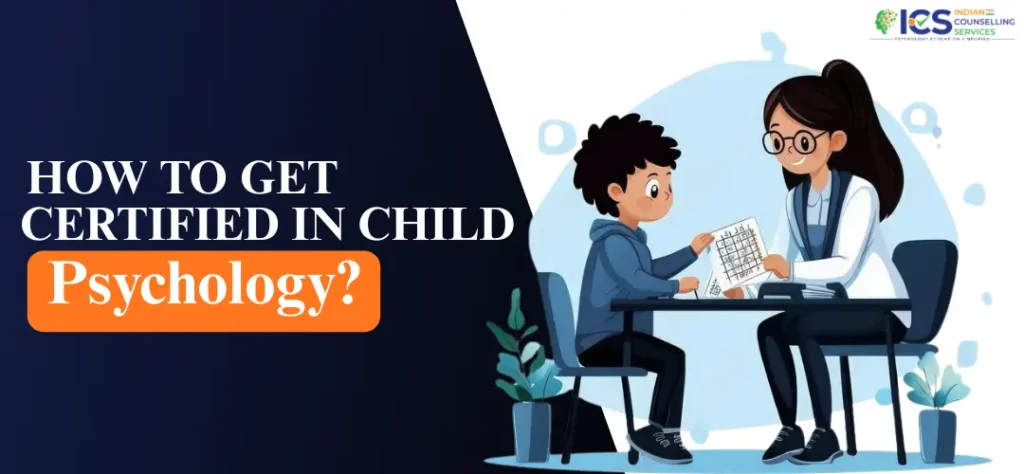
Child psychology has become one of the most valuable and sought-after careers as the awareness of children’s mental health in India rises. Early emotional and behavioural support of children is becoming an important concern, known to parents, schools, and healthcare institutions. Because of this, a valuable question is currently posed by a great number of potential professionals:
What is the way to become certified in child psychology?
This will depend on your education, career objectives, and the age group to which you would wish to work. Child psychology is an area of specialisation, and certification is more than a credential to possess; it is the acquisition of the appropriate skills to practice ethically and effectively with children and families.
What Does Certification in Child Psychology Mean?
Certification in child psychology is about the official training, which prepares you with the knowledge and practical skills to understand the emotional, cognitive, and behavioural development of children. Child psychology is very specific, unlike general psychology, which deals with the period of infancy, childhood, and adolescence.
Certification is not necessarily always a license issued by the government in India. Rather, it tends to be doing a recognised academic degree or a professional training program that equips you to practice within a specified scope.
Who Can Pursue Child Psychology Certification?
The most widespread stereotype is that child psychology can be studied only by psychology graduates. A background in psychology is, though not always, necessary in certification-level programs.
This field receives persons of various backgrounds, including:
- Graduates in psychology, education, social work, or healthcare who want to specialise in child mental health.
- Teachers and educators who desire to help students outside of academics.
- The parents, caregivers, or professionals who have already dealt with children and wish to have the structured training.
Your course of entry will dictate the kind of certification that will be most appropriate to you.
Academic Route: Degree-Based Certification
The conventional path to child psychology entails academic degrees. This is a more established route that is more time-consuming.
Typically, this route includes:
- A degree in psychology or a related discipline is required to acquire background knowledge.
- Specialisation in child psychology, developmental psychology, or counselling psychology.
This career route is perfect for individuals interested in long-term academic recognition or who intend to practice in hospitals, clinics, or research institutions. Nevertheless, it is not the quickest way to certification.
Professional Certification Courses: A Practical Alternative
Professional certification courses are more flexible for individuals who wish to join the field earlier or include child psychology skills in their current career.
Such programs are based on practical application as opposed to academic theory only. They are made in such a way that they enable the learners to get to know the emotional needs, behaviour of children, and their styles of communication.
By taking a formal Child psychology course, the learners are able to acquire the skills that they really need without the need to invest in the very long learning schedules. Teachers, counsellors, and working professionals are the ones who are particularly fond of such programs.
What Do Child Psychology Certification Programs Usually Cover?
A quality certification program is not a surface-level program. It trains students to be responsible in dealing with children and families.
The majority of quality programs entail:
- The knowledge of child developmental stages and emotional developmental milestones.
- Distance training in the observation of behavioural and emotional issues in children.
- Methods of effective communication with children of various age groups.
- Ethical issues and limits when working with minors.
It is this practical orientation that renders certification programs useful in practical application.
Online vs Offline Certification: Which One Is Better?
There are a number of certifications in child psychology now available online in India, due to the emergence of online education in India. These two formats are both good, and it is up to you based on your lifestyle and learning style.
Online certification is effective since:
- It gives flexibility to both professional and student workers.
- Instead, individual schedules can be used in learning.
- Most of the programs feature live sessions, case discussions, and mentorship.
Offline programs can provide more face-to-face contact; however, it might be necessary to have a schedule and to move around. To a large number of learners, online certification offers them optimal accessibility to quality.
How Long Does It Take to Get Certified?
The time taken for certification is different with the kind of program you take.
In general:
- Degree courses can take between five to six years, and this encompasses undergraduate and postgraduate courses.
- Depending on levels of detail and organization, professional certification programs may take a few months or up to a year.
When you want to become employed with children as soon as possible, certification programs provide a much more expedited and direct route.
Career Opportunities After Certification in Child Psychology
The certification will lead to numerous child-oriented jobs. Although the extent depends on the level of training that you have, even at the certification level, there are several opportunities that you can get.
Qualified professionals tend to be:
- In learning centres or schools, child counsellors.
- Behavioural support professionals in clinics or NGOs.
- Parenting coaches or child development facilitators.
Other professionals opt to establish personal practices or cooperate with teachers and medical practitioners.
Important Ethical and Professional Considerations
There is a lot of responsibility when dealing with children. Acquiring skills is not the sole thing in certification- it is practicing ethically.
Any child psychology specialist-in-the-making should realize that:
- It is necessary to work within the area of training to ensure child safety.
- Professional competence is enhanced with continuous learning and supervision.
- It is usually required to work with parents, teachers, and healthcare professionals.
Technical skill is not as crucial in this field as ethical awareness.
Choosing the Right Certification Program
The quality of certification programs is not equal. One should consider the program before admission.
A good child psychology certification must include:
- Have a systematic curriculum and not disjointed subjects.
- Emphasise practical application and real-life scenarios.
- Raise ethical standards and child protection.
Program selection: To make sure that your certification is useful and professionally valuable, you need to select the right program.
Final Thoughts
Certification in child psychology is a strong move towards helping children to be emotionally and psychologically well. Regardless of the path you pursue, be it a degree program or a professional certification, the most important thing is to ensure that the decision you make reflects your objectives, experiences, and willingness to work with the children.
To those who want to be flexible, pragmatic, and gain access to the field faster, taking a structured course in Child psychology will be responsible and efficient.
Finally, certification is not only about credentials, but it is also about becoming an ethical, talented, and trustworthy professional in the life of a child.