In 2026, discussions about mental health are getting increasingly scientific and psychological. Individuals don’t simply want the words “just think positive” anymore. But they would like to know more:
What is it about psychotherapy that actually alters the brain?
One of the most researched answers to this question is Cognitive Behavioral Therapy (CBT). CBT is effective in the treatment of anxiety, depression, trauma symptoms, stress disorders, and numerous other psychological issues, with consistent success.
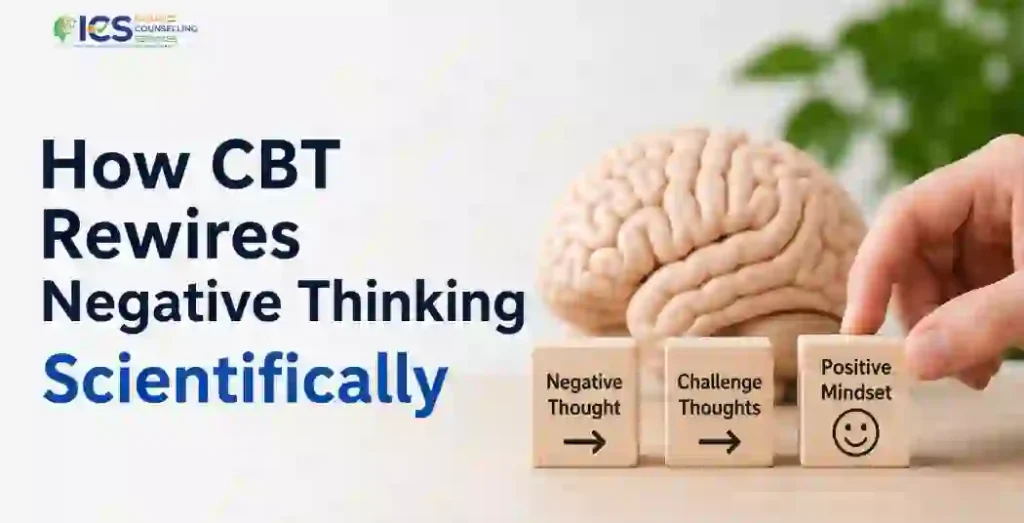
The beauty of CBT is that, over time, CBT rewires negative thinking patterns, rather than just making the person feel better in the moment. CBT can help to modify the way the brain reacts to emotions, thoughts, and behaviors over time by using psychological structures.
Many CBT training certifications will include the scientific connection between thoughts, behaviours, feelings, and neural pathways and mental health.
So, let’s see how CBT rewires negative thinking patterns to work scientifically.
How to CBT Work?
CBT is a systematic, psychological treatment that involves awareness of the relationship between:
- Thoughts
- Emotions
- Behaviors
- Physiological responses
CBT is based on the very simple idea of:
How individuals react to situations has a great impact on how they feel and act.
That is, feelings of emotional suffering may be related not just to events, but to the thoughts that people have about those events.
For example:
- “I made a mistake, so I’m a failure.”
- “Nobody replied to my message because they dislike me.”
- “If something goes wrong, everything will collapse.”
These thought patterns may feel automatic, but one reason CBT rewires negative thinking effectively is that it teaches individuals to identify, question, and gradually change these patterns.
The Science Behind Negative Thinking
The Brain Learns Through Repetition
One major reason why CBT rewires negative thinking is connected to neuroplasticity, the brain’s ability to adapt and reorganize itself.
Neuroplasticity is the phenomenon that the brain is constantly creating and strengthening neural pathways as a result of repeated experiences, thoughts, and behaviors.
In simple terms:
- Thoughts that are repeated often are stronger neurological patterns.
- With practice, emotional responses will become more automatic.
- The brain gets really good at conducting known mental processes.
That is why it can become second nature to think negative thoughts and sometimes become out of your control.
If a person continues to say to him or herself:
“I’m not good enough.”
The more it’s practiced, the stronger the brain makes it.
Eventually, during times of stress, criticism, or uncertainty, the thought can operate automatically.
How Negative Thought Loops Affect Mental Health
Ruminating on negative thoughts impacts more than just one’s mood.
The more cognitive distortions that occur, the more they can escalate:
- Emotional hypervigilance and anxiety.
- Hopelessness and helplessness in situations.
- Avoidant behaviours and social withdrawal.
- The release and activation of stress hormones in the nervous system.
The brain begins to anticipate a threat, rejection, or failure, even when there is no actual threat, rejection, or failure.
This is one of the core reasons why CBT Rewires Negative Thinking by interrupting these harmful neurological and behavioural cycles.
Why CBT Is Especially Relevant in 2026
Cognitive overload is caused by:
- Comparing and overstimulating with social media.
- Chronic Stress & Performance Pressure.
- Too much information and too many unknowns.
- Exhaustion and burnout.
These kinds of environments can exacerbate negative thinking cycles much more.
This is why CBT rewires negative thinking and remains highly relevant today; it teaches individuals practical skills for managing stressful thoughts without becoming trapped in them emotionally.
Learning Through a CBT Training Certification
A structured CBT training certification may include introducing students to one or more of the following:
- Thoughts and thought distortions; thought restructuring.
- Behavioral intervention/exposure strategies.
- Skill deficits in the control of emotions and coping.
- Understanding of the scientific principles of cognitive and behavioural psychology.
This training is important for mental health practitioners, counsellors, coaches, and anyone interested in the evidence-based psychological approaches.
Common Misconceptions About CBT
CBT Is Not “Forced Positivity”: CBT does not involve ignoring or denying reality or emotions.
Rather, it enables people to have more well-rounded and correct interpretations.
CBT Is Not Instant Brain Rewiring: Repetition, consistency, and practice over time will change neural pathways.
CBT Does Not Eliminate Negative Thoughts Completely: The goal is not perfection, but to increase emotional flexibility and reduce distortions in thinking.
Final Thoughts
Repeated thoughts, behaviours, and emotional responses have a profound impact on the way the brain changes. This is one of the reasons why CBT rewiring negative thinking has worked so well.
Negative thinking patterns can get entrenched over time and be more than just temporary. Awareness, cognitive restructuring, behavioural change and repetition allow the brain to slowly create new pathways of emotional and mental health.
That is why CBT has remained one of the most accepted evidence-based therapies in contemporary psychology.
Healing the mind is not a denial of the negative thoughts. It’s about educating the mind not to take all fear-based thoughts as gospel.
FAQs (Frequently Asked Questions)
What does CBT do scientifically?
CBT technique that can change the functioning of the brain by changing repetitive thought patterns and behaviors.
Can the brain really change through therapy?
Yes, over time, the brain does form new neural connections; this is what is called Neuroplasticity.
How long does CBT take to work?
Some variability of results can be seen, but over time, with practice, there can be an improvement in emotion and cognition.
What is taught in a CBT training certification?
This typically involves behavioural management, emotional control, cognitive re-structuring and therapy methods based on facts.