
Cognitive Behavioural Therapy (CBT) may offer the solution you’ve been searching for to manage your thoughts, emotions, and behaviours more effectively. At its core, CBT is a present-focused therapy that helps individuals understand the interrelatedness between thoughts, feelings, and actions, as well as changing patterns or behaviours that lead to improvements in feelings and outcomes. CBT goes far beyond simply speaking – its focus lies on problem-solving techniques as well as learning new abilities that improve daily living.
CBT boasts an intriguing history. It has its roots in two earlier approaches – behavioural therapies and cognitive therapies – but over time, their ideas merged to become the comprehensive therapy we know as CBT today, creating one powerful solution to mental wellbeing.
Reasons behind CBT’s widespread application can vary; evidence-based therapies like Cognitive Behavioural Therapy have their place. As CBT works well against multiple conditions and its practice has proven its worthiness in numerous studies, its widespread adoption makes sense. CBT works through providing practical strategies that empower you to take charge of and make positive changes in your life.
Add Your Heading Text Here
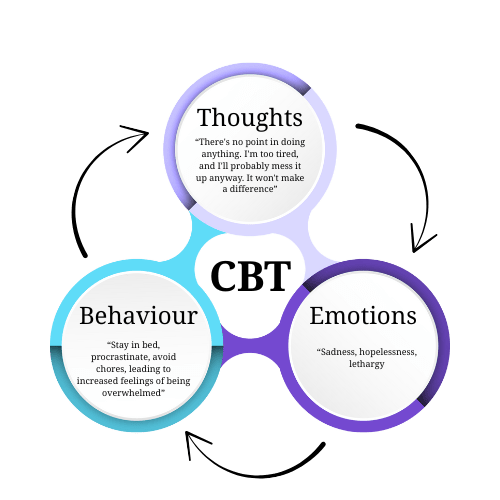
So, how exactly does CBT work? At its heart lies one simple and powerful idea: the Cognitive Triangle model. This outline shows us the intimate interdependency among three core aspects of human experience – thoughts, emotions, and behaviours. According to this model, these components constantly interact. Imagine it like three corner points on an invisible triangle where every corner affects the other two corners simultaneously:
- Thoughts – Our thoughts can include any ideas, beliefs, or images that come into our mind automatically and without thought – for instance, “Oh no, something must have gone wrong here!” (This would be considered negative thinking).
- Emotions –Our emotions encompass feelings like happiness, sadness, anger, anxiety, and excitement that often stem from thoughts. Anxious or stressed? Your stomach might even begin churning! These can all lead to strong emotional states in us that lead to physical reactions like nausea.
- Behaviors – Our behaviours consist of all the actions that we perform or fail to take, whether that means acting upon emotions and thoughts directly. For instance, delaying opening an email could make you even more anxious than before! Trying not to check emails could only compound matters further and can make matters even worse.
List of 10 Common CBT Techniques
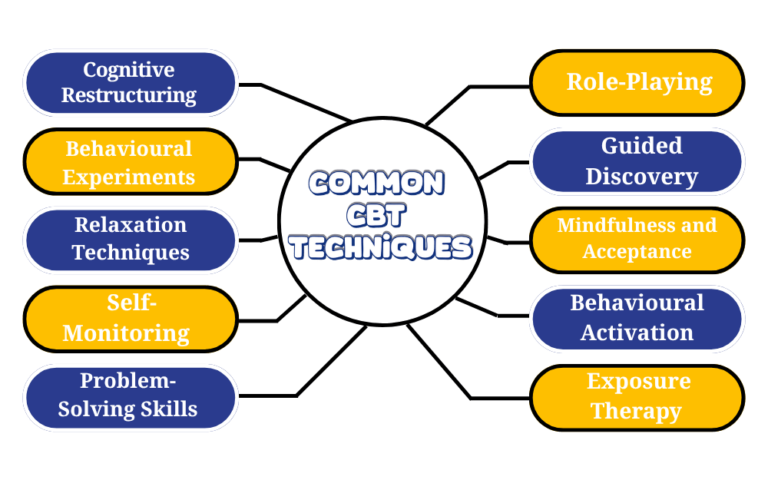
CBT employs various practical methods known as Cognitive behavioural Therapy techniques that can be used to alter unhelpful thoughts and behaviours, helping change them for good. Understanding its workings means familiarizing oneself with these tools – these differ from other CBT types as they offer direct assistance; here is a list of frequently utilized CBT techniques.
- Cognitive Restructuring – CBT employs cognitive restructuring as one of its core elements to identify and challenge unhelpful thoughts that make us feel bad, such as all-or-nothing thinking or always expecting the worst. You will learn to recognize “cognitive distortions”, such as all-or-nothing or always expecting failure; for instance if your mindset says: “I always mess everything up,” cognitive restructuring provides tools that help find evidence against this belief; for example looking back over moments where things did go well to replace this unhelpful thought with something more balanced thereby replacing it with something unhelpful with something constructively more helpful.
- behavioural Experiments – behavioural experiments allow you to conduct controlled trials that test your beliefs. Say you believe people will judge you for speaking up; using behavioural experiments enables you to see whether this belief holds up under close observation, often without producing any negative consequences, helping shift underlying perceptions that shape our belief systems and allow change from within.
- Exposure Therapy – Exposure Therapy is often employed for anxiety disorders and phobias. The therapy works by gradually facing down your fears by progressively exposing yourself to their source. Step-by-step exposure might involve looking at pictures or watching videos featuring dogs; eventually leading up to being near or even being physically near them altogether in an effort to reduce anxiety over time.
- Relaxation Techniques – Relaxation techniques help manage physical signs of stress and anxiety. When stressed, our bodies tense up; deep breathing techniques such as deep abdominal breathing can be very effective at soothing our nervous systems, and progressive muscle relaxation involves contracting then relaxing different muscle groups until tension releases in your body, reducing overall levels of stress. These strategies work wonders in relieving anxiety.
- Problem-Solving Skills – Learn structured ways of approaching challenges effectively using problem-solving skills. Many people can feel overwhelmed when facing problems; using this technique breaks them into smaller, manageable steps that make life simpler and reduce anxiety. First, you define the issue clearly before brainstorming possible solutions, considering each carefully before choosing and testing one solution, providing an empowering way of meeting challenges effectively.
- behavioural Activation – behavioural Activation can be very effective against depression. Being depressed often makes us stop enjoying our favorite activities. With behavioural Activation, you’re encouraged to schedule positive activities like taking a walk or meeting up with a friend into each day as part of this approach to helping reduce feelings of helplessness. This helps break the cycle of inaction and low spirits.
- Mindfulness and Acceptance – Mindfulness and Acceptance involve staying present. By learning to observe thoughts and emotions without judgment or forceful manipulation, we can help ourselves accept difficult experiences more readily while diminishing negative thoughts over time. This approach reduces fighting negative thoughts, which often makes them weaker over time.
- Role-Playing – Role-playing provides you with a safe space in which to practice new skills. Your therapist suggests practicing difficult conversations as a means of building your confidence for real-life encounters; alternative approaches include communicating and reacting differently so you feel ready when faced with real situations.
- Guided Discovery – Guided Discovery is a therapy technique in which your therapist guides you to find answers on your own. Instead of telling you what they think, Guided Discovery uses questions to lead the discussion forward; for instance, if you feel stuck, the therapist might pose this question: ‘What have you tried in the past that helped?” This enables you to think critically and solve problems independently.
- Self-Monitoring – Monitoring yourself includes tracking thoughts, feelings, and behaviours using either a diary or an app. For instance, noting when anxiety flares up is helpful because it allows you to record exactly what was on your mind at that exact moment in time. This can increase awareness about how your internal world functions, making you aware enough to begin making necessary changes in it.
Use Cases of CBT In Practical Situations
CBT is a highly flexible therapy. It helps people with many challenges. It is not just for one specific problem. Instead, its core principles can be used in various situations. Let’s explore some everyday use cases of CBT.
- Anxiety Disorders like General Anxiety Disorders (GAD), Panic Disorders, Social Anxiety, Phobias, and Obsessive-Compulsive Disorders (OCD)
- Mood Disorders like depression, negative thoughts, and Bipolar disorders.
- Eating Disorders, which include Anorexia Nervosa, Bulimia Nervosa, and Binge Eating Disorder.
- Substance Use Disorders aim to reduce the use of alcohol and drugs.
- Post-Traumatic Stress Disorder (PTSD)
- Chronic Pain Management to reduce emotional distress linked to chronic pain.
- Sleep Disorders (Insomnia)
- Anger and Stress Management
- Relationship Problems
Want To Become An Expert In CBT?
You’ve learned a lot about CBT today. We explored its workings and its different forms and techniques; now you understand its true power to transform lives, helping individuals manage thoughts, emotions, and behaviour more efficiently. Do you feel inspired by its power or excited to expand on what you know? Using these skills to assist others might be what drives your desire.
Indian Counselling Services has the ideal solution. With our online CBT course, you will learn all about its core principles, master its techniques, and gain a greater understanding of its various forms. Furthermore, this can serve as your initial step on becoming a certified CBT practitioner; however, this may also require educational degrees and qualifications as part of its requirements.
Imagine applying these skills in real life; imagine being able to empower and guide other individuals toward improved mental wellbeing. Join our course now and begin your journey!