
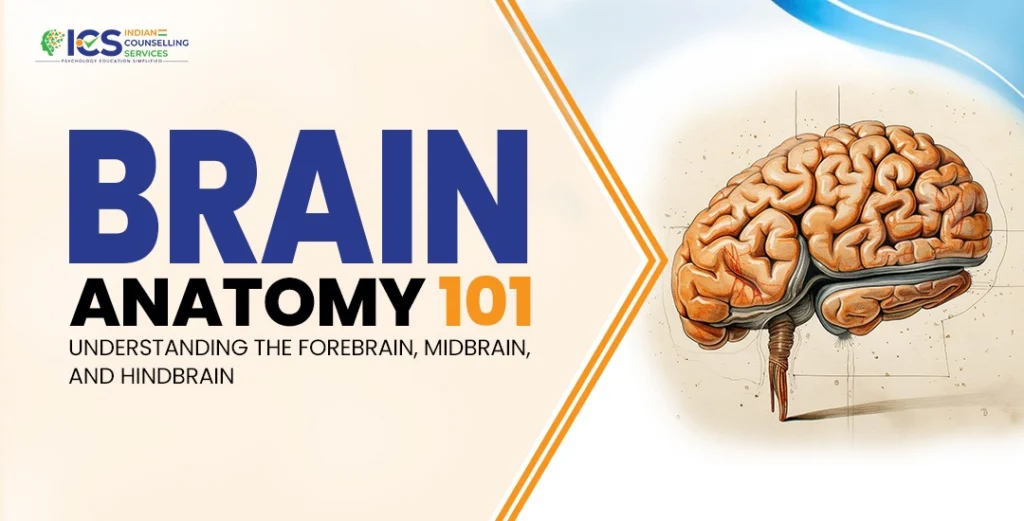
The human brain is a confusing concept to understand, but once it is divided into three main parts, it becomes much less daunting. Each of the forebrain, midbrain, and hindbrain is involved in different functions; nevertheless, they are integrated so that they coordinate your thoughts and emotions, amongst other things, including your breathing and movement.
In the future, when neuroscience and mental health remain at the center of interest, it appears necessary to have a background in brain anatomy, not only among students, but among any other person interested in human behavior. These concepts are studied in-depth by many learners who embark on this path with some structured programs, such as psychology diploma courses.
The Big Picture: How the Brain Is Organized
On a fundamental level, the brain is broken down into three major parts:
- The higher thoughts, feelings, and decision-making are done in the forebrain.
- The midbrain is a relay center, and it controls the simple motor functions.
- The hindbrain controls important aspects of life, such as breathing and heart rate.
The specialized structures are found in each region, but they are so closely interrelated that your body and mind can work as a system.
The Forebrain: The Center of Thought and Emotion
The largest section of the brain is the forebrain, and the most complex. It is the one that makes us uniquely human, i.e., we are able to think, feel, plan, and create.
Key Structures and Functions
The forebrain includes:
- Cerebrum: It is the biggest section of the brain, which is segmented into two halves. It regulates rational thinking, speech, memory, and free movement.
- Thalamus: This is a sensory relay station, which conveys information to the relevant sections of the brain.
- Hypothalamus: The hypothalamus is in charge of internal equilibrium (homeostasis), ensuring hunger, thirst, temperature, and hormones.
- Limbic System: This is a combination of structures, which are the amygdala and hippocampus, that form part of emotions and memory.
Why It Matters
Decision-making and processing of emotions take place in the forebrain. This is an active part of the brain whether you are resolving a problem, remembering something, or you are reacting emotionally.
The Midbrain: The Brain’s Communication Hub
The midbrain is found between the forebrain and the hindbrain, but it is very important.
Key Functions
- Plays the role of a visual and aural switchboard.
- Regulates the movement of the eyes and body responses.
- Supports motor coordination.
- Contributes towards alertness and consciousness.
Key Structures
- Superior and Inferior Colliculi: Process sound and visual stimuli.
- Substantia Nigra: It is the part that is associated with movement and reward pathways.
- Reticular Formation: The reticular formation controls wakefulness and attention.
Why It Matters
The midbrain makes sure that your brain is fast in reacting to environmental stimuli. Indicatively, when you turn your head as a result of a sudden sound, it is nearly immediate, courtesy of this area.
The Hindbrain: The Life-Sustaining Center
The hindbrain deals with the simplest and most fundamental activities that keep you alive.
Key Structures and Functions
- Cerebellum: Coordinates movement, balance, and posture.
- Pons: This is a bridge between the various sections of the brain, and it controls sleep.
- Medulla Oblongata: Regulates the important processes, namely breathing, heart rate, and blood pressure.
Why It Matters
The brain would not be able to survive without the hindbrain. It is rather automatic, and your body remains active even in circumstances when you do not consciously think about it.
How These Three Regions Work Together
This is because even though the regions have their respective roles, they do not act independently.
- The hindbrain is what keeps you alive through the management of the vital functions.
- Sensory input is processed by the midbrain and promotes rapid reaction.
- It is the forebrain that interprets the information and makes a decision according to which we act.
As an illustration, when you feel anything hot:
- The hindbrain takes care of the reflex to draw your hand back.
- The midbrain interprets the signal sent via the senses.
- The forebrain deciphers the pain and reminds you not to repeat it later.
This integration gives emphasis to the dynamic nature of the brain.
Why Understanding Brain Anatomy Is Important in 2026
Neuroscience is becoming increasingly relevant due to the growing awareness of mental health.
Understanding brain regions helps you:
- Be aware of the way thoughts and emotions are shaped.
- Learn to better comprehend mental illnesses.
- Develop better learning and memory techniques.
- Learn to be more emotionally regulated.
The basic knowledge acquired in psychology diploma courses might be a gateway to a career in counseling, research, and healthcare, both for students and professionals.
Real-Life Applications of Brain Knowledge
The study of the brain is not merely a theoretical one, but it has its practical advantages.
- Mental Health Awareness: The knowledge of the functionality of various brain areas might aid in the detection of anxiety or depression symptoms or the signs of neurological diseases.
- Improved Learning: Understanding the way that the brain processes information can improve study methods.
- Better Decision-Making: Decision-making processes of the emotional and rational brain are more balanced when one is aware of the processes.
- Enhanced Communication: Interpreting human thoughts and reactions helps to advance interpersonal relations.
Common Misconceptions About the Brain
In spite of the increased awareness, there are a number of myths.
- “We only use 10% of our brains” — This is not true; most of the parts of our brains are active during the day.
- “Left-brained vs. right-brained people” — Functions are partially specialized, but they are highly interdependent.
- “Brain functions are fixed” — There is a myth that brain functions are fixed, and thus, the brain is highly adaptable because of neuroplasticity.
Knowing the fundamentals will enable one to distinguish between science and myths.
The Future of Brain Science
With recent developments in neuroscience, the field of neuroscience is changing the way we comprehend behavior, mental health, and cognition in 2026.
Emerging areas include:
- Brain-computer interfaces
- Mental health diagnostics based on AI.
- Neural patterns-based personalized therapy.
The beginning point of the exploration of these exciting developments is a good background in brain anatomy.
FAQs (Frequently Asked Questions)
What is the main difference between the forebrain, midbrain, and hindbrain?
The forebrain is responsible for thinking and feeling, the midbrain for receiving senses and reflexes, and the hindbrain for managing life-related processes.
Which part of the brain controls emotions?
Emotional processing is largely the contribution of the limbic system of the forebrain, the amygdala, in particular.
Is the brain capable of change over time?
Yes. The brain is able to learn how to change and restructure through the process of neuroplasticity.
Why is the hindbrain important for survival?
It regulates vital body processes such as heart rate and breathing, without which one cannot live.