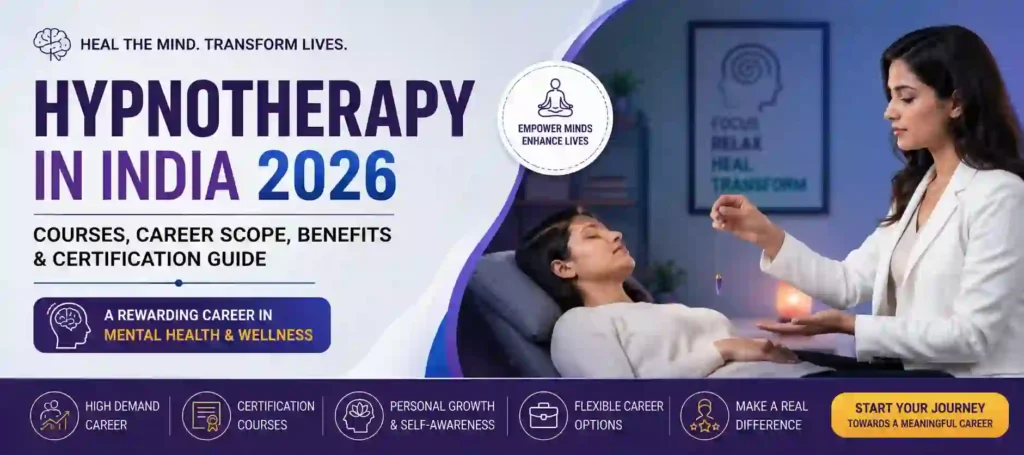
Have a fascination with healing power of subconscious mind since you were a kid? Present-day psychology is also using hypnotherapy as a burgeoning approach to treat mental, emotional, and behavioral issues in people through the use of hypnosis techniques.
It is commonly employed in therapy to treat anxiety, stress, pain, addiction and enhance self-esteem. Contrary to popular belief, hypnotherapy is not about mind control, loss of awareness or other misconceptions, but is an ethical, client-driven therapy.
Market research shows that the global wellness sector linked to hypnosis is anticipated to increase rapidly over the next few years, with an improving requirement for trained professionals.
For those who want to make this a career, this guide will help you understand everything about hypnotherapy, its scope and how you can start your journey in 2026.
What is Hypnotherapy?
Hypnotherapy is a type of psychotherapy that involves using hypnosis as a technique to create a relaxed and concentrated mental state. This state makes positive suggestions more accepted by the client for behavioral/emotional change.
It is commonly used by psychologists and counselors for:
- How to deal with anxiety and stress
- Pain control
- Sleep disorders
- Addiction recovery
- Emotional trauma healing
In sessions, techniques such as deep breathing, guided imagery and focused attention are utilized to safely enter into the subconscious mind.
History of Hypnotherapy
In the 1800s, James Braid coined the term “hypnosis” and broke the term down into two components: psychological and mystical.
The previous versions of hypnosis were associated with stage shows and misguided techniques. Today’s hypnosis is not a random, unethical and unscientific practice, however; it is a disciplined, ethical and scientific method.
Current Hypnotherapists operate in a collaborative fashion, allowing full awareness and participation, with the client.
Use cases of Hypnotherapy
In a number of psychological and behavioral conditions hypnotherapy is utilized, such as:
- Phobias and fears
- Childhood trauma
- Relationship issues
- Addictions – smoking, overeating, etc.
- Stress and anxiety disorders Sleep problems
- Chronic pain management
- Emotional regulation
It is also used as a way to relax and promote overall mental health and self-awareness.
Is Hypnotherapy Safe?
Hypnotherapy is safe, if it is administered by a trained and certified professional.
There are a number of key safety principles:
- Client is fully informed and in control.
- There is no mind control or manipulation.
- Therapy will be collaborative and will be goal oriented.
- Ethical guidelines are adhered to
Ideas such as “loss of consciousness” or “brainwashing” are incorrect and do not fit with contemporary psychology.
The advantages of learning Hypnotherapy in 2026 are numerous.The benefits of learning Hypnotherapy in 2026 are many.
1. High Career Demand: Mental health professionals are in increasing demand worldwide and certified hypnotherapists are in a very good position to secure jobs.
2. Skill Expansion: It improves your psychology, counselling and therapeutic competencies, and increases your flexibility in the mental health arena.
3. Flexible Career Options: Opportunities are available in clinics, hospitals, wellness centers and even as a private practice.
4. Effective Client Results: Hypnotherapy may be more effective than some traditional methods in generating a deeper and quicker emotional healing.
5. Personal Growth: Hypnotherapy also boosts your self-awareness, emotional intelligence and mental clarity.
The process of becoming a Certified Hypnotherapist in India is straightforward.One can become a Certified Hypnotherapist in India very easily.
To get to be a professional Hypnotherapist in India:
- Take a psychology or counseling foundation course
- Take a certified hypnotherapy training course Develop practical skills such as induction and subconscious work.
- Develop skills in practical work such as induction and subconscious work.
- Gain supervised practice experience
- Get a certificate from a well-known organization
Structured Hypnotherapy Training and Certification programs are available from institutes such as Indian Counselling Services (ICS) where training is provided and structured.
What are the career opportunities following hypnotherapy course?
Once certified, you can become:
- Clinical Hypnotherapist
- Wellness Coach
- Counselling Psychologist (specialization)
- Mental Health Practitioner
- Private Practice Consultant
FAQs (Frequently Asked Questions)
Does hypnotherapy work?
Hypnosis is supported by psychological research and is used in the clinical and therapeutic setting.
Is it possible for everyone to learn hypnotherapy?
Yes, it is possible to learn it by certified courses, even students, psychologists, counsellors and beginners in psychology.
Is there any loss of control with hypnosis?
No, the client(s) are always fully aware and cannot be compelled to do anything.
How long will it take you to become a hypnotherapist?
It varies from course to course, but most hypnotherapy certifications can be earned in a matter of few months to a year.
Is Hypnosis a good career choice in India?
Yes, hypnotherapy is a potential career in India as mental health is now becoming popular.