
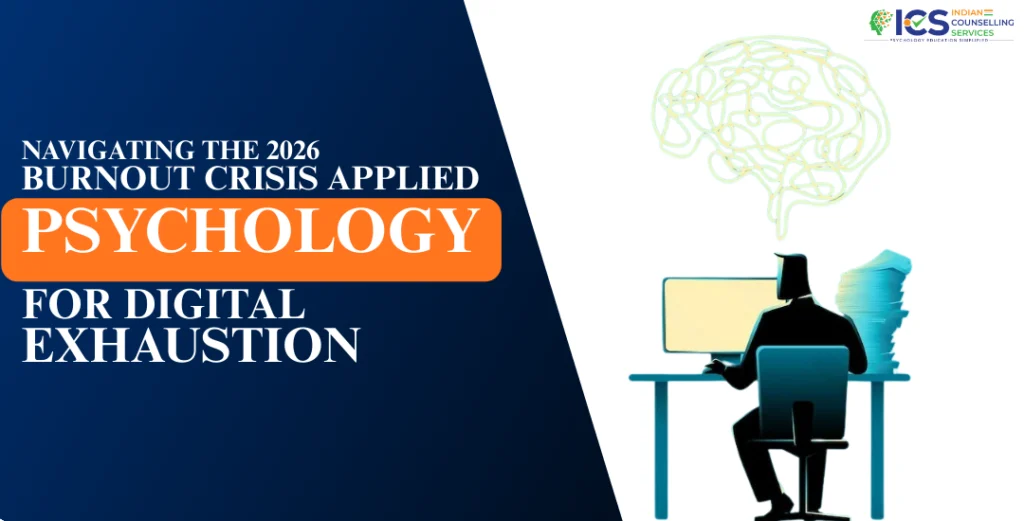
In 2026, burnout will be quite different from what it was ten years ago. It is no longer associated with overworking or the full day in the office, but rather is tightly linked to the continuous exposure to digital devices, the blurring of work and life, and cognitive overload. Such contemporary exhaustion cannot be addressed by generic self-care suggestions only. Evidence-based approaches to digital burnout can be applied to prevent, recover, and understand it sustainably with the help of applied psychology.
In this blog, the author discusses the use of applied psychology in explaining and understanding digital exhaustion, and how structured learning applied to professional psychology certified programs prepares individuals to respond to burnout.
Understanding Digital Burnout in the 2026 Context
Technology does not bring about digital burnout, but the mind that is overloaded with constant stimulation.
What Makes Digital Burnout Different from Traditional Burnout
- Digital burnout is a cognitive load that may occur due to prolonged physical fatigue, but not the reverse.
- Notifications, multitasking, and screen time do not allow the nervous system to be put into restorative states.
- Lack of boundaries in work, rest, and social interaction enhances emotional depletion.
The field of applied psychology is concerned with the way that such patterns come into play to interfere with attention, motivation, and emotional control.
The Psychological Mechanisms Behind Digital Exhaustion
Burnout is a psychological process and neurological, but not a failure.
Key Psychological Factors Driving Digital Burnout
- The long-term cognitive load overworks the working memory and impairs mental flexibility in the long run.
- Motivation and reward processing are impaired due to dopamine dysregulation that occurs as a result of continuous digital stimulation.
- Continued activation of stress triggers leaves the nervous system in the high alert position, where it is unable to relax.
Knowing these mechanisms means that one can have focused interventions and not superficial solutions.
Applied Psychology’s Role in Burnout Prevention
Applied psychology is the translation of theory into practical strategies, which are compatible with new digital lifestyles.
How Applied Psychology Addresses Burnout
- It assists people in determining behavioral patterns that lead to mental exhaustion and apathy.
- It applies evidence-based models to redesign habits of routines, attention, and responses to emotions.
- It focuses on prevention and early intervention as opposed to crisis management.
Such skills are being introduced in the form of specialty psychology certifications that deal with mental health and behavioral science in the workplace.
Digital Exhaustion in Workplaces and Education
Burnout has ceased to be a preserve of intense careers.
Where Digital Burnout Is Most Visible in 2026
- Remote and hybrid workers have prolonged screen time and little psychological distance between work and family.
- Students have to contend with unremitting digital learning conditions without much mental rest.
- Emotional labor and incessant digital reports are controlled by care professionals and knowledge workers.
Applied psychology assists organizations in re-engineering systems that conserve mental energy but do not consume it.
Evidence-Based Strategies to Manage Digital Burnout
It takes deliberate psychological treatments to recover.
Practical Applied Psychology Techniques
- Cognitive setting of boundaries assists people in distinguishing between work identity and personal identity in online worlds.
- The behavioral activation strategies restore motivation with well-organized values-based actions.
- Balance between recovery and stimulation is restored by using nervous system regulation techniques.
These practices are commonly trained in professional psychology qualifications targeting burnout prevention and mental hardiness.
Why Generic Self-Care Is No Longer Enough
Rest or motivation cannot be a sufficient part of burnout recovery.
Limitations of Surface-Level Solutions
- Brief interlocutors fail to deal with the underlying patterns of cognitive overload.
- Hacks about productivity tend to put more pressure instead of lessening it.
- The trends of wellness do not take into account the personal psychological variations and reactions to stress.
The school of thought of applied psychology is on the long-term change of behavior rather than the short-term alleviation.
The Growing Importance of Psychology Certifications in 2026
Mental health literacy is emerging as a professional requirement.
How Certifications Support Burnout Management
- The field of psychology certifications offers organized knowledge of stress, mental, and emotional management.
- They prepare professionals to identify burnout indicators at an early stage, both in themselves and others.
- Training that is based on certification encourages ethical and evidence-based intervention as opposed to guesswork.
With burnout turning into a community health issue, professional psychological understanding is gaining prominence in all fields.
Burnout, Identity, and Meaning in the Digital Age
Burnout is usually indicative of underlying psychological battles.
Psychological Questions Burnout Forces Us to Ask
- Does one value unlimited access to everything?
- Has being productive substituted purpose as a definition of self-worth?
- Are digital habits supporting or eroding emotional well-being?
Applied psychology is useful in assisting people to realign effort with purpose as opposed to fatigue.
Building a Sustainable Digital Life Using Psychological Principles
It is better to prevent than to cure.
Long-Term Psychological Adjustments
- A planned set of routines built on digital helps to alleviate decision fatigue and mental clutter.
- Emotional intelligence enhances stress detection at the onset of burnout.
- Creating restorative habits supports long-term cognitive health and resilience.
The principles play a pivotal role in applied mental training and psychology certifications in contemporary stress management.
Final Thoughts
The 2026 burnout crisis is not an indicator of personal manifestation of weakness- it is one of the consequences of untamed digital overload. Applied psychologist provides a science-based solution to solving and reducing the causes of digital exhaustion. Learning to combine cognition, emotion, and behavior in the digital environment allows individuals and organizations to come out of survival mode. Due to systematized learning and corresponding psychology credentials, an individual can overcome burnout in a clear, compassionate, and long-lasting way.
FAQs (Frequently Asked Questions)
What is digital burnout?
Digital burnout refers to a state of mental and emotional fatigue, which is triggered by a state of uninterrupted cognitive load and continuous digital stimulation.
How is digital burnout different from stress?
Stress is very temporary, and on the other hand, burnout is longstanding; it influences motivation, concentration, and emotional stability.
Can applied psychology really help with burnout?
Yes, there are evidence-based tools provided in applied psychology to transform behaviors, control emotions, and alleviate cognitive overload.
Are psychology certifications useful for burnout prevention?
The certifications of psychology provide a systematic, problem-solving approach that assists people in identifying, handling, and avoiding burnout.
Is burnout a mental health condition?
Burnout is not a clinical diagnosis, but when severe, it can have a serious effect on mental health and requires a psychological intervention.