
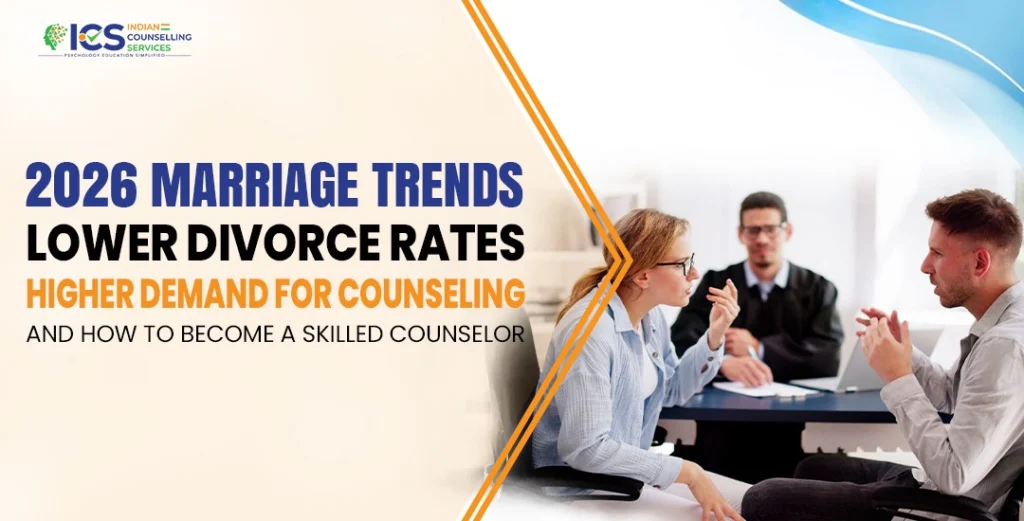
Some changes in marriage display more social and psychological transformations. Although the trend in the earlier decades tended to point to the increased divorce rates, current trends point to a more complicated scenario. The current couples are becoming more deliberate, emotionally conscious, and open to seeking help when things go wrong in their relationship. Consequently, a steady rise in divorce is being noted to be slowing down or even decreasing, even in certain areas, according to most professionals.
Meanwhile, we have experienced an increased demand for relationship support. The couples are not waiting until a crisis strikes to seek professional assistance; instead, most of them are considering counseling as a proactive investment in the relationship’s health. This cultural shift is providing solid prospects for professionals trained in marriage counselling, as talented counselors become increasingly significant in helping couples develop strong partnerships.
We shall examine the major marriage trends that will define the year 2026 and their implications for anyone who wants to pursue a career in relationship counseling.
Contemporary marriage is not so socially obligatory but rather emotionally compatible.
- Before committing themselves, partners are taking more time to learn about values, styles of communication, and long-term objectives.
- EI is emerging as one of the primary variables in relationship satisfaction.
Such a deliberate course of action usually results in longer-lasting foundations, which make impulsive separations unlikely. Nevertheless, the fact that they have more emotional expectations also implies that couples need to have the means of conflict management better equipped for conflict management, and this is where trained counselors come in.
Marriage counselling practitioners who take up a marriage counselling course understand how to steer couples towards more amicable communication habits and retain the respect of both parties.
It is one of the most important relationship changes, that are the normalization of early intervention.
- A lot of marital counseling is currently undertaken by many couples before they get married to set realistic expectations.
- There are those who come to sessions at a time of transition, like parenthood, relocation, or a change of career.
Preventive counseling lessens the accumulated resentment that is not resolved and enhances the ability to solve problems.
This proactive attitude is a symptom of a larger mental health culture: citizens are starting to perceive psychological support as a strength and not a final option.
To prospective counselors, it will increase the number of career opportunities in premarital counseling, relationship education, and long-term partnership counseling.
Technology has also revolutionized the interaction between couples with connection as well as complexity.
- Digital communication is constant, which has the potential to blur the work-life boundaries.
- Miscommunication in text-based communication can contribute to little differences.
Although modern couples can be more emotionally conscious, they are still facing misunderstandings that need to be resolved in a structured manner.
An intensive marriage counselling course provides professionals with a structure to assist the couple in effectively communicating, listening, and responding to issues rather than making a quick response.
Effective communication is the key to a long-lasting relationship.
With the increasing openness in mental health discussions, the couple is in a better position to assist one another emotionally.
- There is a better likelihood that partners will talk about their stress, anxiety, and emotional needs without any stigma.
- Therapy is now being perceived more as a discursive developmental process rather than an indicator of relationship breakdown.
Relational stability tends to enhance when both people are psychologically supported.
This is a significant contribution of this cultural acceptance to the increasing counseling profession. Experts assist couples in effectively applying awareness to behavior change.
Individuals who have undergone a marriage counselling course are often the supporters of emotional safety, something which is closely associated with the duration of relationships.
Economic and professional accomplishments are redefining the roles of marriage.
- Couples should discuss duties more mindfully in order to stop the imbalance.
- Unless dealt with consciously, time limits cut the chances of meaningful connection.
Instead of playing conventional roles, couples are establishing relationship models that are in tandem with their lifestyles.
By allowing couples to negotiate these things and keep each other appreciative, counselors can guide the couple on what to say to one another through the negotiation process without allowing the stress of the logistics to destroy the emotional intimacy between the couple.
Why the Demand for Marriage Counselors Is Rising
There are a number of forces that are pulling together in order to create the demand of trained professionals.
- Greater mental health literacy is encouraging couples to seek guidance earlier.
There is still a declining social stigma of therapy. - Expectations of relationships are getting more advanced.
All these aspects are making marriage counselors indispensable contributors to contemporary well-being.
To those considering meaningful career entrants, a marriage counselling course provides an entry point into the world of work that is effective and future-oriented.
How to Become a Skilled Marriage Counselor
This is not a profession one can join without any training; it needs systematic training and knowledge of psychology.
1. Build a Strong Knowledge Foundation
- The psychology of relationships gives knowledge about attachment styles, conflict cycles, and emotional regulation.
- Professional credibility is enhanced by learning evidence-based therapeutic approaches.
Having a good academic foundation will help counselors provide compassionate yet competent services to couples.
2. Develop Advanced Communication Skills
- Good counselors also engage in neutral listening without taking sides.
- Open-ended questions are thoughtful and should not be defensive since they assist partners in reflection.
The abilities will assist in turning emotionally involved discussions into constructive conversations.
These competencies are generally taught during training in a course in marriage counselling through practice and discussing cases.
3. Cultivate Emotional Objectivity
- Professional boundaries not only keep the counselor and the clients safe.
- Emotional objectivity enables practitioners to facilitate discussions without being involved.
This rapport leads to the development of trust without loss of treatment clarity.
4. Gain Supervised Practical Exposure
- Watching seasoned workers is a way of improving practical knowledge.
- Formal practice develops confidence in dealing with multidimensional relational functioning.
Experience helps fill the question of theory and practice, which is essential in professional development.
5. Commit to Lifelong Learning
Relationships are changing with cultural and technological transformation.
- Continuing education also assists counselors to remain in tandem with the new research.
- When therapeutic skills are expanded, practitioners will be able to help more and more diverse couples.
Learners who consider learning as a continuous process usually come up with sustainable careers.
Final Thoughts
The future of marriage in 2026 looks promising: there is an increase in deliberation, emotional intelligence, and willingness to be advised. Reduced divorce rates do not necessarily imply reduced struggles; it is usually an indication that there was more readiness to overcome them.
To the people who are attracted by a career that involves the psychological comprehension of real human influence, a marriage counselling degree would be a revolutionary move. Proficient counselors do not merely resolve conflict, but assist couples to find a way back to each other, re-establish trust, and create a relationship that would resist change.
With society ever realizing that good relations stand by the general well-being, the role of a marriage counselor will just continue to increase in significance.
FAQs (Frequently Asked Questions)
Are divorce rates really declining?
In most areas, divorce has been kept at par, as couples are seeking counseling more and finding emotional compatibility before getting married.
Is marriage counseling only for struggling couples?
No. Couples are highly proactive in counseling to ensure their communication is enhanced and they avoid any conflicts in the future.
What qualifications are needed to become a marriage counselor?
The demands are different, but formal training, internship, and psychological training are most likely necessary.
Is marriage counseling a good career choice in 2026?
Yes. The increasing mental health awareness and changing relationship expectations are creating a high demand for professionals who are trained.