
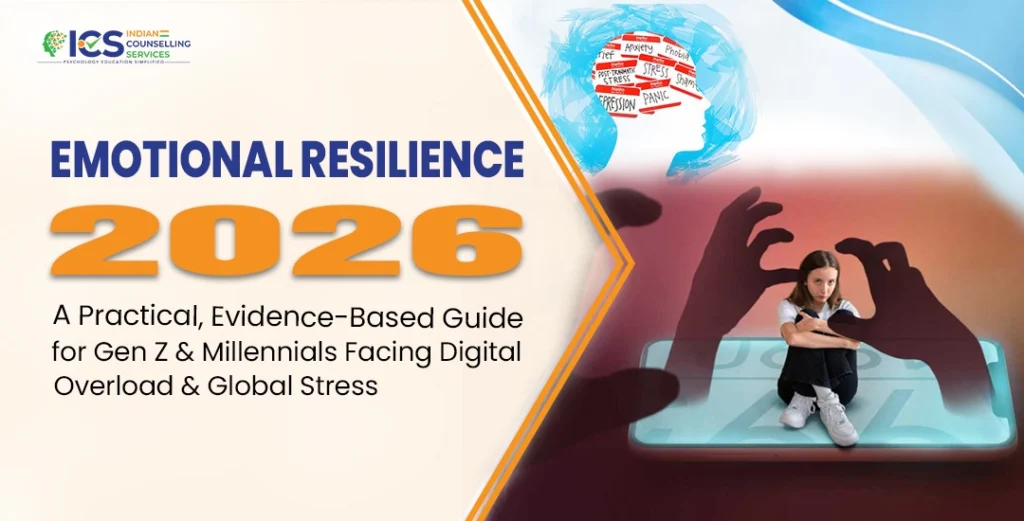
In 2026, emotional resilience is not an option – particularly in Gen Z and Millennials down in the digital overload, career challenge, and global uncertainty. Starting with continuous alerts and ending with economic turmoil, the stressors of today are omnipresent, noticeable, and highly intimate.
Are you always mentally exhausted because you do what is right? You are not the only one. It is not the additional productivity hacks that are needed, but rather the emotional control, cognitive flexibility, and stress recovery mechanisms.
It is a guide about the real-world, evidence-based tools that help one develop emotional resilience in an overconnected world. To get more profound and systematic knowledge, one may enroll in psychology courses, which offer evidence-based practices that go beyond the superficial tips on coping.
What Is Emotional Resilience?
Emotional resilience refers to the possibility to cope with stress and overcome obstacles, as well as remain psychologically balanced in an uncertain situation. It is not about repression of feelings or acting like one is okay.
Resilient individuals:
- They do not allow stress to lead them.
- They get over failure without declining into self-doubt.
- They do not respond in a reflexive manner but coordinate the emotional responses.
Behavioral and cognitive psychology studies indicate that resilience is an aspect that can be learnt. As people practice, the brain gets stronger to cope with adversity.
Why Emotional Resilience Is Critical for Gen Z & Millennials in 2026
The first generations to have been brought up in full immersion in the digital ecosystems are the Gen Z and the Millennials. The nervous system is continually in a state of hyper vigilance due to constant exposure to news cycles, comparison culture, and messages about productivity.
This often leads to:
- Heightened neuroticism and stimulation.
- Shortened attention spans.
- Reactivity and disruption of sleep.
The first step in resiliency management is managing the digital input, and then trying to manage the emotional output.
Achievement pressure has been escalated by professional instability and the increase in the cost of living. Most of the young adults identify productivity and self-esteem.
Widespread patterns of thinking are:
- “If I slow down, I’ll fall behind.”
- “Everyone else is ahead of me.”
- “I should be doing more.”
Techniques of cognitive restructuring (common in formal psychology education) serve to criticize these distorted thoughts and substitute them with more moderate views.
anxiety despite apparent daily stability in life. Uncertainty is perceived by the brain as a threat.
Growth does not remove international strain. Despite it, it increases internal stability.
The Science of Emotional Resilience
Studies have found that resilience consists of three main components:
Nervous System Regulation
In case the body is in fight-or-flight mode, the sense of control of emotion is lower. It is based on the regulation of the nervous system.
You can support regulation by:
- Slow, deep breathing for several minutes a day.
- Taking short device-free walks to reduce sensory overload.
- Light physical activity in order to release stress hormones.
The resilience begins in the body, and later it becomes strong in the mind.
Cognitive Flexibility
Cognitive flexibility enables you to redefine failures in a realistic way as opposed to catastrophically.
Rather than believing that you have failed and, therefore, are helpless, you can make yourself rehearse the scenario as a form of feedback and improvement.
Cognitive behavioral therapy studies continuously indicate that reframing helps to decrease the intensity of emotions and helps to make better decisions in the long term.
Meaning-Making and Perspective
Positive psychology studies have shown that people who relate suffering to self-development heal better.
Reflective questions include asking oneself questions like, What can I learn out of this? transfers your brain out of helplessness.
Practical Emotional Resilience Strategies for 2026
You do not require such radical life changes. Micro-disciplines bring about quantifiable psychological changes.
Set Clear Digital Boundaries
You have the option of restricting the news to a designated time rather than always being exposed to it. Switching off unnecessary notifications will decrease stress.
Practice Emotional Labeling
Rather than telling yourself that you feel bad, find out the exact feeling. You may have noticed emotions of overstimulation, rejection, or insecurity.
In neuroscience studies, it has been found that correctly labeling emotions dilutes them.
Build Daily Recovery Rituals
Burnout is caused by stress that is not accompanied by a recovery. You will have time to take small steps between activities, make regular sleep a priority, and note some moments of emotional stimuli briefly at the beginning of the day in a journal.
Premeditated healing enhances sustainability.
Gradually Increase Stress Tolerance
Resilience capacity is diminished when all the discomfort is avoided. Structured challenges, Controlled challenges, e.g, initiating difficult conversations or experimenting, will ensure that your brain is more trained to tackle uncertainty.
Confidence is developed by exposure, which can be controlled.
Why Psychological Education Matters
Social media provides immediate mental health recommendations, whereas resilience needs long-term knowledge.
In organized psychology classes, it provides the learner with:
- Emotional regulation instruments based on evidence.
- Understanding of patterns of stress response.
- Relevant cognitive reframing models.
- Mental flexibility Long-term plans.
Coping is changed into skill-building through education.
Long-Term Benefits of Emotional Resilience
Strengthening resilience improves:
- Managing emotions under stress.
- Adaptability in a career in volatile markets.
- Communication and relationship stability.
- Less burnout and anxiety symptoms.
Resilience is an asset of mental health and an advantage of the profession in a rapidly evolving world.
Final Thoughts
The strength of the emotion in 2026 does not imply having become ineffective. It is growing psychologically and regulation-informed.
The stressors that Gen Z and Millennials are exposed to are distinct, yet their exposure to mental health knowledge is unparalleled. Chronic overwhelm can be converted into sustaining strength by controlling your nervous system, re-conceptualizing distorted beliefs, developing recovery practices, and investing in further psychological training.
You do not own the systems of the world and computer algorithms. However, you would be able to condition yourself.
That is real resilience.
FAQs (Frequently Asked Questions)
What is emotional resilience?
Emotional resilience refers to the capacity to adjust to stress, overcome disappointments, and be able to control emotions in a difficult situation.
Can emotional resilience be developed?
Yes. The studies indicate that resilience is enhanced by regularity in the functioning of the nervous system, cognitive restructuring, and rest.
Why is emotional resilience important for Gen Z and Millennials?
Chronic stress is caused by digital overload, economic strain, and global insecurity, which require resilience to be mentally stable.
Do psychology courses help build resilience?
Yes. Evidence-based emotional regulation, stress management, and cognitive flexibility tools are offered in the structured psychology courses.