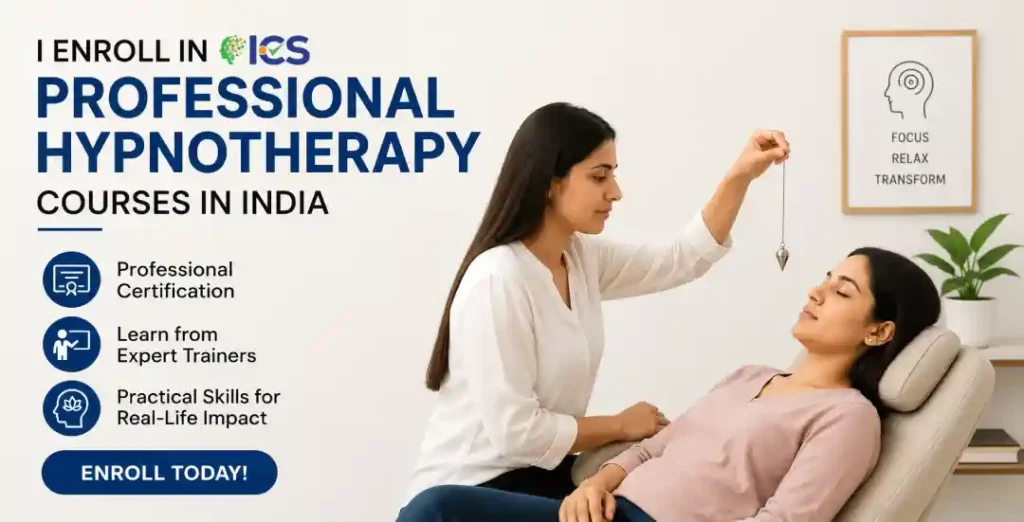
In recent years, individuals interested in the mind-body-emotion-behaviour relationship and in personal change have become increasingly interested in hypnotherapy in India. Increasing numbers of learners want to learn about hypnotherapy, from those aiming to be wellness practitioners and counsellors to coaches and people interested in personal development.
However, there are numerous training choices out there, both online and offline, and one question that arises is:
Where can you actually enroll in professional hypnotherapy courses in India?
Selecting the right course is not as simple as taking the first program that comes up in a search. The curriculum, trainer experience, learning format, practical exposure, course duration, certification details, and how the training aligns with their profession should be taken into account by the learners.
This guide tells you what to take into consideration when choosing hypnotherapy courses in India, and how to make a better decision.
What Is Hypnotherapy?
Hypnotherapy is also a therapeutic technique where hypnosis is utilized as a component of a therapeutic system to create changes in thoughts, perceptions, emotions, and behaviours.
A person can feel a state of concentration and relaxation during hypnosis. A trained practitioner can then utilize a setting suggestion or therapeutic technique as needed for the purpose of the session.
Exploring hypnotherapy in the context of:
- Educating about relaxation and stress management.
- Solving some behavioral/habit issues.
- Fostering self-assurance and a positive self-image.
- Encouraging individuals to grow and feel good.
Due attention should, however, be given to the fact that hypnotherapy cannot be recommended as a panacea or a substitute for suitable medical or mental-health treatment.
Why Are Hypnotherapy Courses Becoming Popular in India?
People’s enthusiasm for hypnosis stems from an increased awareness of complementary ways to improve well-being and human behavior.
Those employed in human service professions are especially interested in further training in their communications and behavior.
Learners may consider learning hypnotherapy, since they want to:
- Know about hypnosis and its uses.
- Hone coaching/wellness skills.
- Understand more about the subconscious mind and actions.
- Enlarge their knowledge and understanding of relaxation and suggestion techniques.
- Discover a new professional learning space.
The actual motivation for enrolling will be dependent upon the learner’s background and career aspirations.
Where Can You Enroll in Hypnotherapy Courses in India?
Hypnotherapy training in India can be found in various ways, such as specialized training institutes, professional education providers, wellness organizations, and online platforms.
Program offerings are not necessarily equal, however, and some may be less available, less good, or less comprehensive in their scope.
As you are looking for hypnotherapy courses in India, first check the official course page of the provider and read the course details before you read any commercial hypnosis course claims or advertisements.
Check out details regarding training duration, format, certification, learner support, practical components, and the curriculum.
Online Hypnotherapy Courses
The availability of online education has made professional training a lot more accessible.
For students who live in an area that does not have large centers for hypnosis training, or who have other obligations or work to attend classes, an online hypnotherapy program may be very convenient.
Online programs vary by provider, but may consist of:
- Live instructor-led sessions.
- Recorded Lectures & Learning materials.
- Hands-on demonstrations and activities.
- Assignments or assessments.
- Learning opportunities for interaction with trainers and other learners.
Be sure to verify the amount of instruction and hands-on experience you will have before enrolling.
Offline Hypnotherapy Training
For students who like to learn through direct contact and practice in the classroom, traditional classroom programs may be appropriate.
Offline training can offer demonstrations, supervised practice, and hands-on instruction and feedback from peers and trainers.
Classroom-based programs can be less convenient for some learners, however, due to location and/or schedule.
So it is best to choose online and offline learning according to the learning style, availability and necessity you have.
What Should a Professional Hypnotherapy Course Include?
A good program will be more than just an introduction to hypnosis.
There may be some differences in the curricula, but students should seek, as much as possible, coverage of the fundamental concepts and techniques, ethical issues, and practical applications of the material.
The following are key points to take into account:
- Fundamentals of Hypnosis: The course should provide an explanation of hypnosis, an understanding of the hypnotic state, and what typically occurs during a hypnotherapy session.
- Hypnotherapy Techniques: The techniques taught as part of the course need to be clearly introduced to the learners and how they are used in suitable contexts.
- Practical Learning: Applied learning with a practical demonstration and exercise can make hypnotherapy learning more useful.
- Ethics and Professional Boundaries: Instruction should include the importance of responsible practice, informed consent, maintaining confidentiality, professional boundaries, and when referring to another qualified practitioner may be required.
- Trainer Credentials: Before registering, check out the background and experience of the trainers.
The information on trainers should be easily verifiable, at least reasonably accessible, on a transparent course provider.
How Long Do Hypnotherapy Courses Take?
The length of time that a hypnotherapy course lasts varies.
Programmes can vary in duration from brief introductory courses to full practitioner-level courses.
The time will vary according to the learning desired.
If you are looking for general awareness or personal development, then a short course may be enough. Individuals who want more formal and professional training might prefer a more intensive program with more depth, practical exposure, and assessment.
Don’t decide on a course based on length alone; compare the content of the course that can be learned within the time allotted.
What Does Hypnotherapy Certification Mean?
Generally, certification is a seal of approval from a specific training provider that a learner has met the requirements set by that provider.
But the recognition and scope of a certificate can vary greatly, as do the professional applications.
Before enrolling, check:
- Who gives the certificate at the end of the course.
- Which tests/needs have to be done.
- If there is or isn’t practical training.
- A description of the scope of the provider as described by the provider.
- If the certification is applicable to the career path in which you wish to pursue it.
Most of all, don’t presume that anyone who has taken a hypnosis course can diagnose or treat medical or psychiatric issues.
The scope of a professional depends heavily on the individual’s background and training, the laws applicable to his/her profession, and where he or she works.
Who Can Consider Hypnotherapy Training?
Hypnotherapy education might be attractive to individuals from a variety of backgrounds, such as those with an interest in human behavior and assisting professions.
There may be potential learners such as:`
- Counsellors and mental health workers who are interested in further education.
- Coaches and Wellness professionals broadening their skill sets.
- Psychology students who wish to learn about alternative methods.
- Teachers & trainers who want to learn communication techniques.
- People who are interested in using hypnosis for self-improvement and/or professional growth.
Requirements are different depending on the program, so make sure to read the particulars of the program that you are interested in.
How to Choose the Right Hypnotherapy Course
There are many programs available, and it can help to avoid setting expectations that are too high and to save time by making a systematic comparison between the programs.
Prior to enrollment, ask yourself:
What do I want to achieve?
Do you want to focus on personal development, learn new skills, become a coach, improve your wellness, or further understand Hypnosis?
Then evaluate:
What does the course actually teach?
Study the content of the course, rather than the name.
Finally, consider:
Who is teaching it?
The background and experience of trainers, the approach they use in their teaching, and a realistic presentation of the program are good indicators of the quality of a program.
Why Online Training Is Becoming an Attractive Option
The need for flexible learning has grown in importance for working professionals and students.
A good online program may enable the learner to attend training without moving or drastically rearranging current programs.
Online courses might thus offer a realistic approach to professional growth and everyday responsibilities for those looking to compare hypnotherapy courses.
But convenient use doesn’t have to be the only factor. The quality of instruction and learning, the curriculum, and support should be at the heart of the decision.
The Future of Hypnotherapy Education in India
With an increasing interest in mental wellness and behavior, there may be a continued demand for structured training in hypnotherapy.
Learners are also aware of their program choices. Many today are not seeking certificates, but instead want a clear curriculum, hands-on learning, qualified staff, and a clear vision of the job.
This change may incentivize training providers to emphasize responsible and skill-based training.
Final Thoughts
When you’re looking for hypnosis courses in India, you must make a comparison and not just go with what’s most obvious.
Search for an open curriculum, experienced trainers, hands-on education, certifications, and professional lines. Most importantly, select a course that is suitable to your actual goals and existing qualifications.
Well-organized courses in hypnosis, communication, and behavioural methodology may give learners an opportunity to learners to investigate hypnosis, communication, and behavioural techniques more in-depth if they wish to obtain flexible learning for professional development.
FAQs (Frequently Asked Questions)
Where can I study hypnotherapy in India?
The training in hypnosis can be obtained from specialized institutes, education providers, and online training programs.
How do I choose a hypnotherapy course?
Check out the curriculum, trainers’ experience, hands-on training, length of training, certification, learning style, and suitability to your objectives.
Can I study hypnotherapy online?
Yes. Numerous institutions provide online classes via live sessions, recorded media, hands-on workouts, or a combination of these.
Does a hypnotherapy certificate make me a therapist?
Not necessarily. It is important to note that certification is dependent on the program, prior qualifications, relevant regulations, and the scope of practice that you plan to engage in.