
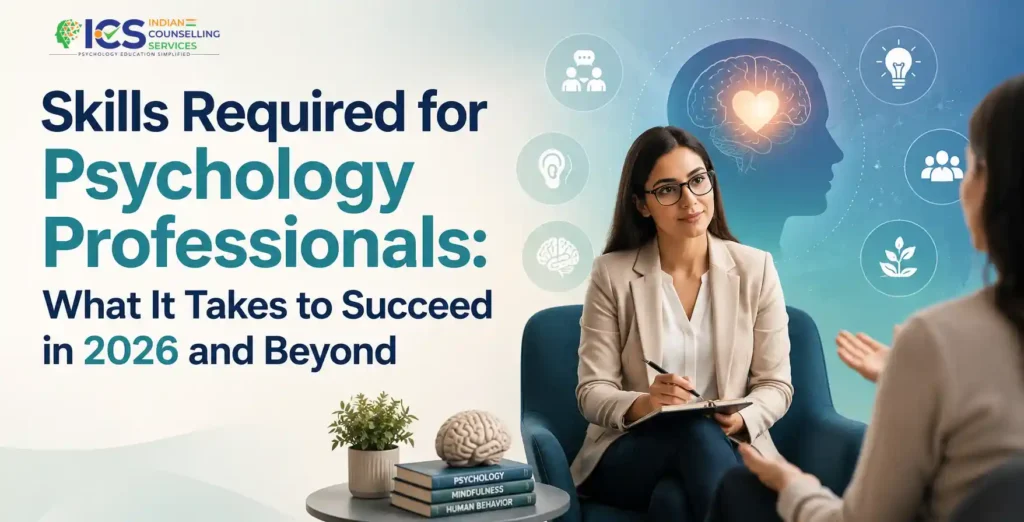
Those who think about psychologists envision one person seated in a therapy room who is attentive and giving advice. Of course, listening is crucial to the job of a psychologist, but there are many other skills needed to be a successful psychologist.
The psychologists, counselors, behavioral specialists, educators, coaches, and mental health professionals of today operate in more complex settings. They engage with people of all backgrounds, face quickly evolving social problems, and assist others in coping with stress, anxiety, and/or problems in the workplace or personal growth.
The importance of mental health is growing and, with it, the need for practitioners with knowledge of mental health combined with great interpersonal and analytical skills. This is why there is a growing number of students and working-class people taking up Psychology courses to learn theories and acquire skills.
For those thinking about a career in psychology, or just curious about what is required in 2026 and beyond of a great psychologist, here are the top skills that will be crucial.
Psychology Is About People First
When talking about specific skills, it is crucial to first realize one simple fact: psychology is, after all, the study of human beings.
Theories, research studies, assessments, etc., are useful tools, but they were designed to aid professionals in understanding thoughts, feelings, behaviors, and relationships with others better.
That is, technical knowledge is not sufficient.
The best psychology professionals may be those who are able to blend the science of psychology with empathy, communication, and a critical mind.
Strong Communication Skills
Communication is the lifeblood of the vast majority of the psychology-related professions.
Communication skills are extremely important to the success of the psychology professional, whether it is with clients, a class of students, a patient, a group of patients, a colleague, or an organization.
Strong communication involves much more than speaking well.
It includes:
- Explain complex psychological concepts in simple and understandable terms.
- The ability to ask questions to stimulate conversation.
- Active listening skills (knowledge, ability, and disposition of not interrupting and making assumptions while listening).
- Variation in communicative style that takes into account the persons and circumstances.
Good communication fosters trust, understanding, and better working relationships.
Active Listening and Presence
A lot of people will hear the words of others. There aren’t many who really hear.
Active listening skills are among the most important listening skills in psychology as they enable the psychologist not only to listen to what is being said but to hear what is being felt.
Often, effective listening requires:
- Careful listening, both verbally and nonverbally.
- Not giving too much advice or solutions right away.
- Showing interest and sympathy during discussions.
- Summarizing and clarifying information to gain understanding.
It’s easier for people to open up when they feel understood and are truly listened to.
Emotional Intelligence
Emotional intelligence is one of the most desired job skills in recent years in all fields.
It is particularly significant for professionals in the psychological fields.
Emotional intelligence is the ability to understand and regulate your own emotions as well as recognise and react to others’ emotions.
People with high emotional intelligence skills are likely to do the following better:
- Establish rapport and trust with the clients or students.
- Handle upsetting situations in a nonagitated way.
- Listen and take in rather than respond impulsively.
- Correctly establish professional boundaries.
Emotional intelligence is still an integral part of good psychological practice while attaining a greater awareness of mental health.
Empathy Without Over-Identification
Empathy is said to be the ability of another person to experience and feel the feelings of other people.
But psychologists have to master the art of being empathetic, while at the same time maintaining an objective attitude towards the client.
Effective empathy means:
- Entertaining a person in his or her point of view, without prejudice.
- Being able to identify emotions but not being overwhelmed by them.
- Offering help and also retaining professionalism.
- Establishing safe containment for people to share their experiences.
This balance enables professionals to be compassionate and make sound decisions.
Critical Thinking and Analytical Skills
Psychology is an art and science.
Interpersonal skills are important, but professionals need to be able to think critically and objectively about information.
People performing Psychological work may need to:
- Look at various reasons behind behaviour.
- Make careful interpretations of patterns and observations.
- Compare and contrast evidence to make conclusions.
- Be able to identify what assumption is from what verified information.
Critical thinking ensures that decisions are made based on facts and not without considering personal opinion and intuition
Observation Skills
People don’t just talk!
Body language, facial expressions, voice, and behavioral patterns can give us clues as to a person’s emotional state and their experience.
Psychology workers use good observation skills to:
- Look for subtle changes in behaviour, which could be signs of distress.
- Identify incongruities in verbal and non-verbal communication.
- Recognise patterns that affect behaviour.
- Collect data to improve assessments.
Observing can often be the basis for enhancing understanding and developing intervention plans.
Problem-Solving Abilities
It is common among psychology professionals to aid individuals in coping with hardships in their lives.
There is no simple answer to these problems, as each situation is different.
Professionals with good problem-solving abilities can:
- Discuss various points of view for a situation.
- Develop feasible and viable strategies.
- Make adjustments to interventions when conditions vary.
- Help people make decisions.
Creativity is a vital component of effective problem-solving, as well as analytical thinking.
Cultural Awareness and Sensitivity
Psychology workers frequently have to work with people from diverse cultural, social, and economic backgrounds, and modern societies are becoming more and more diverse.
Knowing about the cultural influences is very important as beliefs, values, communication patterns, and expressions of emotions might differ greatly among people and communities.
Professionals who have cultural sensitivity have a better ability to:
- Develop relationships and rapport with diverse populations.
- Don’t make assumptions or incorrect inferences.
- Increase support and make it more inclusive and effective.
- Understand and appreciate the impact of cultural factors on behaviour and mental health.
Professionally, it is becoming increasingly expected that you should be culturally competent.
Ethical Decision-Making
Ethics is integral to the field of psychology.
Ethical issues where professional judgment, confidentiality, and responsibility come into play are common.
The following are the key aspects of strong ethical skills:
- To respect privacy and confidentiality.
- Maintaining professional boundaries.
- Doing what is in the best interest of those who are being supported.
- Applies professional and/or guidelines appropriately.
Ethical practice is important to ensuring the safety of both practitioners and the people they care for.
Adaptability in a Changing World
Psychology is a field that is constantly changing, developing with the technology and the changing trends in the workplace, changes in society, and new research.
Therefore, adaptability is an important skill for the workplace.
The skills required for psychology professionals are:
- Gain knowledge of new evidence-based approaches and methodologies.
- Adapt to the needs of the client and organization.
- Use digital tools and online service delivery approaches.
- Further their knowledge during their working lives.
Many of the most successful professionals are lifelong learners.
Resilience and Self-Awareness
There are times when working in a helping profession can be fulfilling, and there are times when it can be emotionally draining.
Health professionals, especially psychologists and psychiatrists, will come across situations of trauma, stress, loss, and personal difficulties.
Taking care of personal well-being is then paramount.
Healthy professionals typically:
- Develop the ability to reflect and be aware of emotions.
- Be aware of the early signs and symptoms of stress and burnout.
- Have a healthy work-life balance.
- Ask for guidance, assistance, and continued professional development as required.
Self-awareness strengthens both professional effectiveness and personal well-being.
Why Psychology Education Focuses on More Than Theory
People tend to think that psychology education is about learning theories and research studies. Although it is crucial to possess theoretical knowledge, today’s training programs increasingly focus on honing skills in addition to the classroom.
In many cases, learners will find that they are able to build a stronger sense of quality in psychology courses.
- Communication skills and interpersonal skills.
- Emotional intelligence, self-awareness.
- The ability to analyze and to think critically.
- Knowledge of ethics and professional practice.
- Observation, assessment, and problem-solving skills.
These skills are useful in many careers besides psychology, including leadership, education, healthcare, human resources, and more.
The Future of Psychology Careers
Psychology’s future is much more than just that of a conventional clinical practitioner.
The importance of Mental Health, Emotional Intelligence, workplace well-being, and behavioural insights is gaining traction.
Consequently, there are opportunities for psychology professionals in:
- Mental health and counselling services.
- Schools and learning support agencies.
- Workplace wellness and training programs.
- HRD and development of the organization.
- Coaching & Personal Development.
- Research and behavioural sciences applications.
Global knowledge of psychology is becoming more and more relevant in all professions, as the demand for a human approach is growing.
Final Thoughts
A successful psychology professional is more than just a theoretician and textbook specialist. They possess sound communication skills, the ability to observe, empathy, ethical decision-making abilities, and a lifelong learning approach.
Technical knowledge is the basis, but it is these skills that make it more likely that the professionals can support, guide, and be aware of others.
With an increased emphasis on mental health, well-being, and human behavior in the world, these skills will be even more useful.
Psychology courses provide a valuable foundation for developing the knowledge and skills necessary for success in this rapidly evolving and influential profession for those wanting to pursue careers in this area.
FAQs (Frequently Asked Questions)
What skills are most important for psychology professionals?
In addition to the aforementioned qualities, important skills include communication, empathy, emotional intelligence, critical thinking, observation, problem-solving, and ethical decision-making.
Why is emotional intelligence important in psychology?
Emotional intelligence helps professionals understand emotions, build rapport, manage difficult situations, and communicate effectively.
Can psychology skills be useful outside mental health careers?
Yes. The skills of psychology have great value in education, business, leadership, human resources, coaching, health services, and many other fields.
How can Psychology courses help develop professional skills?
Psychology classes frequently integrate theory instruction with skill building in communication skills, behavior analysis, emotional intelligence, problem-solving, and other areas.