
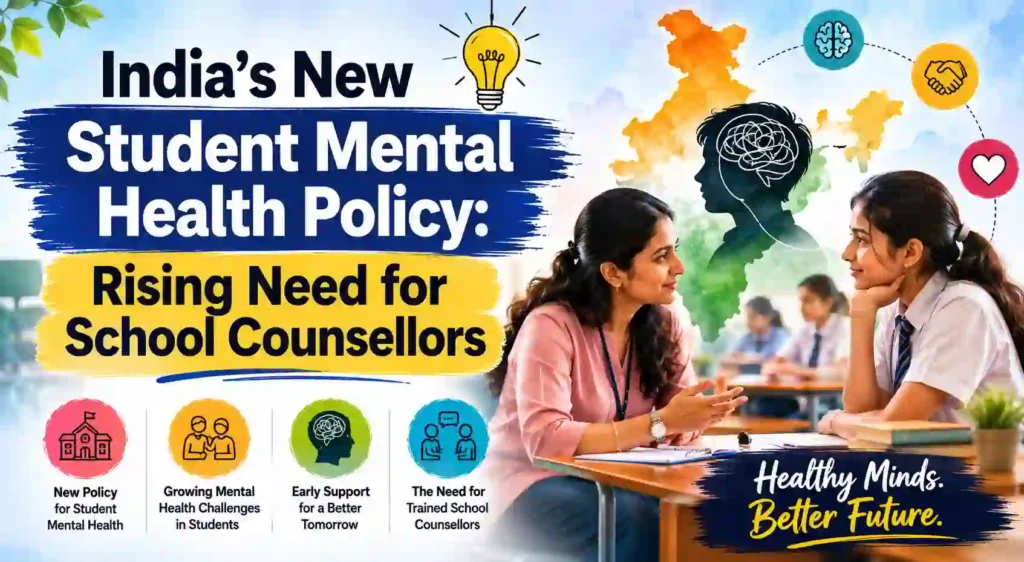
A few years back, most of the discussion about students was around the marks, board exams, and career options. There was a different discussion today. Parents, teachers, and the entire education system are increasingly concerned about students’ mental health.
Students are silently coping with stress, social and academic pressures, and burnout in the system in India. Children are at risk from stress, being under pressure to perform at a high level, comparing themselves to others, and being under pressure to ‘always perform’.
Acknowledging student mental health concerns has pushed the re-thinking of education to the forefront for educators and school system policy makers alike. The awareness of student mental health concerns is driving a re-thinking of education. This is a priority for emotional well-being, and rightly so, as this is having an impact on useful learning.
The significance of school counselling has been heightened in the present context due to the Student Mental Health Policy, the NEP 2020, and the new CBSE Counseling Guidelines 2026.
This has led to a considerable demand for emotional and psychological support to help students.
A valuable and innovative trajectory for developing a school counselor career.
The Growing Mental Health Crisis Among Students
Students are more than exam-stressed. A lot of children experience emotional stress all year long.
The whys and hows are all around:
- Academic competition.
- Fear of failure.
- Social media comparison.
- Cyberbullying.
- Family expectations.
- Peer pressure.
- Loneliness and isolation.
- Lack of emotional support.
It is expected that students will excel academically, be socially active, take part in extracurricular activities, and plan their futures at a very early age. Some can handle it, many can’t.
More teachers and parents are becoming aware of indicators like:
- Anxiety before exams.
- Low self-confidence.
- Emotional withdrawal.
- Sudden anger or irritability.
- Difficulty concentrating.
- Sleep disturbances.
- Reduced social interaction.
Students face issues that most educators are unaware of, including academic and social stress.
Even if students recognize mental health issues, it is often a disadvantage because teachers are still unaware of such issues.
Why Emotional Wellbeing Should Always Be an Educational Priority
Why Emotional Wellbeing Is Becoming a Priority in Education
The fixation on students’ academic performance has always been the priority in India. Yet schools are currently realizing that learning, self-esteem, social skills, and general growth are greatly influenced by a child’s emotional health.
A student is much more likely to be:
- Perform better academically.
- Build healthier relationships.
- Handle pressure more effectively.
- Develop confidence and resilience.
- Participate actively in school life.
This paradigm shift is transforming the approach to education for schools. Emotional wellness is becoming a more important focus than grades and accomplishments.
Schools are starting to realise that students aren’t only asking for academic guidance, they’re asking for emotional guidance as well.
India’s New Focus on Student Mental Health
India’s gradual path towards a more organized system of student mental wellness. Policymakers and educational boards are starting to understand that mental health care needs should not be a crisis or emergency measure, but a routine component of school education.
The new Student Mental Health Policy India will seek to:
- Support pupils’ emotional health and wellbeing in school.
- Raise awareness about mental health issues.
- Help identify emotional problems at an early stage.
- Minimise the stigma associated with counselling.
- Create safer and healthier school environments.
- Enhance access to professional counselling support.
The emphasis isn’t just on dealing with large-scale issues when they arise, and neither is the emphasis on prevention, awareness, and emotional development from an early age.
This is a huge development in the Indian education system.
NEP 2020 and the Role of School Counselling
The National Education Policy (NEP) 2020 took a broader approach to education. It argued that school systems should also prioritize students’ emotional, social, and psychological growth in addition to academic success.
NEP 2020 urges:
- Social-emotional learning.
- Life skills education.
- Student well-being initiatives.
- Inclusive and supportive learning environments.
- Better mental health awareness in schools.
There is an obvious growth in the significance of School Counselling in India.
Schools are now held to task to have adequate emotional support systems in place for students, and counsellors are now a central element of that support system.
It is evident that neglected mental health is not an elective course of education.
CBSE Counselling Guidelines 2026: A Stronger Push for Student Support
The CBSE Counselling Guidelines of 2026 seem to more strongly advocate for the mental health of students.
CBSE launched several programs to reduce the pressure that students felt in the past years, including:
- Psychological helplines during board exams.
- Stress management programs.
- Teacher awareness workshops.
- Student wellness activities.
- Life skills education.
Schools are now more encouraged to designate specialist counsellors to conduct regular emotional and behavioural support for the students.
This institutional support is gradually gaining importance in Indian school education in the field of counselling.
Why Schools Need Trained Counsellors More Than Ever
Today’s students confront far greater emotional issues than those of past generations in a more intense manner. This is why trained school counsellors are becoming paramount in educational institutions.
A school counsellor assists pupils to:
- Reduce stress and anxiety.
- Deal with peer pressure.
- Improve emotional regulation.
- Develop self-esteem and confidence.
- Deal with bullying or social issues.
- Manage academic and personal difficulties.
Counsellors work closely with parents and teachers in order to identify emotional issues before they become serious.
In most cases, the difference early intervention makes is that it ends up saving students.
The greatest of these is that counsellors provide students with a safe space to be listened to, be understood, and be supported in a judgement-free manner, while also providing a mental break.
The Role of Parents, Teachers, and Counsellors
Mental health isn’t limited to the school setting. This will require cooperation between parents, teachers, and counselling specialists.
- Parents: Parents are key in determining the emotional health of the child. Supporting the emotional health of a child, keeping his/her mind clear, and not taking it too personally. A willingness of the family to communicate and an unthreatening environment can also play a very important role in the emotional growth of the child.
- Teachers: Behavior is usually changed when first noticed by the teacher. It’s important to help children who are in need of emotional support, and this can be done through the help of people who understand and recognise them.
- Counsellors: The school counsellors within that framework are the mental health workers in the school who help children deal with emotional problems, help children regulate their behaviour, and help children, teachers, and families to form positive relationships.
When all three are working properly, children will feel safer, more resilient, and stronger.
School Counsellor Career Scope India: A Growing Opportunity
As the recognition of the mental health of school-aged children has grown, there has been a growing demand for counseling professionals.
Types of Career Scope for Counselors in India
- CBSE and ICSE schools.
- International schools.
- Private educational institutions.
- Child wellness centres.
- NGOs and educational programs.
- Student mental health initiatives.
It is undeniable that schools today are looking for professionals who have a sound understanding of child psychology, emotional well-being, and counselling skills.
It’s not only a field for career growth; it’s a field that could make a difference in the lives of the youth every day.
The role of a school counsellor is one of the most pertinent and impactful career options for psychology students and professionals in the mental health landscape in India.
Conclusion
The change in the education system in India is expected to be positive. The issues of mental health, emotional stability, and the support of students are all relatively new to the mainstream educational conversation.
Children and adolescents are more and more coming under the strain of doing well academically, and are experiencing cyber-bullying, anxiety, and emotional trauma. Schools now know that academic achievement is not the only measure of a child’s progress and overall well-being.
The future path is quite obvious: trained counselors will be essential within schools for NEP 2020 implementations, changes to the CBSE Counseling Guidelines 2026, and forthcoming changes in the Student Mental Health Policy of India.
With the increasing awareness, School Counselling in India is set to be one of the most vital aspects of today’s education.
This profession is more in demand than ever, and it has never been more important than it is now for people who want to make a difference and have an interest in psychology, child development, and emotional wellness.
FAQs (Frequently Asked Questions)
What is School Counselling in India?
School counseling as a service to students is the management of students’ emotional, behavioral and psychological issues and concerns in school. Counseling predominantly helps students to cope with stress and anxiety and manage their academic and personal issues.
Why are schools focusing more on student mental health?
School counseling as a service to students is the handling of students’ emotional, behavioral and psychological issues and concerns in school. The students’ main problems with counseling are coping with stress and anxiety and dealing with academic and personal problems.
How does NEP 2020 support school counselling?
The problem of mental health, stress, and emotional burnout is more visible in Indian schools as the number of mentally stressed students and emotional burnout has crossed 2 fold.
What are the CBSE Counselling Guidelines 2026?
With NEP 2020, school counselors have become increasingly more important as underscoring and prioritizing holistic education includes a focus on emotional well-being and life skills, in a supportive and safe learning environment.
What is the career scope for school counsellors in India?
The guidelines will be linked to the mental health support system in the educational environment, which will include counselling services, stress management, and wellness programs, in order to bring caring for the whole person to the school.
How can someone become a school counselor?
Become a School Counsellor in India have experienced an immediate rise in the scope of a job profile for school counsellors due to the need for trained mental health professionals, and increasing awareness and concern for the well-being of students in schools.