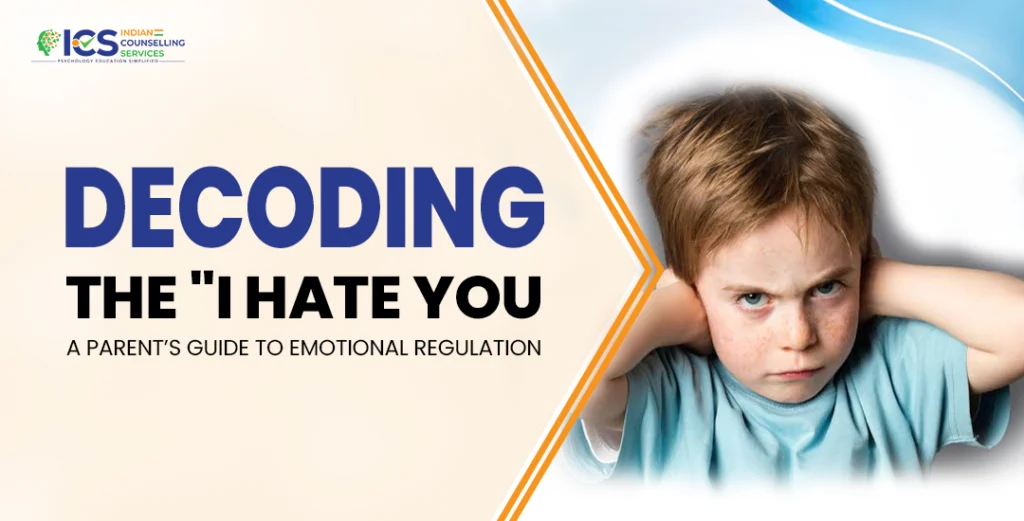
There is hardly anything that is more shocking to a parent than hearing their child say that they hate them. The terms may be very painful, disorienting, and even frightening. Parents could be left asking themselves what they did incorrectly, whether the child really meant it, or maybe it is a sign of some underlying emotional problem.
But in the vast majority of cases, however, these words are not words of actual hatred. They are emotional signals. Children do not have the vocabulary and ability to manage themselves to communicate frustration, disappointment, or overwhelming feelings in healthy ways.
Making sense of what goes behind such strong utterances is among the major themes covered in a course in kid psychology, in which the presence of emotional growth, behavioral patterns, and communication styles is dealt with extensively.
This guide will assist parents in knowing why children say I hate you and the way that they should respond to them in a manner that facilitates emotional regulation and healthy development.
Why Children Say “I Hate You”
The emotions of children are no less than those of adults, but their nervous system is not yet so well-developed to cope with them.
The part of the brain called the prefrontal cortex, which controls impulse control, decision-making, and emotional regulation, is not fully developed until late in early adulthood. In the meantime, emotional parts of the brain are already functional in childhood.
This has become an imbalance as children will experience strong emotions but find it difficult to express them in a constructive way.
A child might be saying: When a child says I hate you, he may be saying:
- “I’m angry that you said no.”
- “I feel powerless right now.”
- “I’m overwhelmed and don’t know how to calm down.”
- “I’m frustrated and need attention.”
The first step of an effective response is to realize the emotional meaning of the words.
The Role of Emotional Regulation in Childhood
Emotional regulation is described as the capacity to perceive, comprehend, and control emotions.
This is not something that the children are born with. It is acquired over time with experience, directions, and examples from the caregivers.
By reacting to emotional outbursts calmly, the parents teach children that strong emotions are not harmful to relationships, and thus, they can be expressed. They eventually find themselves developing the internal resources that they can use to control their emotions.
Child development courses, such as most organized child psychology course programs, have given attention to how early years emotional coaching influences psychological resiliency in the long term.
When someone says I hate you, it can cause outrage within the heart. Parents can be offended, furious, or even tempted to punish the child because he/she is disrespectful.
Nonetheless, responding on the spur of the moment tends to worsen the situation.
Rather time out and have a moment. This was a moment of silence because it did not allow the conflict to escalate into a power struggle.
Emotionally disturbed children cannot get help through confrontation but through calm direction.
Rather than reacting to the saying, go to the emotion of it.
You might say:
- “It sounds like you’re really angry right now.”
- “I can see that you’re upset.”
- “You’re frustrated because you didn’t get what you wanted.”
This style justifies the feeling, but not the action.
Children usually become less emotional when they feel that they are understood.
There are a great number of children who hate you since they do not have other means of expressing their feelings.
It can be assisted by parents who should model healthier language.
Such expressions as:
- “I’m really angry.”
- “I’m disappointed.”
- “I wish things were different.”
After some time, kids come to know that there is no need to insult someone to express the emotion.
This is an emotional vocabulary-building process that is core in most child psychology course programs.
Learning about the emotions of your child does not imply that you should disregard disrespectful behavior.
Once the child has calmed down, explain to him or her softly that the use of hurtful language is not tolerated.
You might say:
“It is all right to be angry, and not at all right to say mean things. We had better say something better of your feelings.”
This imparts responsibility, but at the same time, emotional safety is upheld.
Children are more observers than listeners.
When parents act in response to frustration in a way that involves shouting, criticism, or withdrawal of emotions, they may be emulated by the children.
Rather show good coping behaviors like:
- During stressful situations, deep breathing.
- Peacefully communicating with uncomfortable emotions.
- Admitting the mistakes.
Children tend to pick up the skills when they observe adults being responsible in the way they handle emotions.
When the Behavior Happens Frequently
Sometimes, emotional outbursts are considered normal with regard to the development of children. But when the statements such as I hate you are very frequent or the statement is accompanied by aggressive behavior, there might be underlying deeper emotional issues.
Persistent emotional dysregulation may be linked to:
- Stress or anxiety of a great degree.
- Problem with frustration management.
- Social challenges at school
- Alterations in the family setting.
A child psychologist can be very instrumental in such cases.
Child psychology course trainees are taught to evaluate emotional trends and assist the families to acquire supportive mechanisms to improve the process of healthier communication.
Turning Conflict Into Connection
But even though it is painful to hear the vile words of a child, such situations may help to teach people emotionally as well.
As parents react with patience, sympathy, and stable limits, children will slowly understand that relationships can be safe even in the time of conflict.
Parent-child trust is enhanced by this feeling of emotional security.
In the course of time, children learn to stop and reconsider their emotions and communicate them in a healthier manner.
FAQs (Frequently Asked Questions)
Do children really mean it when they say “I hate you”?
Usually not. When children are angry and frustrated, they tend to use harsh language.
Should parents punish children for saying hurtful things?
Rather than punishing, the root cause of feeling can be managed, and the learning of respectful communication can be taught.
At what age do children learn emotional regulation?
Relevant in early life and practice, emotional regulation is developed during the adolescent stage.
Can a child psychology course help parents understand behavior better?
Yes. However, a course in child psychology would give one an idea of what happens in the emotional development of a child, how to communicate with children, and how they behave.