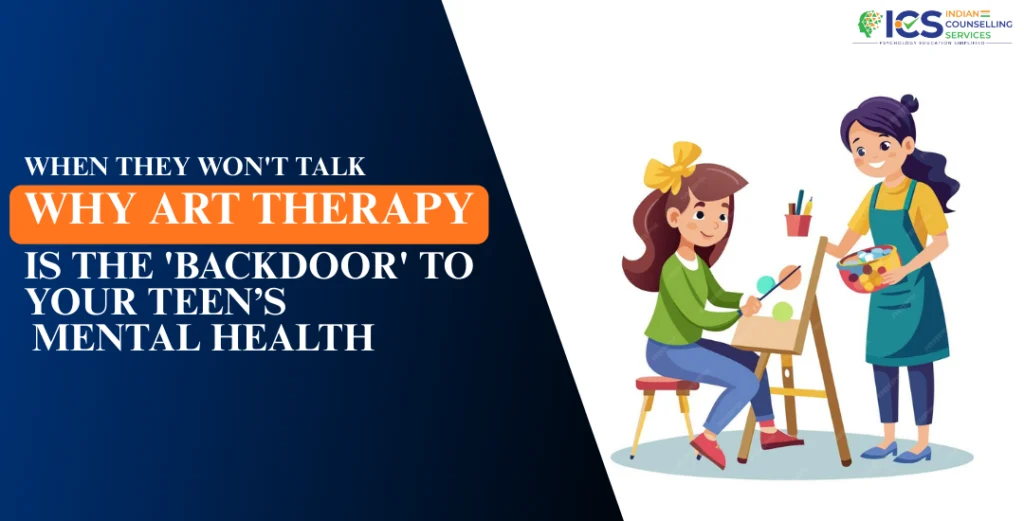
Teenagers are commonly referred to as shut tight, pouty, or not willing to communicate. Although this may be irritating to the parents and caregivers, silence may be one of the indications of emotional burden and not defiance. Most adolescents are not able to express some multifaceted feelings, including anxiety, shame, confusion of identity, or depression.
And here is where art therapy comes in. Rather than imposing a dialogue, it provides a soft backdoor into the inner world of a teenager, and emotions are able to be revealed in a safe, creative, and non-stressful manner.
Why Traditional Talk Therapy Doesn’t Always Work for Teens
The way teenagers feel is different from that of adults.
- Adolescents might not be able to explain their feelings using words.
- It may be too unsafe to talk face-to-face as one fears being judged.
- The brain undergoes developmental changes that have an impact on impulse control and emotional processing.
At the adulthood stage, emotional parts of the brain mature more quickly than those that process verbal reasoning. Consequently, adolescents can experience profoundly but cannot even do so.
Talk-based methods may cause unwanted resistance in cases where a teenager does not feel understood or is being interrogated.
What Is Art Therapy and How Does It Work?
Creative expression is a therapeutic tool of art therapy.
- The teens employ drawing, painting, collage, clay, or mixed media to convey emotions.
- It is the process rather than artistic skill and final product.
- Themes and emotions that come about naturally are interpreted with the help of a trained therapist.
Art is a connection between feeling and consciousness. This is because creative expression can give relief and clarity to teens who feel overwhelmed by words and not force them to disclose.
Why Art Feels Safer Than Talking
Creative expression minimizes defenses of the emotions.
- Art can be expressed indirectly, which seems not so confrontational.
- Adolescents are able to express emotions without giving them direct names.
- The exercise, in itself, is helpful as a way of controlling the level of stress and anxiety.
When adolescents do art, they find themselves in a less stressful state of mind. This allows a more natural expression of emotions, as well as allowing those available opportunities of insight and healing that might not be brought to the fore by conversation.
Common Issues Art Therapy Helps Teens Navigate
The sphere of art therapy is triumphant.
- Externalization of anxiety, stress, and academic pressure can be done by visual expression.
- The symbolism of depression and emotional numbness is safe to investigate.
- Trauma and grief could be worked through without verbal re-experiencing.
Instead of recounting painful experiences with words, adolescents are able to discover their emotions on their own time. This feeling of control is particularly significant to adolescents who already feel overpowered.
Art Therapy and Identity Development in Adolescence
Adolescence is a sensitive period of identity development.
- Creative expression assists the teens in exploring the self-image and self-worth.
- Through art, a person is free to explore identity and emotion.
- It promotes independence and professional advice at the same time.
Art therapy takes seriously the need of a teen to be independent. It does not tell them what they are or how they should feel, but leaves them to self-discovery by way of expression, a process which is intuitively in accord with the development of adolescents.
The Role of the Art Therapist
Art therapy is not just an activity of creating.
- The therapists learn to notice the trends, patterns, and emotional responses.
- Meetings are not open-ended or unstructured.
- Emotional safety, consent, and boundaries are central to the process.
Individuals who are trained in art therapy courses are aware of psychology and the creative modalities. This twofold knowledge makes emotional expression the source of understanding and development instead of misunderstanding and perplexity.
How Art Therapy Builds Emotional Regulation
Art therapy aids in emotional skills that the teens usually lack.
- It assists adolescence to detect feelings when they are not too big.
- Creative work stimulates the nerve systems that relax.
- Repeated expression improves self-awareness and coping strategies.
As time passes, the teens get to understand how to identify emotional patterns and act more responsibly. These regulation skills tend to be transferred to school, relationships, and family life.
What Parents Should Know About Supporting Art Therapy
The support of parents enhances the result of therapy.
- Do not force teens to talk about their paintings.
- Pay attention to emotional protection instead of meaning-making.
- Respect privacy and the therapeutic process.
Art therapy is most effective when the teens feel that there is ownership of their expression. Parents are important as they are always encouraging and not controlling or judgmental.
Why Art Therapy Is Especially Relevant Today
The teens today have special stressors.
- Social media increases comparison and identity pressure.
- Scholarly demands are the causes of burnout and chronic stress.
- Fewer emotional outlets increase the difficulty of self-expression.
Art therapy is a means of providing an antidote to such pressures. It provides a judgment-free, screen-free environment where teens can rediscover themselves in an earthy manner.
When to Consider Art Therapy for Your Teen
There are some indications that creative therapy might be useful.
- Withdrawal from communication or social activities.
- Continuous changes in mood or without reason, irritability.
- Problem with verbal emotional expression.
Immediate encouragement does not allow emotional problems to sink in. Art therapy may also come in very handy where teens are not cooperative with conventional methods of counseling.
Conclusion
Teenagers are not going to talk, but it does not mean they do not have anything to say: they require another method of being heard. As a way of elucidating the emotional world of a teen, art therapy offers a direct, often effective route into that world by bypassing the resistance and building safety through creativity. The teens will get insight, control, and relief by using their emotions as a way of visualizing a situation as opposed to verbalizing. Having educated professionals who are trained to work with adolescents who have undergone art therapy courses, it makes this a backdoor method in addressing mental health services.
FAQs (Frequently Asked Questions)
Is art therapy only for teens who like art?
Nay, therapeutic advantage has no need of artistic dexterity or inclination.
Can art therapy replace talk therapy?
It is capable of supplementing or, in certain instances, being more effective than talk therapy with teens.
Is art therapy evidence-based?
Yes, it has been shown to be effective in the management of emotion and trauma.
How long does art therapy take to show results?
Most adolescents feel emotionally relieved during several sessions and evolve further with time.