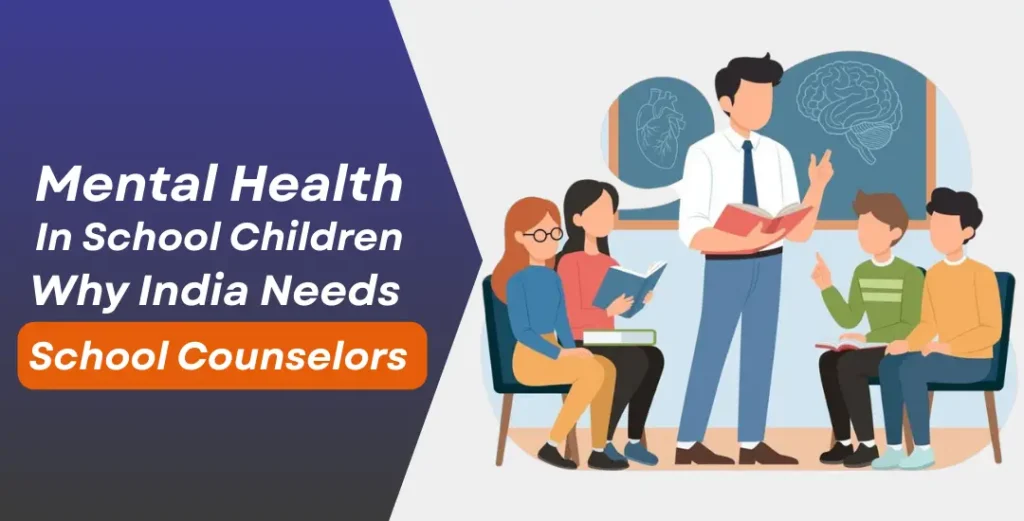
Childhood is a very delicate and precious time period of everyone’s life. Everything that we learn in our childhood stays with us forever, all the games that we’ve played, all the memories we made, the time we spent, we still cherish it but let’s be real childhood isn’t what it used to be.
A 2019 estimate widely quoted in Indian media suggested India needs around 1.5 million counselors to serve 315 million students – and more than 90 percent of schools reportedly lack a professional counselor on board. That gap is massive.
A recent set of local surveys and reports keep echoing the same message: child and adolescent mental health problems are common, rising, and under-detected. A state-level community-based survey in Uttarakhand, for instance, found tens of thousands of children with developmental or psychiatric conditions and flagged low awareness and poor service access
And when schools closed during COVID, emotional disturbance and anxiety went up. CBSE’s school counsellor guidance highlights how the pandemic disrupted routines and left many learners emotionally vulnerable, reinforcing why trained counselors are essential in schools.
why schools are the logical place for mental health support?
Proximity – children spend most of the day in school. Behavior changes are initially experienced by teachers. With the training and the placement of counselors in schools, issues can be detected at an early stage.
Prevention – early intervention alleviates later severity. The slight anxiety, learning, or behavioral problems do not necessarily need to turn into chronic conditions.
Access and equity – most families do not seek help because of stigma, cost or distance to mental health services. The schools access children at both ends of the socioeconomic divide.
Academic connection – mental health influences concentration, attendance, academic, and dropout. Counseling aids the wellbeing as well as learning outcomes.
schools are a primary community-based mental health service to children
What school counselors really do (not just talk).
When I say counsellor, do not think of a kind of amorphous adult, pep-seller. Proficient school counselors can offer:
- Anxiety, depression, grief, peer problems: short-term intervention and individual assessment.
- Specific learning disorders (dyslexia, dyscalculia) learning/assessment and coordination to support remedially.
- Bullying crisis intervention, self-harm indication, family conflict.
- Social skill, stress management, and life skill work: Group work.
- Teacher consultation- arming teachers with classroom strategies.
- Parent direction– matching school and home strategies.
- Referrals to specialist care as required.
This is a multi-skilled role. It demands training, not an add-on that is patched on.
The reality of India being an under-resourced nation
Here’s the brutal part. We have designed our systems in ways where mental health is the “concern of another person, why should I care”. Academics are targeted by health ministries through their hospitals; education departments target the same through the hospitals. The shortage of counselors has been pointed out repeatedly in news and surveys: over 90 percent of the schools surveyed to be without a professional counselor in some national dialogues, or so, which means that the schools that most need assistance will receive none.
Another significant treatment gap that was also demonstrated by the NMHS was the number of individuals (not only children) who do not receive professional assistance. Stigmatization, shortage of trained professionals, lack of equal policy application, particularly in rural or resource-poor schools, will add to the problem, which is why the disparity remains persistent.
The Penalty of No Action – Short Term and Long Term
we continue to defer investment, the price increases:
- Students who are anxious and depressed have poor performance and stand high chances of dropping out.Lost human potential, not marks only.
- Childhood mental health problems are not usually addressed, thus being carried into adulthood leading to increased health expenditure, poor productivity and social impact.
- Family pressure, more school discipline problems, and even tragic consequences such as self harm or serious behavioral problems.
It is not only a human tragedy, it is also a social and economic loss.
Rational solutions implementable solutions
There is no need to reinvent the wheel. A number of pragmatic measures can be graded:
- The mandatory requirement of the provision of a baseline counselor is possible – the government and boards may begin by requiring at least one trained counselor in each school with more than a certain size and a common counselor in a cluster of smaller schools.CBSE and other institutions have begun providing directions; but the action is the most critical.
- Teacher training + referral system – teachers are expected to be taught how to identify red flags and make early referrals.It is cheap and effective.
- Policy and funding –create special budgetary positions in both the education and health sectors, to fund school mental health, recruitment and supervision.
- Go online and hybridize, online counselling and blended care in remote locations, where school staff would be the coordinators.
- Data & assessment – routine screening, data collection and assessment (each school needs to monitor mental-health indicators).
Why does training quality matter?
An individual who has attended a workshop for a few days is not a school counselor. Training of a good school counselor requires training in child development, counseling skills, learning disorders assessment skills, crisis management, and skills on how to coordinate with parents and teachers. This is the reason why programmes of school Counselling course should be evidence-based, accredited and should have practicum school hours.
Addressing Common Objections
“We can’t afford it” – The return on investment in mental health is high. Fewer dropouts, better academic performance, less later-life treatment cost.
“Stigma Will Block Usage” – That’s a reason to embed counselors in schools, not avoid them. Normalization reduces stigma. Peer-group interventions, teacher advocacy, and parent education work.
“Teachers Can Handle It” – Teachers are essential, but they’re not trained mental-health professionals. They need support and referral options.
Conclusion
Honestly, at this point, talking about student mental health without talking about school counselors feels pointless. The data is loud. The stories are louder. Children in India are struggling with anxiety, academic pressure, family stress, bullying, identity issues, and way too much comparison for their age. And yet, most schools still don’t have a trained mental health professional on campus. That gap is dangerous.
we do not have to have other awareness campaigns that end with posters. We must have actual counselors in actual schools, who are going to sit with real kids. Until then, on a bigger scale, India will continue to suffer the cost of missed potential, an increase in emotional distress, and the inadvertent suffering in the classroom.
The solution isn’t complicated. It just needs to be taken seriously. And the time for that is now.